
What are the impacts of deploying digital twins, and will there be more deployment in the AI era? This data-file has aggregated 25 digital twin case studies. The average deployment increases output by 7%, reduces costs by 16% and unlocks c20% energy savings. Details, companies and contexts are in the data-file.
Digital twins assimilate data from sensors and IoT devices, in order to map or represent conditions across physical, industrial assets, which in turn can be used for monitoring or optimization.
Digital twins have been discussed and deployed since the 2000s, but we are interested in whether there will be greater deployment in the AI era. Hence this data file aggregates digital twin case studies.
In the average case study, we found that deploying the digital twin increased output by 7%, reduced cost by 16% and could also achieve c20% energy savings. Although the numbers vary broadly. Details in the data-file.
Economics of digital twins therefore appear favorable. Case studies that crossed our screen typically cited payback periods below 1-year. Even when deploying particularly high-grade, $75k sensors in the nuclear industry, payback periods were around 14-months, in greater uptime and operational savings. Full details are in the data-file.
Often product quality improves in ways that are harder to quantify: for example, one AI model detected 98% of defects in steel slabs with 88% accuracy after 23ms of processing time, while being housed in an environment with 300C temperatures.
Autonomous vehicles also need to represent the world, via an array of autonomous vehicle sensors – cameras, LiDAR, ultrasound and radar imaging systems. Likewise for industrial robots. But note, we would not class these perceptual systems as digital twins, which we reserve for larger, industrial-scale assets, and usually with a broader aerial footprint.
Sensor intensity matters for the sensing and instrumentation industries. As one auto company stated, “there is no AI without data”. The average digital twin case study involved 300 sensors to gather 10,000 data-points per second, but again the numbers varied broadly.
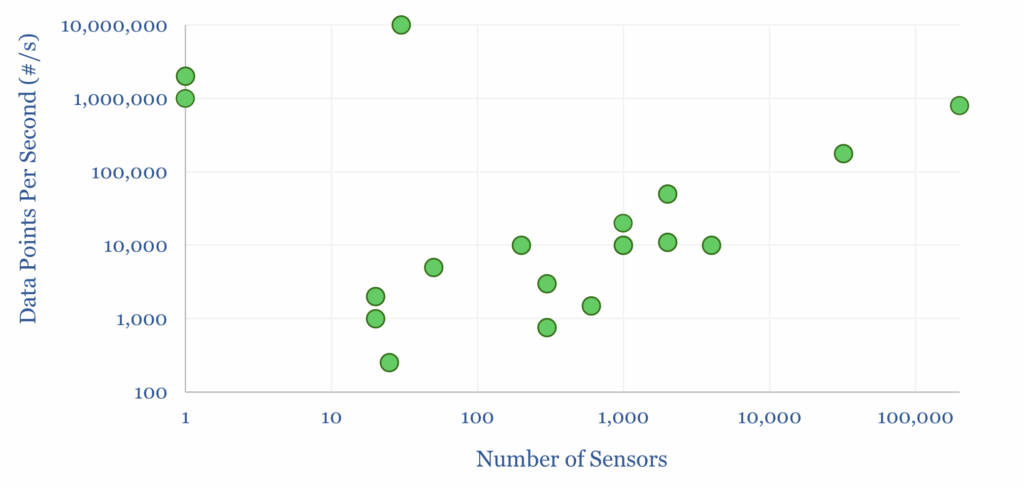
On one side of the spectrum, a single LiDAR sensor can often gather millions of data-points per second. On the other side of the spectrum, an oil platform with a full digital twin was said to use over 200,000 sensors, transferring 800,000 data-points per second, implying a 0.25 second data rate per sensor on average, resulting in a data lake of 1trn data points, “to empower machine learning”.