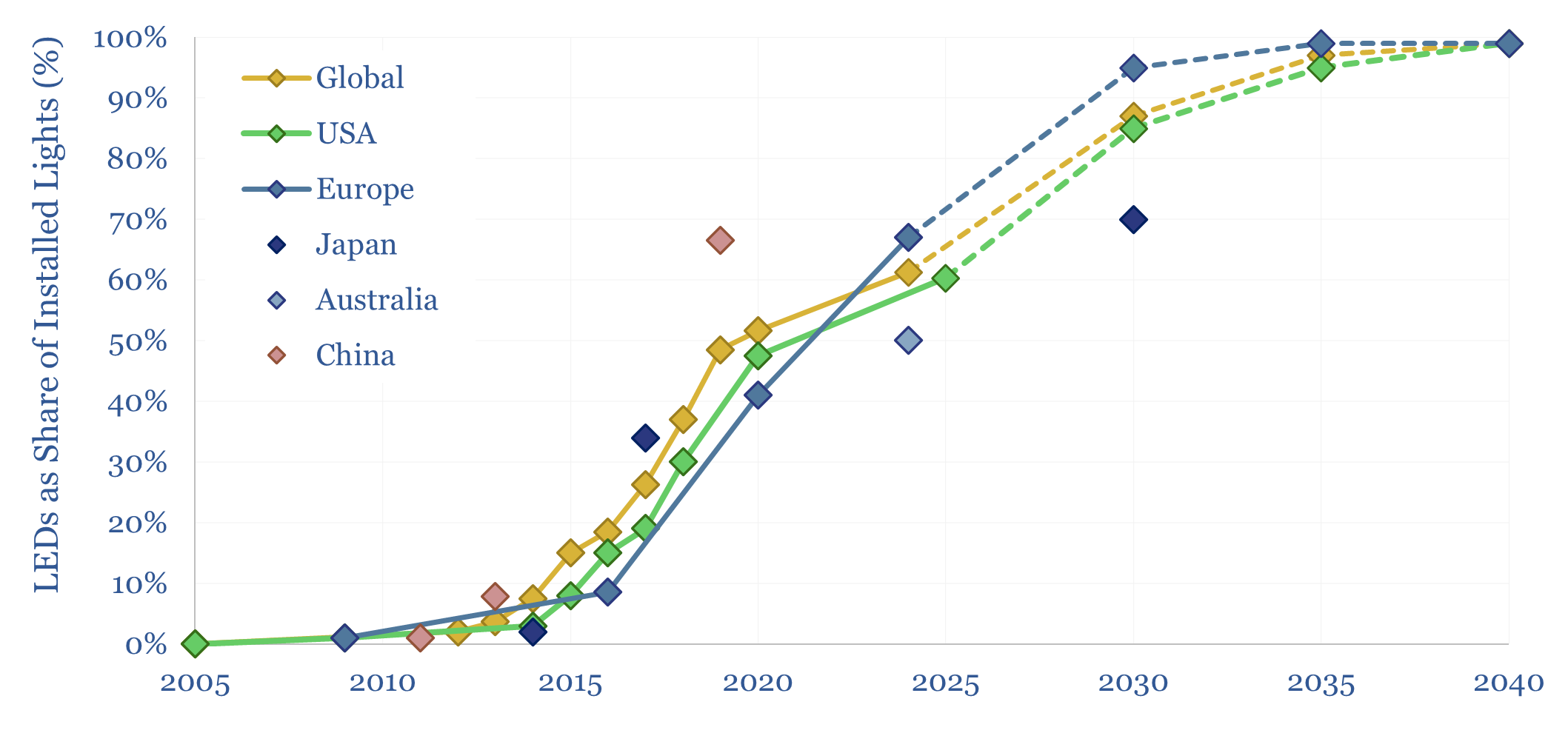
Lighting efficiency over time has improved by 90%, every half-century, for 300-years. Most recently, LED lights are 80% more efficient than incandescent bulbs, and the share of LEDs has increased to 65% of all installed lighting by 2025, which will ultimately saturate around 2030-2035.
If lighting started out at 15% of global electricity demand in 2005 (based on our breakdown of US electricity demand), then if all the incandescent bulbs were switched for 80% more efficient LEDs, over a period of 20-years, then mathematically, this would represent a -0.6% pa drag on global electricity demand growth.
And moreover, when the switch to LEDs was complete, global electricity demand could theoretically re-accelerate by around 0.6% pa. This matters as debates are flaring up about the future pace of load growth.
So where are we in this 20-year journey? This data-file estimates lighting efficiency over time, and plots the deployment of LEDs by region and over time. LEDs are c65% of all global lighting today. They will most likely reach c90% around 2030, then saturate, which potentially allows for higher load growth? Or maybe not…
On the other hand, about half of all global lighting demand is lost because of over-lighting spaces, or lighting them when no one is present. And so smart energy systems could help eliminate this inefficiency?
This data-file also assesses lighting efficiency over time, throughout history, quantifying energy efficiency (in lumens per watt and in percentage terms), plus the costs of lighting (in cents per 1,000-lumen-hours). The file goes back to 1800 and covers candles, whale oil, town gas, incandescent bulbs, halogen and LEDs.
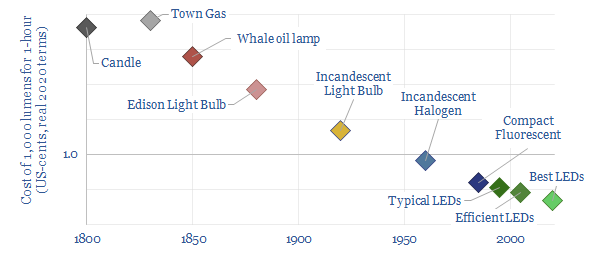
The work culminates with LED lighting, tracing the record efficiency levels announced in recent years. Overall, the best LEDs now achieve over 80% useful energy efficiency, while lighting costs have fallen 100x over the past century. Our outlook on LEDs is below.