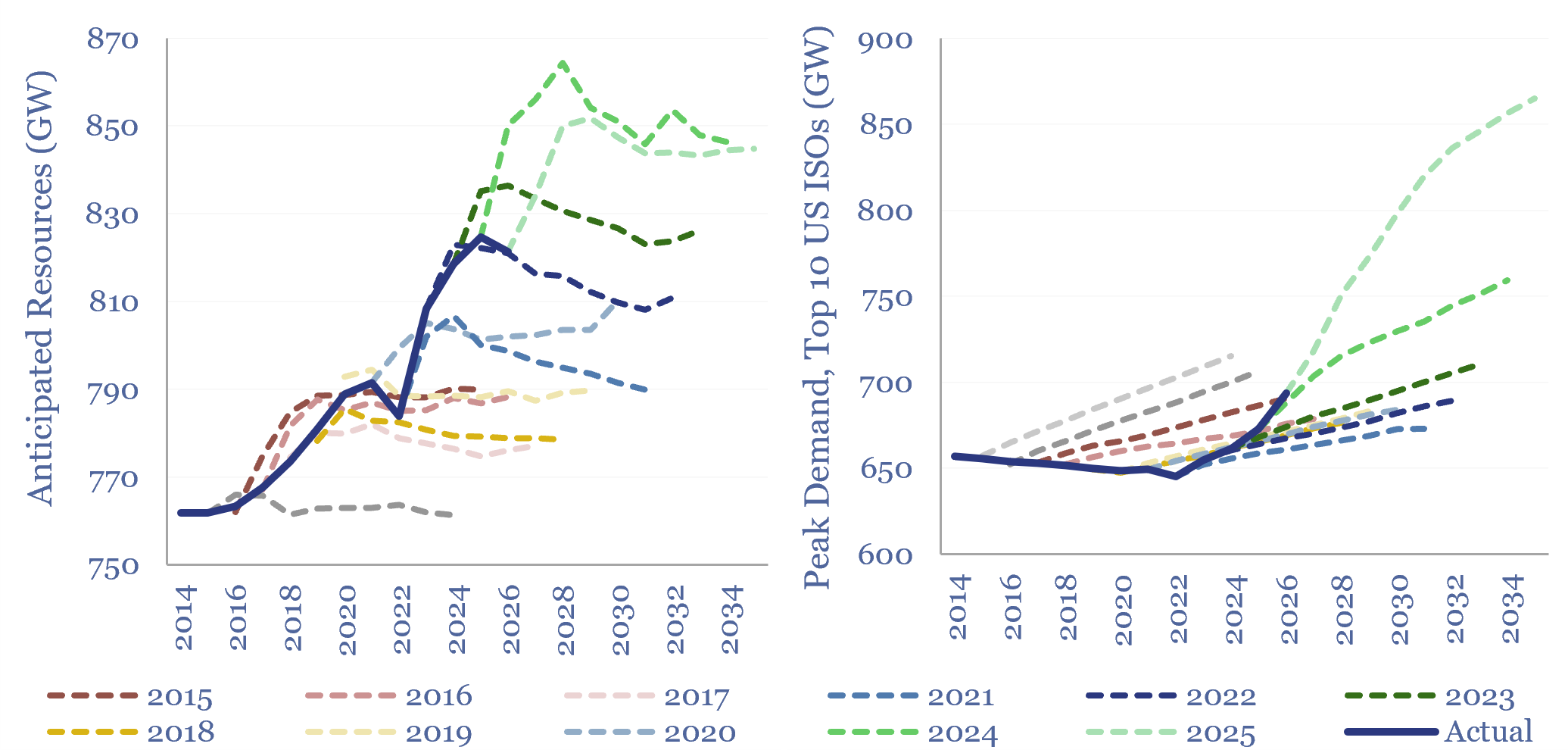
Reserve margins across major ISOs in the US power grid average 26% in 2026, are seen declining to 10% in the next decade by NERC, and turning negative in regions such as PJM and MISO. Surging power demand and resource retirements are the culprits, although may not unfold as feared. This data-file tabulates reserve margin forecasts, by ISO region, and over time.
Reserve margins are calculated by dividing (a) total power generation resources (in MW) that are seen to be available during times of peak grid demand by (b) total anticipated peak grid demand (in MW). Then subtract 1 to yield a percentage figure.
NERC guidelines recommend keeping reserve margins well above 15%, in order to limit Loss of Load Expectations (LOLE) to 1 event per 10-years, as part of resilient power grids.
Aggregated across major US ISOs, reserve margins currently average 26% in 2026, are projected by NERC to decline to 10% in the next decade, due to surging demand and resource retirements, although demand growth may be lower and more flexible.
The chart below is updated through 2024, but we have updated our data-file in March-2026, and it contains all of the latest charts and data-points for TSE clients.

This data-file aggregates NERC’s reserve margin forecasts over time, for major ISOs in the US, such as MISO, PJM, ERCOT, CAISO, NYISO, ISO NE, SPP and SERC FLA. Underlying charts are available on a separate tab for each region. We have aggregated all the regions together in the charts above.
In each case, we have plotted expectations for peak demand, net demand after demand responses and anticipated resources, which in turn comprise existing firm resources plus Tier 1 capacity additions.
In the past, reserve margins have defied pessimistic projections. The main reason has been downwards revisions in demand, and upwards revisions in renewables resources. What is changing is that demand is now surprising to the upside, linked to the rise of EVs and the rise of AI.
Another controversy in measuring reserve margins is how to count the capacity from renewables. 100MW of gas generation is almost always available to provide 100MW. We think the forecasts from NERC and from underlying ISOs may be ascribing 50-60MW of availability per 100MW of renewables. But due to the intercorrelation of renewables, and especially as renewables get built out, this may turn out to be too high.
The underlying source of the data is from NERC’s annual long-term reliability assessments.