-
TSE Temporary Payment Link
Thank you for remitting a payment through the TSE website. We are looking forward to working with you.
-
Decline Rates: the consensus?
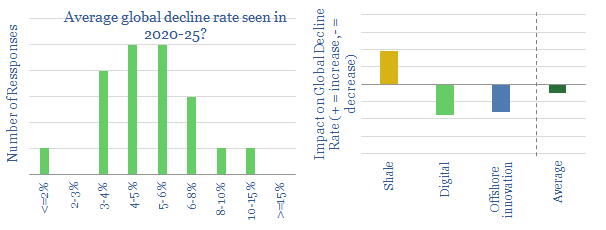
Global decline rates are currently seen at 5.2% pa in 2020-25, according to our survey. This is lower than historical consensus of 5.7%. Although shale is a headwind, it may be offset by the rise of new digital and offshore technologies. Hence modestly more participants see 2020-25 oil markets as over-supplied.
-
Permian Pipeline Bottlenecks?
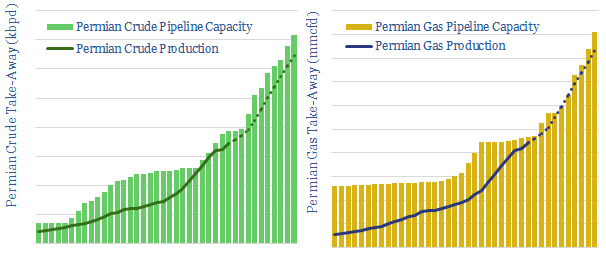
This data-file tracks 50 oil and gas pipelines in the Permian basin — their route, their capacity and their construction progress — in order to assess the severity of pipeline bottlenecks. Oil bottlenecks are moderate, but will ease into 2020. Gas bottlenecks are more severe and remain so.
-
Dreaming of Electric Frac Fleets?
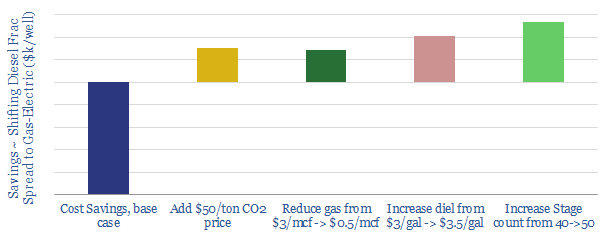
In 2019, the virtues of switching diesel-powered frac fleets to gas-powered electric have been extolled by companies such as EOG, Shell, Baker Hughes, Halliburton, Evolution and US Well Services.
-
New Risers for pre-salt Brazil?
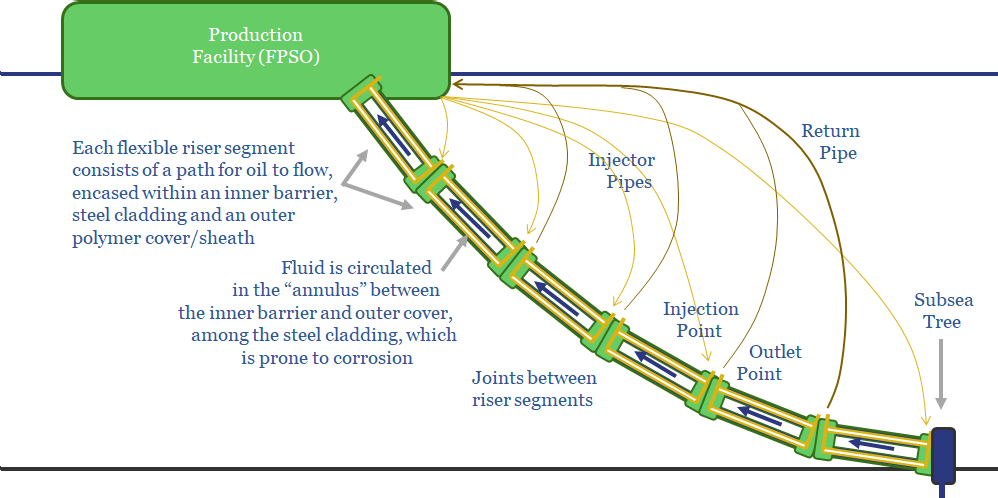
Petrobras has patented next-generation riser designs, to handle sour-service crude from pre-salt Brazil. This is needed after riser-failures at Lula. But complexity is an order of magnitude higher for Petrobras’s new solution. A simpler alternative is the growing potential from thermo-plastic composite pipe.
-
TOTAL’s Plastic-Recycling Progress?
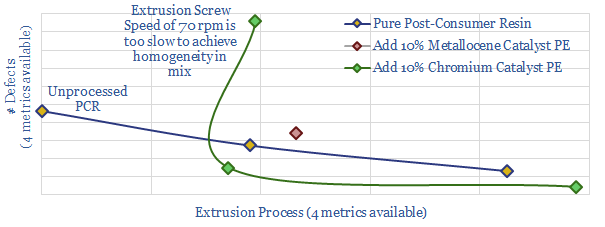
TOTAL is currently pioneering the greatest advances in plastic-recycling technologies among the Majors, based on our database of 3,000 patents. This data-file covers its comprehensive inter-mixing of chromium-catalysed polyethylene, to reduce defects and increase the strength of post-consumer resins. In turn, this extends their use to films, containers and pipes.
-
Well-by-well optimisation?
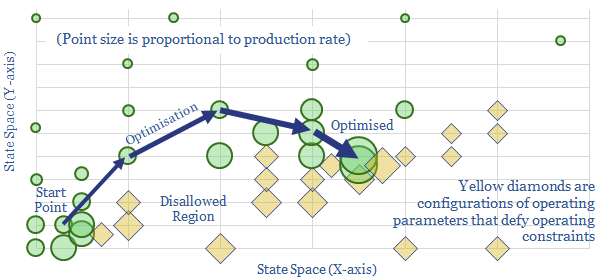
Well-by-well production optimisation can uplift mature fields’ output 5-20%. This data-file summarises the methodology employed by BP, which has filed the most detailed patent we have seen on the topic, from our screen of 3,000 patents around the industry.
-
Power Trains? Electric, diesel or hydrogen
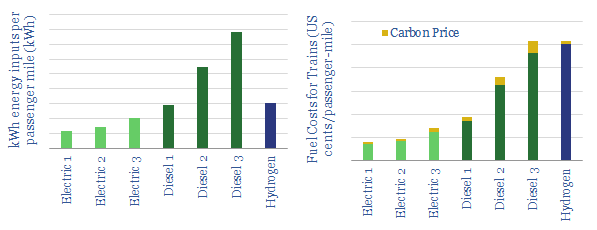
This data-file compares diesel trains, electric trains and hydrogen trains, according to their energy consumption, carbon emissions and fuel costs. The energy economics are best for electrifying rail-lines. Hydrogen costs must deflate 25-75% to be cost-competitive.
-
De-Carbonising Cars. Can Oxy-Combustion Save Gasoline?
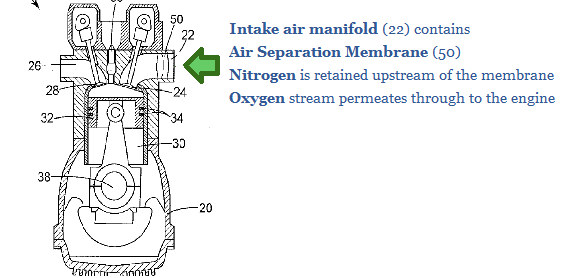
Could next-generation combustion technologies be used to decarbonise oil-fired transportation, raising the trajectory of long-term oil demand? We review a leading oil company’s patents to commercialise oxy-combustion in vehicles, along with the challenges. The outlook remains more positive for gas than for oil.
-
Can super-computers lower decline rates?
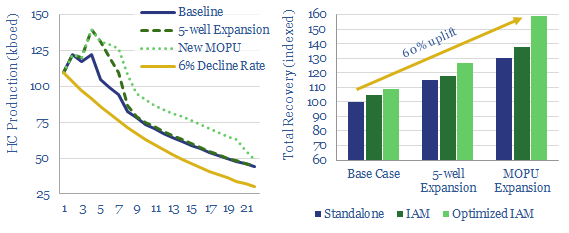
Advanced reservoir modelling can stave off production declines at complex offshore assets. This data-file illustrates how, tabulating production estimates based on a technical paper using Eni’s high-speed computer assets. 60% uplifts in LT production and EUR are achieved.
Content by Category
- Batteries (96)
- Biofuels (44)
- Carbon Intensity (48)
- CCS (64)
- CO2 Removals (9)
- Coal (41)
- Commentary (65)
- Company Diligence (104)
- Data Models (921)
- Decarbonization (162)
- Demand (129)
- Digital (86)
- Downstream (47)
- Economic Model (220)
- Energy Efficiency (76)
- Hydrogen (63)
- Industry Data (308)
- LNG (56)
- Materials (86)
- Metals (88)
- Midstream (45)
- Natural Gas (161)
- Nature (76)
- Nuclear (28)
- Oil (175)
- Patents (39)
- Plastics (44)
- Power Grids (155)
- Renewables (153)
- Screen (137)
- Semiconductors (35)
- Shale (58)
- Solar (72)
- Supply-Demand (53)
- Vehicles (95)
- Video (24)
- Wind (47)
- Written Research (406)