-
Shale Productivity: Our “Top 50” Improvements
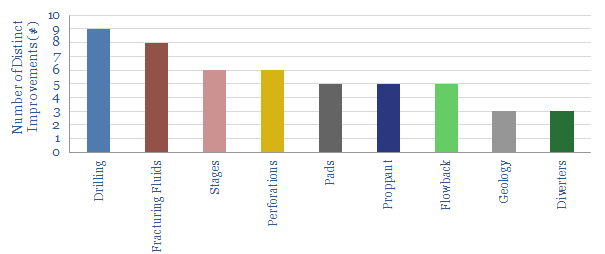
Critics still downplay shale productivity. This simple data-file compiles fifty examples of genuine improvements across the industry since 2015. A “one line” summary is provided for each one.
-
Hydrogen Cars: how economic?
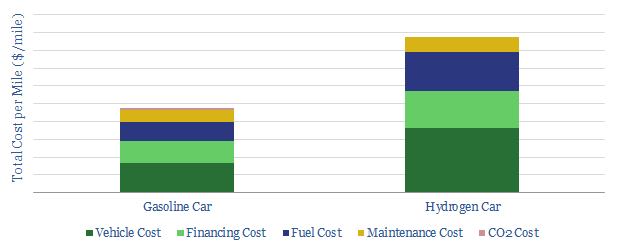
We model the relative economics of hydrogen cars, which are c85% costlier than US gasoline in our base case. In Europe, c20% cost-deflation could bring hydrogen cars close to competitiveness.
-
LNG Ships: a new record-setter?
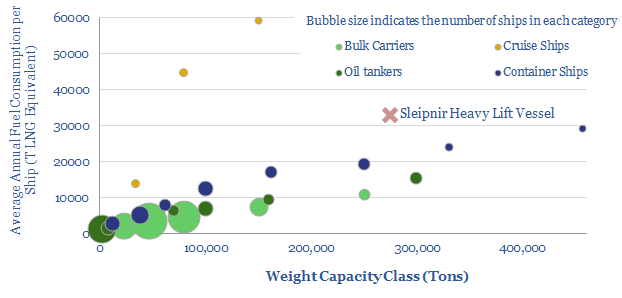
Multiple records have just been broken for an LNG-powered ship, as construction completed at Heerema’s “Sleipnir” crane-lift vessel. It is a remarkable, LNG-powered machine, substantiating the 40-60MTpa upside we see for LNG demand, from fuel-intensive ships, after IMO 2020.
-
Aerial Vehicles: why flying cars fly
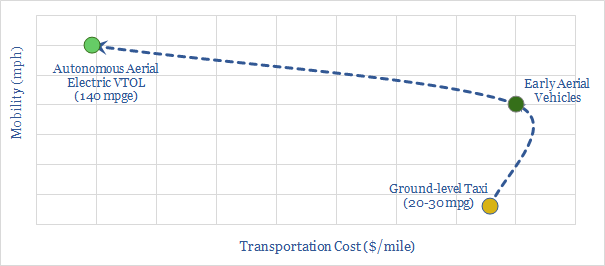
Aerial vehicles will do in the 2020s what electric vehicles did in the 2010s. They will go from a niche technology, to a global mega-trend that no forecaster can ignore. These conclusions stem from a deep-dive analysis into the technology, the fuel economies and the costs, all of which will be transformational.
-
Aerial Vehicles Re-Shape Transportation Costs?
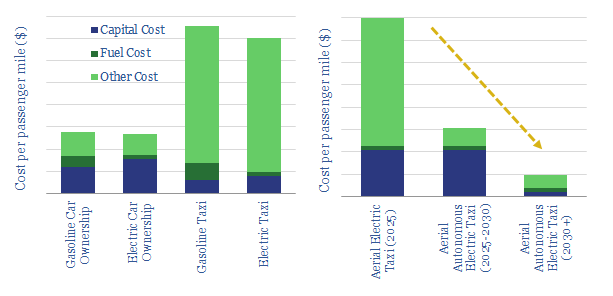
This model calculates costs per passenger-kilometer for transportation, based on input costs. Aerial vehicles could compete with taxis as early as 2025. By the 2030s, their costs can be c60% below car ownership.
-
Who’s Afraid of Aerial Vehicles?
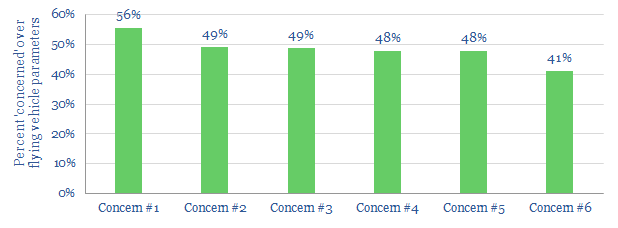
This data-file tabulates consumer attitudes towards aerial vehicles, based on the best perception study we have seen in the technical literature. It shows the influence of geography, income, age, gender, education levels and length of commute; along with top concerns.
-
Digital Deflation: How Hard to Save $1/boe?
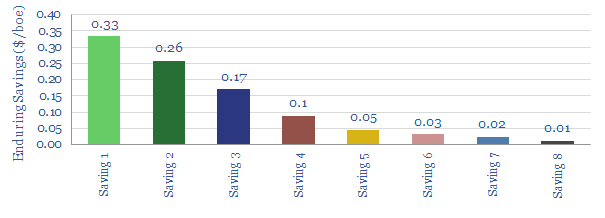
A typical operator can readily save $1/boe via continued, digital deflation. Our numbers are derived from a new case study from Cognite, which is among the leaders in oilfield digitization, collaborating with cutting-edge E&Ps. Digitization remains the most promising opportunity to improve offshore economics.
-
Round Trip Battery Efficiencies
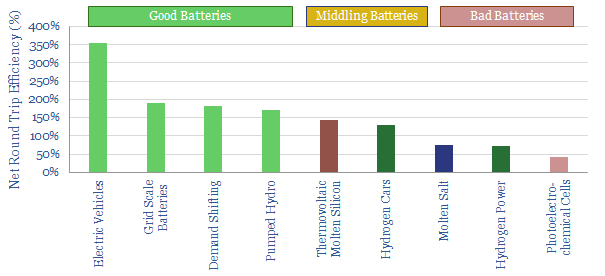
Different batteries have different round trip efficiencies. We see great potential, for example, in electrification of the vehicle fleet, which can achieve c3.5x efficiency gains. We see less potential, for example, backing up the grid with hydrogen, which reduces total system efficiency by c30%.
-
A Short History of Travel Speeds
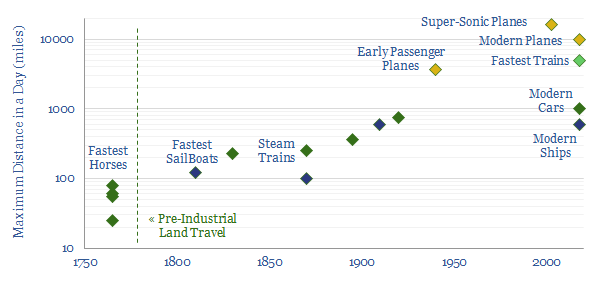
Top travel speeds have increased c100x since pre-industrial times, however in the past 20-years, the trend has reversed. Average mobility is down c6-7% since 2000. This data-file contains our notes and the data-points we have compiled on travel-times throughout history.
-
Oil Companies Drive the Energy Transition?
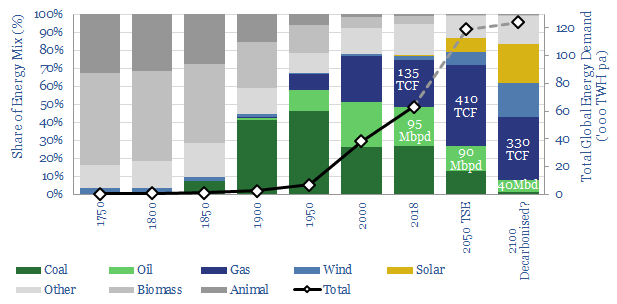
There is only one way to decarbonise the energy system: leading companies must find economic opportunities in better technologies. No other route can source sufficient capital to re-shape such a vast industry that spends c$2trn per annum. We outline seven game-changing opportunities. Leading energy Majors are already pursuing them in their portfolios, patents and venturing.…
Content by Category
- Batteries (96)
- Biofuels (44)
- Carbon Intensity (48)
- CCS (64)
- CO2 Removals (9)
- Coal (41)
- Commentary (65)
- Company Diligence (104)
- Data Models (922)
- Decarbonization (162)
- Demand (129)
- Digital (86)
- Downstream (47)
- Economic Model (221)
- Energy Efficiency (76)
- Hydrogen (63)
- Industry Data (308)
- LNG (56)
- Materials (86)
- Metals (88)
- Midstream (45)
- Natural Gas (161)
- Nature (76)
- Nuclear (28)
- Oil (176)
- Patents (39)
- Plastics (44)
- Power Grids (156)
- Renewables (153)
- Screen (137)
- Semiconductors (35)
- Shale (58)
- Solar (72)
- Supply-Demand (53)
- Vehicles (95)
- Video (24)
- Wind (47)
- Written Research (407)