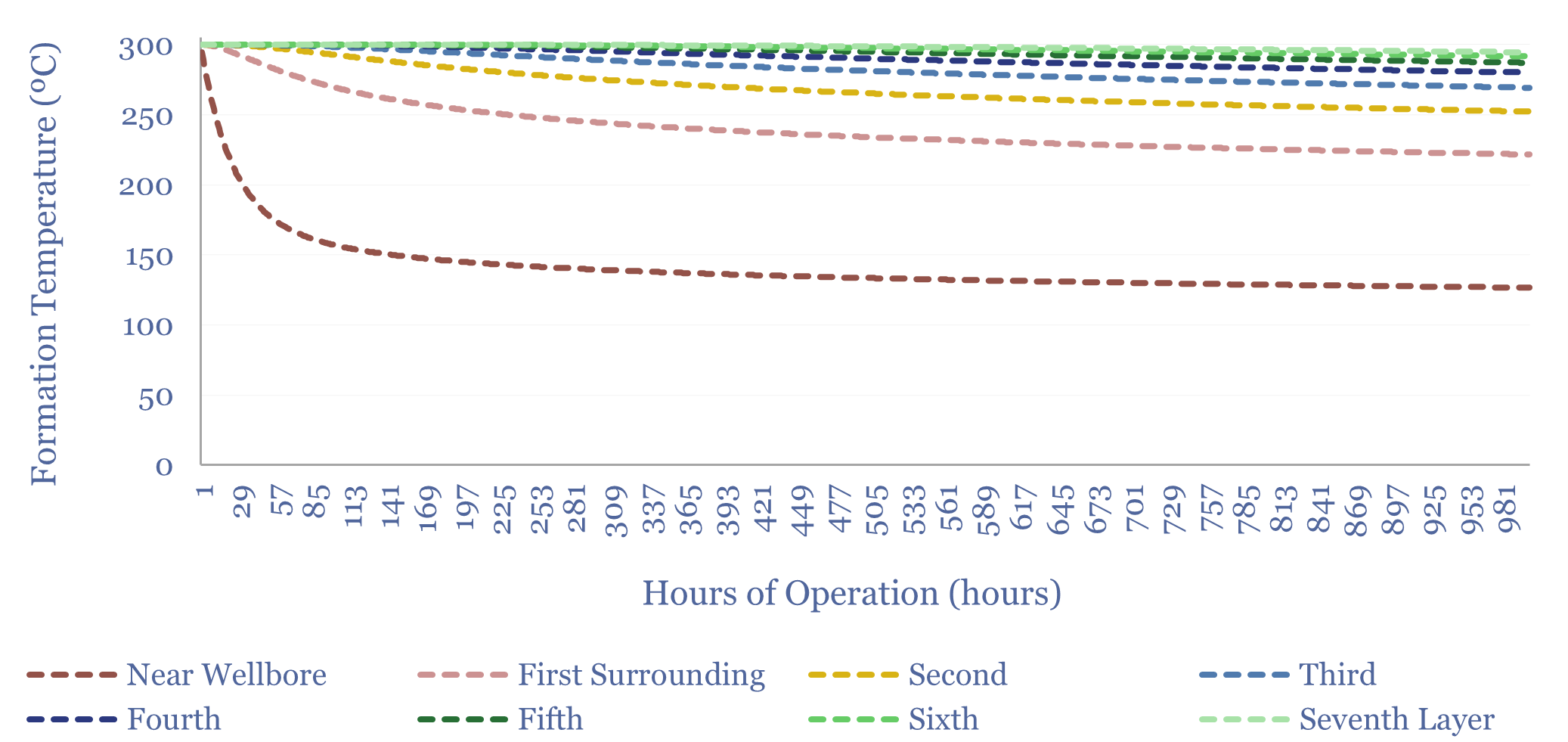
This data-file is a geothermal reservoir model, showing how a lateral well could harvest heat from the sub-surface, cool the rock surrounding the well, and ultimately settle at a “steady state” (in MW-th), where the flow of heat into the well from surrounding rock layers matches the rate of heat extraction. Inputs can be stress-tested.
Advanced geothermal is a next-generation geothermal concept, where water is flowed down a first well, along a lateral section (or possibly, multiple lateral sections), heat-exchanging with a hot reservoir rock, then super-heated fluids return back to the surface.
This data-file models the reservoir for an advanced geothermal wellbore, harvesting the heat from hot rocks, via a long, lateral well.
Specifically, we have modeled a geothermal reservoir across 220 x 1m x 1m “cells”, over a period of 1,000 hours (schematic below).

Every hour, water harvests heat from a wellbore at the center of the reservoir, and the surrounding cells exchange heat with one another, based on their temperature differences.
Under our base case expectations, a 1km lateral would thus cool from 300ºC to 36ºC after 1,000-hours, which is not enough to sustain electricity generation.
A 10km lateral cools to 127ºC, which can sustain 1.8MWe of power, but requires 15c/kWh for a 10% IRR on $8,000/kW capex, when reflected in our model of geothermal economics.
Inputs that can be varied in our advanced geothermal reservoir model include the lateral length (in km), the rate of geothermal heat upwelling (in W/m2), the initial reservoir temperature (in ºC), water flow rates (in m/s), the thermal conductivity of reservoir rocks (in W/m-K) and the specific heat capacity of the reservoir rocks (in J/g-K).
A 12-page report, explaining the model mechanics in more detail, and our conclusions into geothermal reservoirs, is also available separately (see below). This advanced geothermal reservoir model contains back-up calculations for the report.