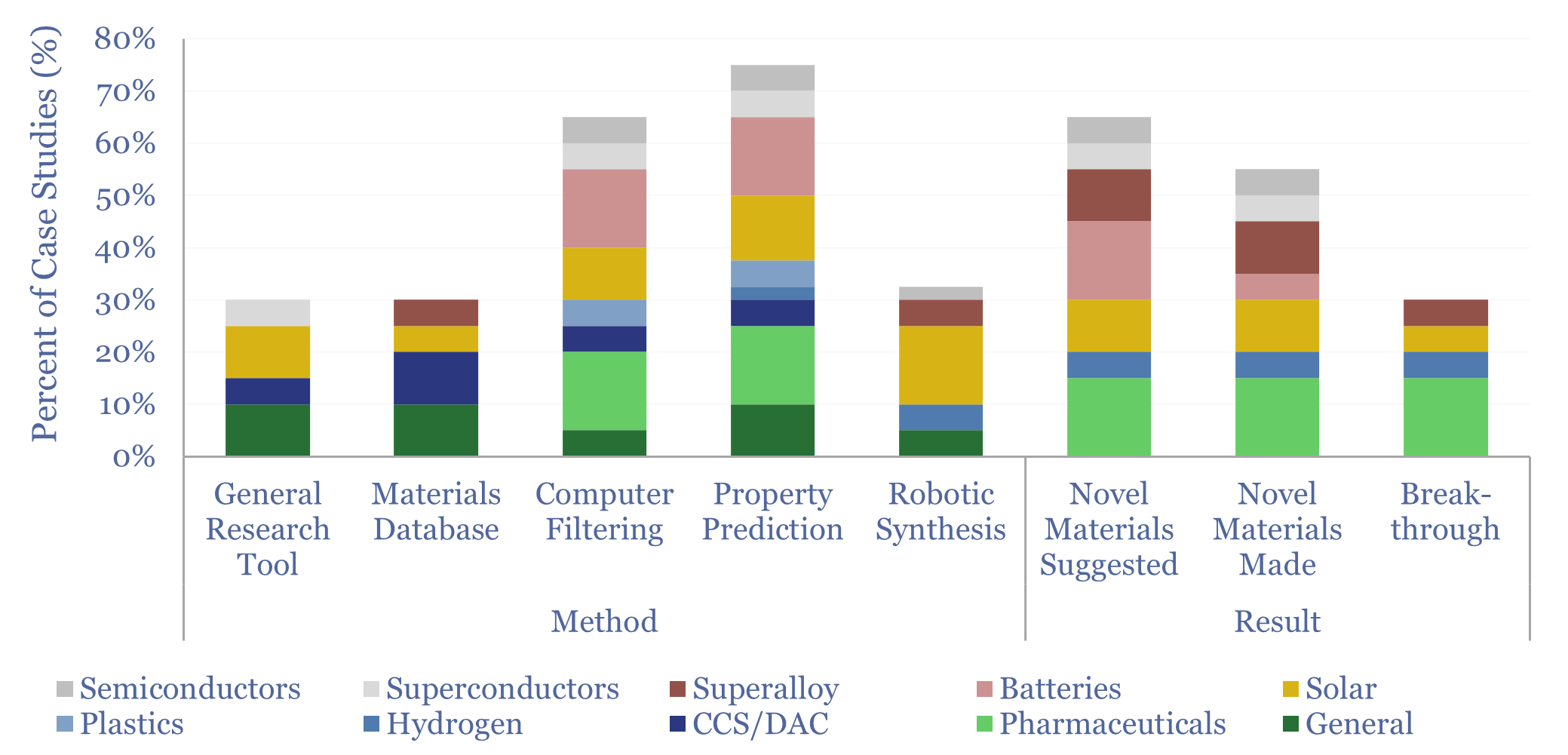
How is AI affecting materials development? This Excel data-file tabulates 20 recent case studies using AI for materials development, across pharmaceuticals, solar, batteries, CCS, plastics, semiconductors, superalloys and superconductors. We conclude the AI is a step-change for improved materials development, it is happening now, and it is commercially relevant.
In this data-file, we have tabulated 20 recent case studies using AI to develop novel materials. No doubt there are many more examples out there in the world, and we will want to expand the file in the future. But reading the particulars of these case studies, at the very micro level, is the best way to understand what is happening and how it might change the world.
Using AI to accelerate materials development is not something that “might happen in the future” but definitively something that is “happening now”, accelerating the identification, optimization and synthesis of new materials. This is shown clearly in the case studies in our data-file.
Is AI a step-change for materials development? Our answer is yes. Materials such as Teflon or penicillin were famously discovered by accident. Patents we review often begin by declaring “it was unexpectedly found that…”. Prior research has leaned heavily on trial-and-error. AI is accelerating traditional processes, but also predicting and generating.
Is it commercially relevant? Our answer is yes. 50% of our case studies came from teams in Academia, some of which have commercialized discovered materials (especially in pharma). Another 20% were from early-stage companies, 15% from ‘big tech’, and 10% from larger companies.
Different methods using AI for materials development are shown in the chart above. As an example of a materials database, for example, in 2023, Google DeepMind’s GNoME AI project predicted 2.2M novel inorganic crystal structures, and that 380,000 would be particularly stable, which would have taken 800 years via traditional experimental means. By filtering through this database, in 2026, for example, researchers in Italy identified 16 possible lithium-free battery cathodes.
Interesting companies, and case studies, impacting solar (especially perovskites), batteries (especially solid-state or lithium-free), semiconductors, superconductors, superalloys, plastics, CCS and gas turbines and reviewed in the data-file.