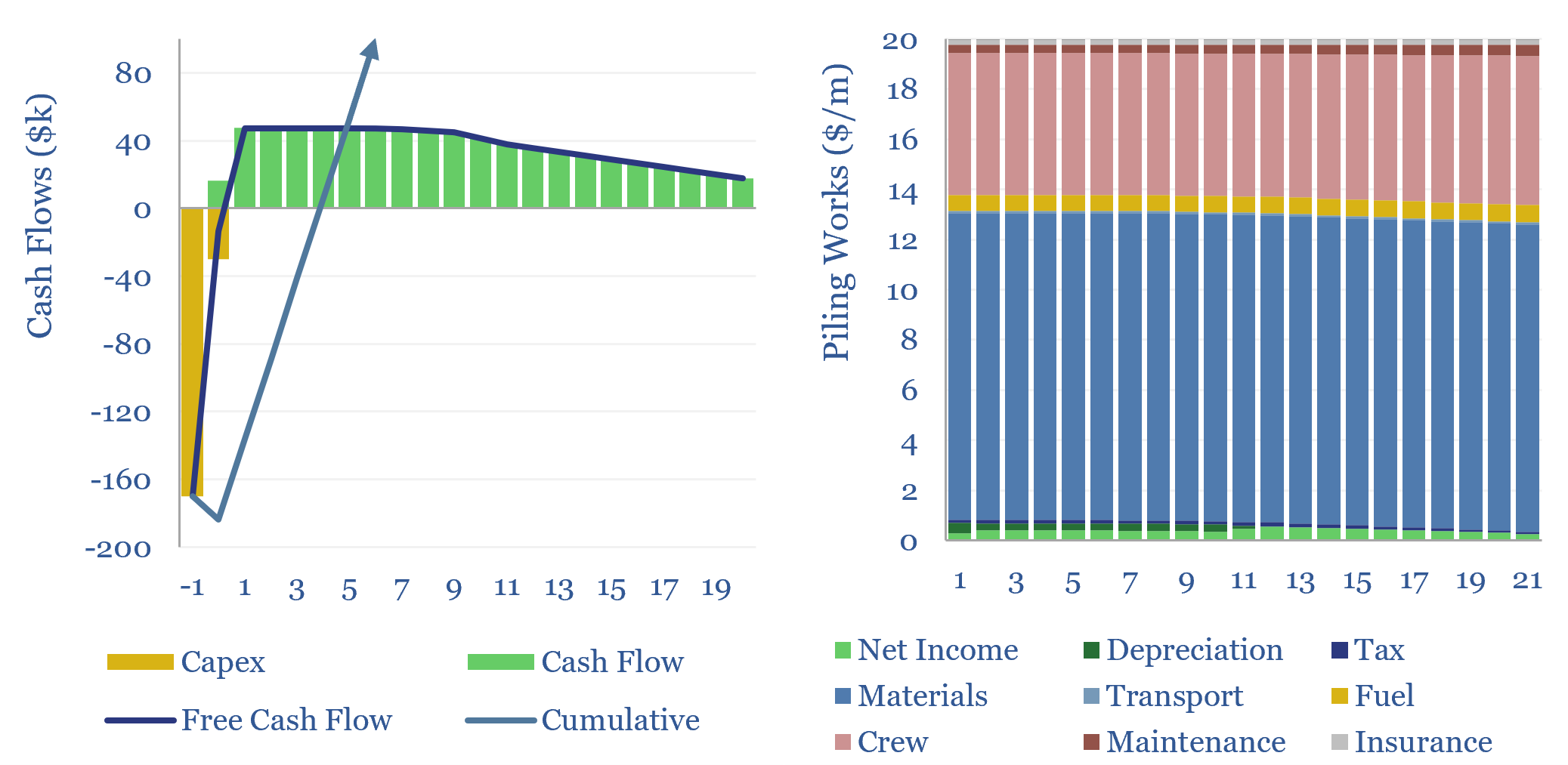
Piling works involve driving long vertical shafts into the ground, which will anchor and support a structure. The cost of piling works can run to $20-200/m, as captured in this data-file, to generate a return and cover the costs of piling operations.
An important goal across our economic models is to disaggregate costs across materials, manufacturing and installation. The latter category will include activities such as earth works, transportation of modules onto site, and establishing solid foundations.
Hence our goal in this data-file is to capture the costs of piling works, going back to first principles, and asking what fee (in $/m, or $/hour) is needed to generate acceptable returns on owning and operating pile-driving equipment, sinking slender support columns into the ground, which will anchor large structures and distribute their weight solidly into the Earth.
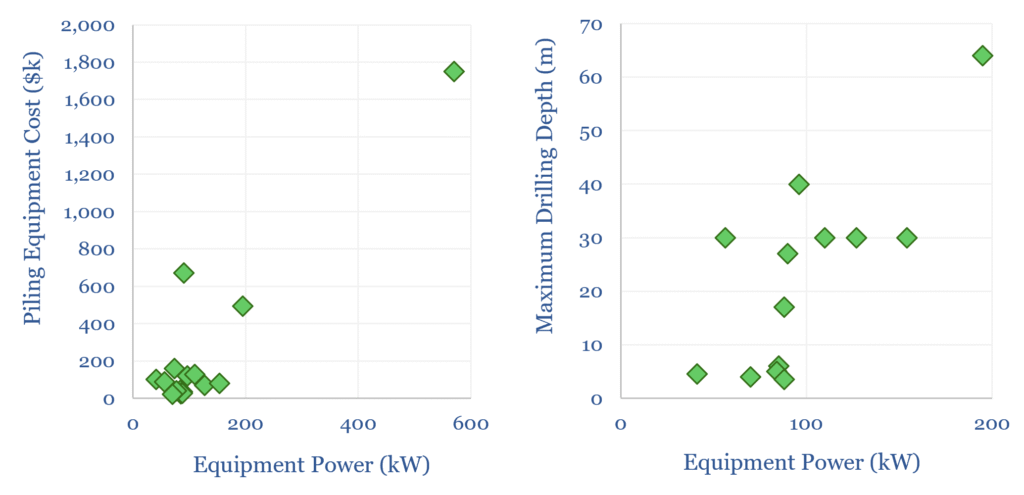
Our cost estimates are based on the capital costs and energy consumption of pile-driving and pile-drilling equipment and machinery, as captured in the charts below.
We can then multiply our cost estimates by the typical piling intensity of different project types, which are captured across 40 examples in our data-file, and also charted below. Note that the data-file includes the capacity of each project (in MW or MTpa), in order to extract meaningful comparisons.
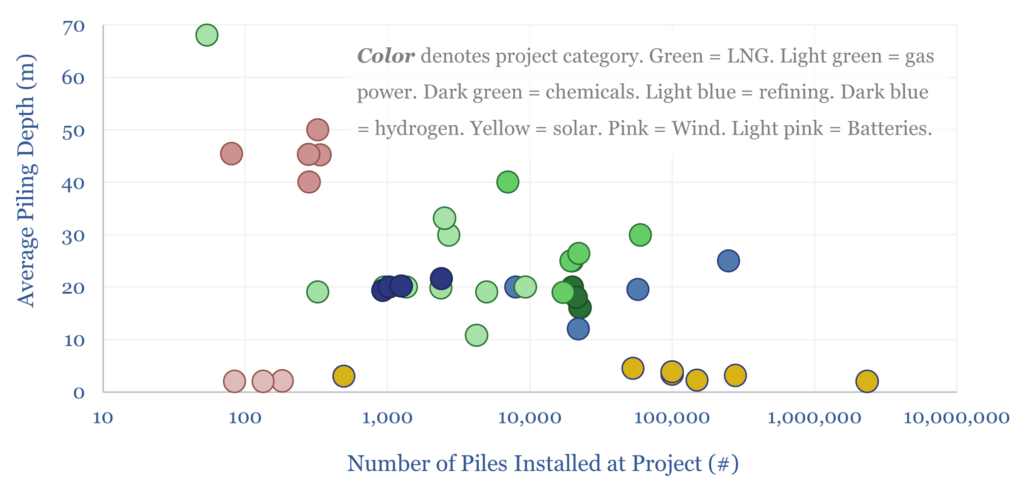
A typical solar project, for example, requires 500+ piles per MW of capacity, each driven about 3m into the Earth, for 1,500-2,000 meters of piling per MW. At a cost of $20/m, this equates to $30-40/kW in our breakdown of solar costs.
Large LNG projects can require 6,000-60,000 piles per MTpa, driven 20-40m into the ground, which equates to 20,000 – 110,000 m/MTpa of piling. At a typical cost of $60/m, this might equate to $1-10/Tpa of the total installed cost of an LNG plant.
A large gas-fired power plant requires 3-30 piles per MW, sunk to 20m, for 50-500m/MW of piling, which can comprise $1-30/kW of total installed costs.
Amidst these wide ranges, the largest contributor to piling cost is the size of the piles that need to be sunk, which in turn depends on the terrain where the facility is being installed.
Dense sands and clays, which are well-consolidated, soft and yet “grippy” might result in low costs. Hard rock of poorly consolidated sands/clays interleaved with rocks, which requires deep piling and drilling might result in materially higher costs.