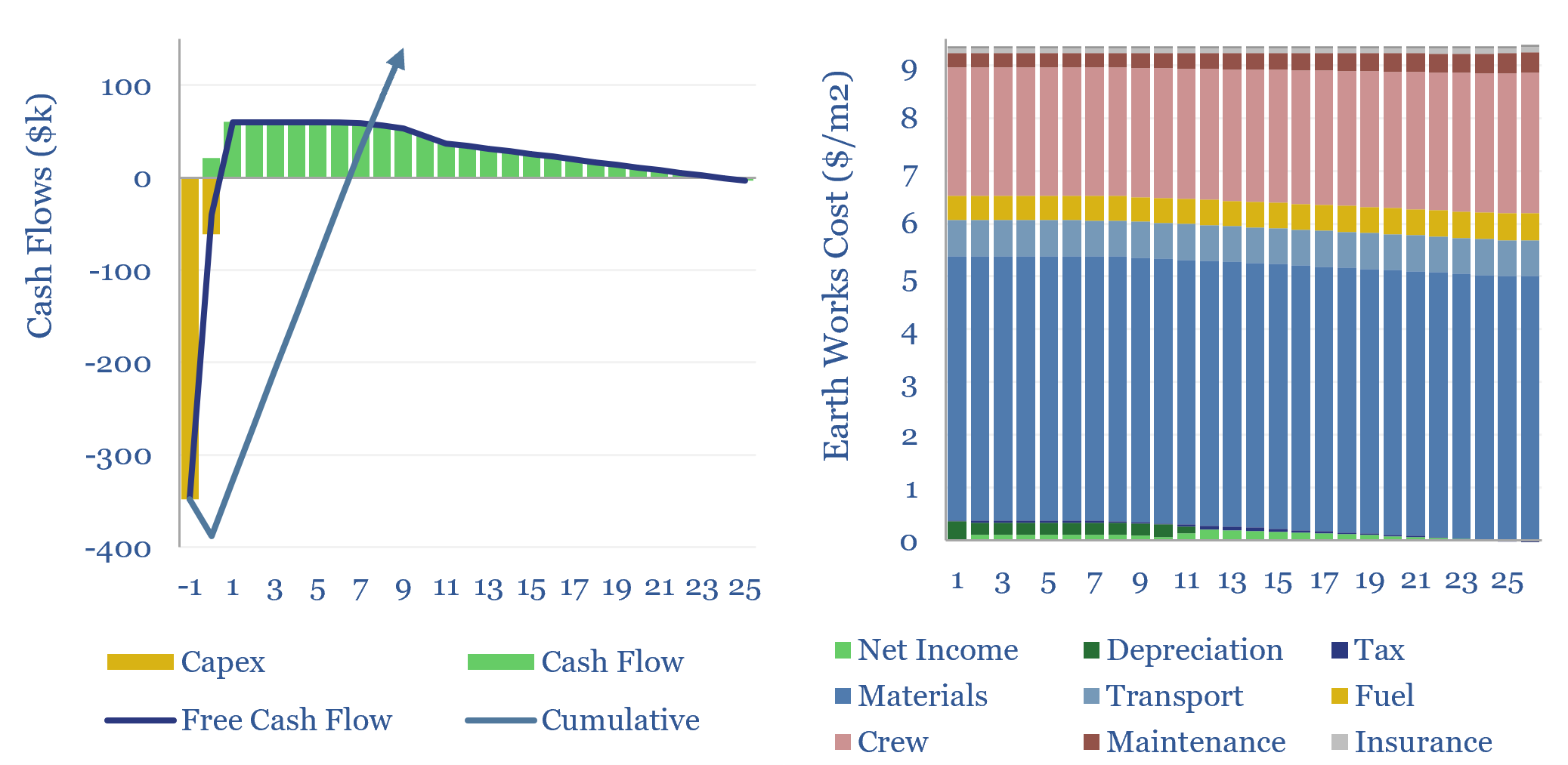
The costs of earthworks might range from $1/m2 to $300/m2 at a construction project, depending on the depth that needs to be excavated and the amount of aggregate that needs to be back-filled. This data-file estimates the costs of earthworks, across power and energy projects, which is usually around $10-15/kW.
Earthworks involve clearing a site of debris, leveling out natural undulations in terrain, and potentially grading the site with a layer of aggregate/sand, which can serve as a firm base layer, on which to install equipment or begin construction.
This data-file captures the costs of earthworks, as part of our ongoing effort to disaggregate the capex costs across the industrial world, from grid-scale batteries, to utility-scale solar, to nuclear plants, to LNG plants, to AI data-centers.
The costs of earthworks, in our base case, run to around $10/m2, in order to clear 0.5 m3/m2 of debris, add 10cm of aggregate, and then compact the surface, and thus generate a 10% IRR on moderately used equipment.
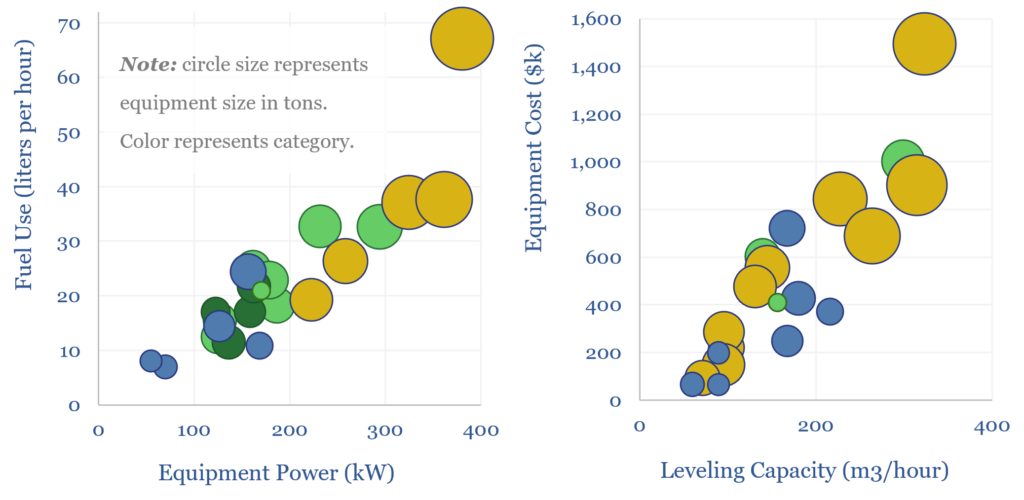
Equipment used for earthworks may include dozers, graders, loaders or excavators, whose costs (in $k), power requirements (in kW or hp) and fuel use (in liters per hour) are quantified based on commonly used examples, especially from Caterpillar and Komatsu (charts below).
In the ‘Comparison’ tab of the model, we have multiplied our estimates into the costs of earthworks by the typical land intensity of different energy technologies. For example, the costs of earthworks likely run to $10-15/kW when building solar, wind and CCGTs. Costs are surprisingly low for grid-scale batteries and data-centers, and surprisingly high for nuclear ($300/kW?!).
Please download the data-file to stress-test the costs of earthworks, as one of the many construction-related line-items in the capex budget of a larger-scale construction project. Other examples include building access roads and transporting materials to site.