
Aixtron has a market leading position in GaN MOCVD technology, which is increasingly used in the power electronics of data centers, solar and EVs. This data-file assesses 20 patents from Aixtron and Veeco, to unpack how GaN MOCVD works, what are the key challenges, and to quantify Aixtron’s potential moat.
GaN HEMTs are increasingly important for fast-switching, at low power losses and compact form factors. This helps to unlock 800V power architectures for AI data-centers, across the down-converters in each compute tray, and for solid-state circuit breakers. We have also seen interesting deployments in GaN-based microinverters.
So how are GaN HEMTs made? AlGaN and GaN are deposited onto substrate via metal organic chemical vapor deposition (MOCVD). Precursor gases such as TMG (Ga(CH3)3) and ammonia (NH3) are diluted in carrier gases such as H2 and N2, then sprayed over a rotating susceptor, where they are thermally decomposed to form a thin layer of GaN. A simplified reactor design is shown below, illustrating how GaN MOCVD technology works.
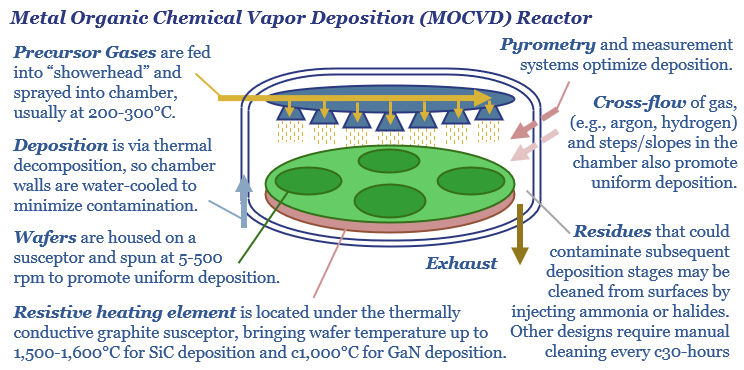
Aixtron was founded in 1983, it is publicly listed in Germany, with 1,086 employees, €557M of revenues in 2025, at 19% EBIT margin (down from 25% in 2023, due to recent market softness, especially in SiC). By 2026, Aixtron has delivered 3,000 vapor deposition systems worldwide. Aixtron’s market share for GaN MOCVD machines has been estimated at 70-78%.
What are the key challenges that create a moat around GaN MOCVD technology, and how far ahead is Aixtron, compared to its next closest competitor, Veeco. To answer this question, we reviewed over 20 Aixtron and Veeco GaN patents in this data-file.
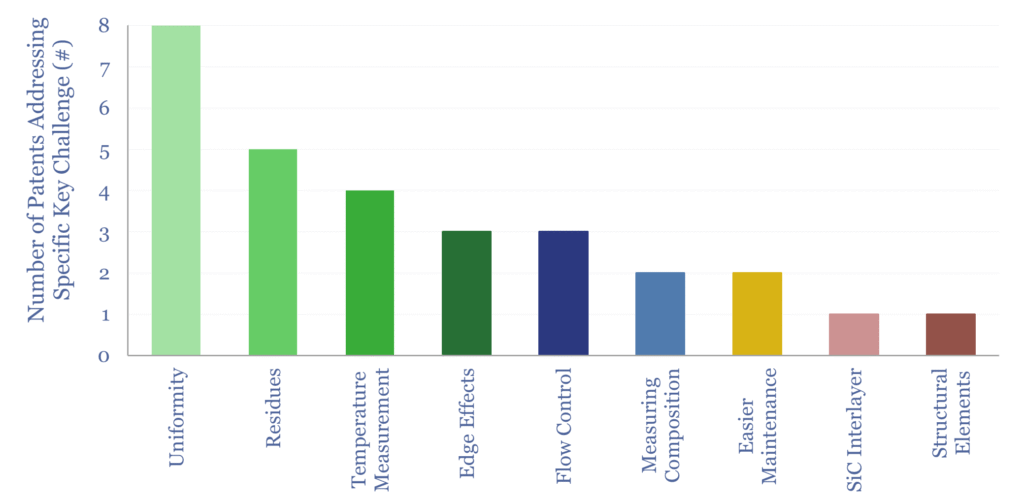
Aixtron’s patents contained excellent, specific and mostly intelligible details, suggesting a strong moat around its GaN MOCVD technology. Specific solutions locked up in Aixtron’s patents focus on achieving uniform deposition of GaN on 300mm silicon substrates, in situ cleaning to lower maintenance costs, and precise controls. Further details are in the data-file.