Industry Data
-
Coal power generation: minute-by-minute flexibility?
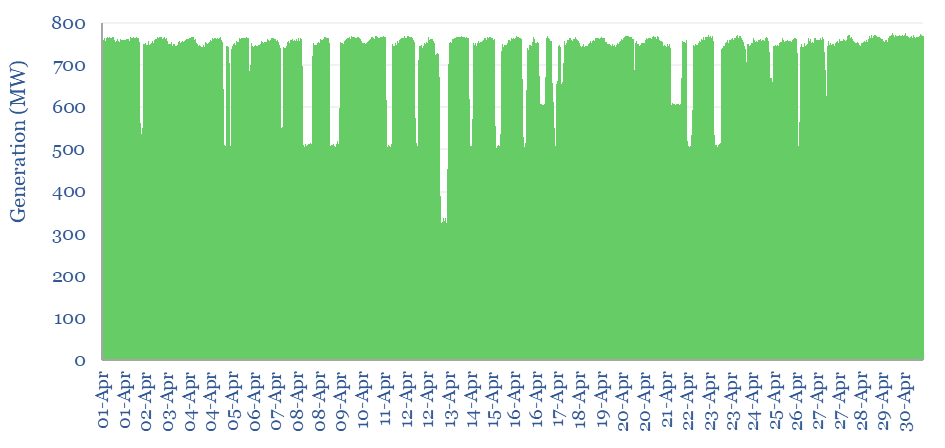
Coal power generation is aggregated in this data-file, at the largest single-unit coal power plant in Australia, across five-minute intervals, for the whole of 2023. The Kogan Creek coal plant produces stable baseload power, with average utilization rate of 85%. But it exhibits lower flexibility to backstop renewables than gas-fired generation.
-
Grid-scale battery operation: a case study?
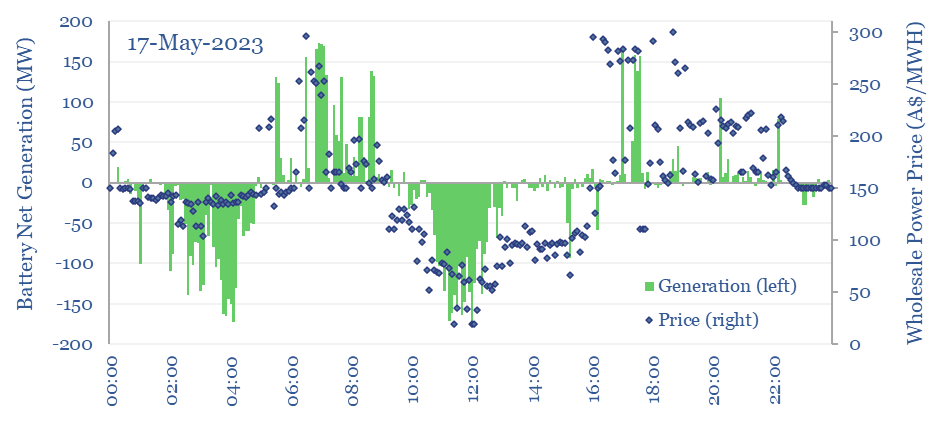
Grid-scale batteries are not simply operated to store up excess renewables and move them to non-windy and non-sunny moments, in order to increase reneawble penetration rates. Their key practical rationale is providing short-term grid stability to increasingly volatile grids that need ‘synthetic inertia’. Their key economic rationale is arbitrage. Numbers are borne out by our…
-
Wind generation case study: minute by minute volatility?
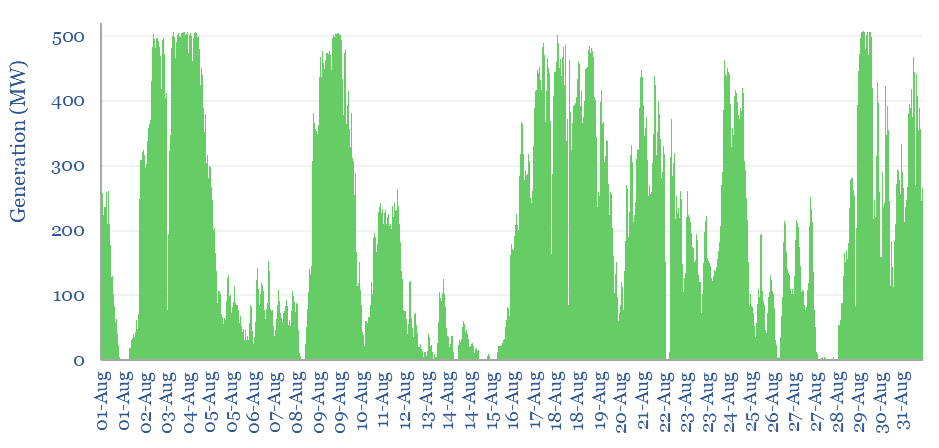
The volatility of wind generation is illustrated in this data-file, by aggregating the data for a large wind project in Australia, every five minutes, across an entire calendar year. Intra-day and inter-day volatility is 30-60% higher than for solar. 2-6 day feasts and famines are hard to backstop with batteries. Solar also cannibalizes wind?
-
Solar generation: minute by minute volatility?
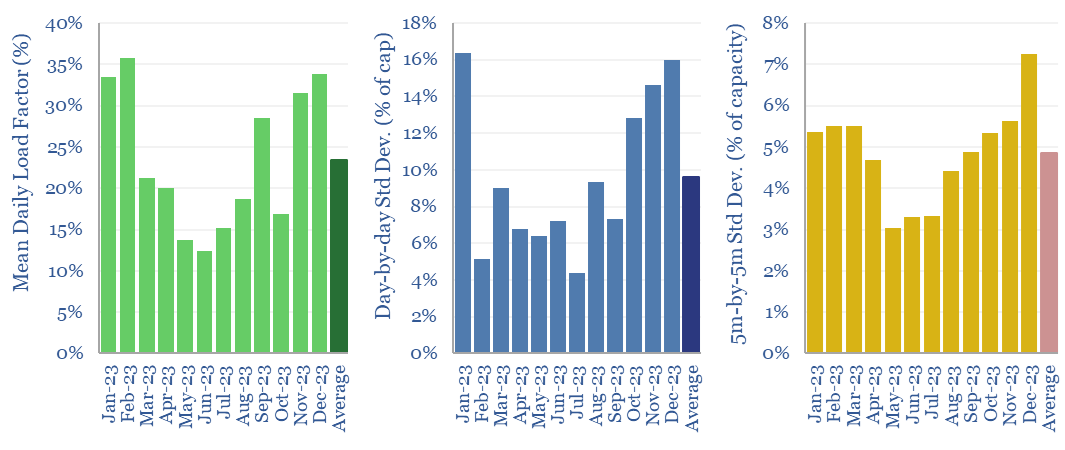
The volatility of solar generation is evaluated in this case study, by tracking the output from a 275MW solar project, at 5-minute intervals, throughout an entire calendar year. Output is -65% lower in winter than summer, varies +/-10% each day, and +/- 5% every 5-minutes, including steep power drops that in turn require back-ups.
-
Gas power generation across five-minute intervals?
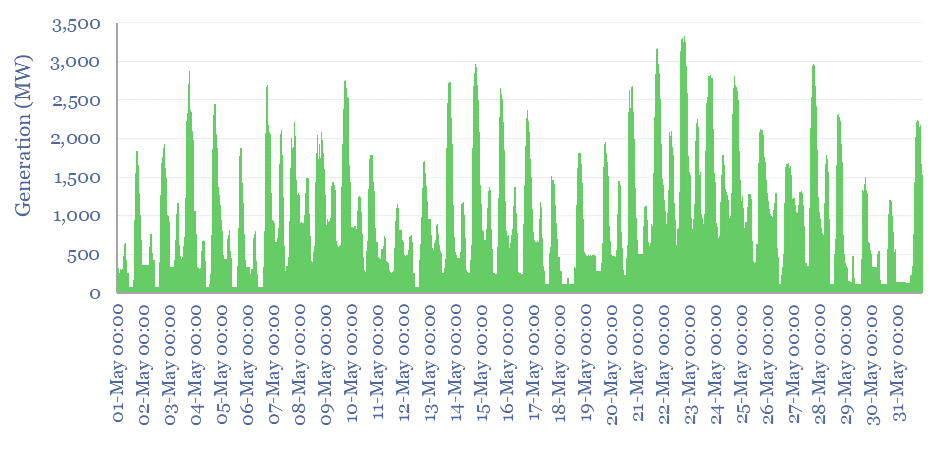
Power generation data are aggregated for ten of the largest CCGTs and gas peaker plants in Australia, across five-minute intervals, May-2024 and May-2014. This makes for a fascinating case study into how gas turbines are used to stabilize power grids, backstop renewables, and how this has changed over time.
-
Commodity price volatility: energy, metals and ags?
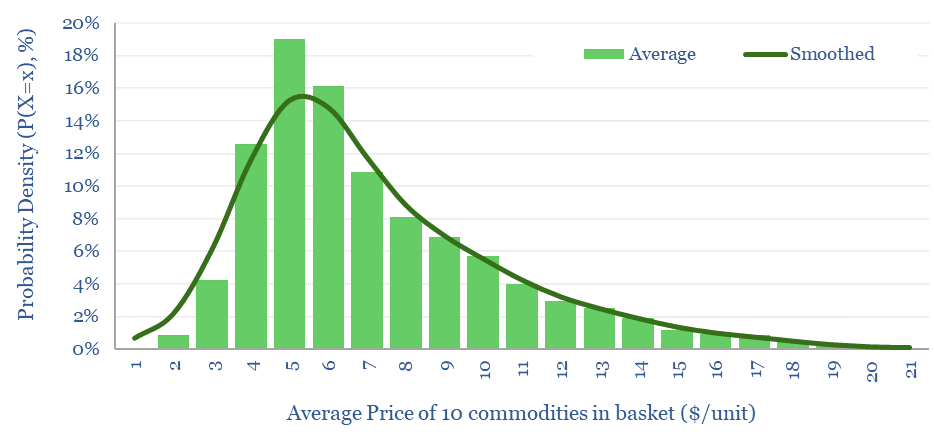
Commodity price volatility tends to be lognormally distributed, based on the data from ten commodities, over the past 50-years. Means are 20% higher than medians. Skew factors average +1.5x. Standard errors average 50%, while more volatile prices have more upside skew.
-
Solar insolation: by latitude, season, date, time and tilt?
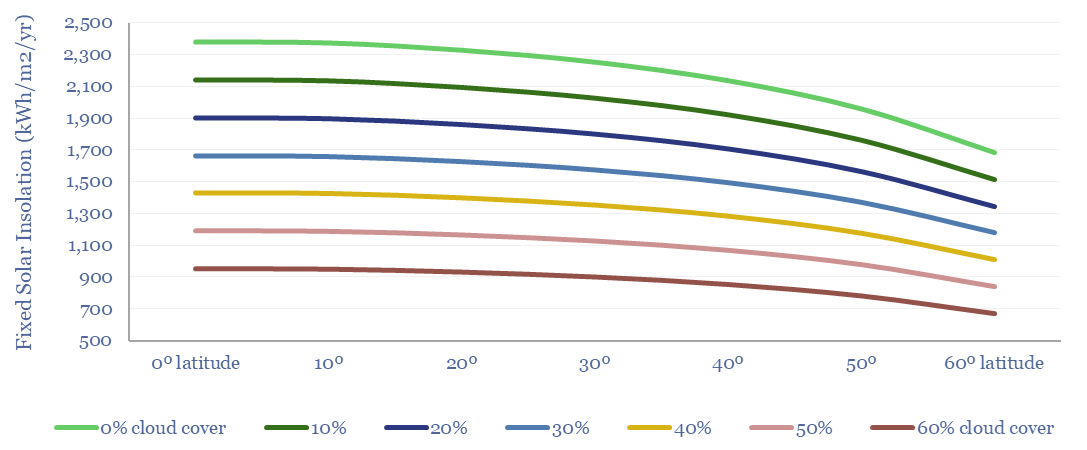
Solar insolation varies from 600-2,500 kWh/m2/year at different locations on Earth, depending on their latitude, altitude, cloudiness, panel tilt and panel azimuth. This means the economics of solar can also vary by a factor of 4x. Seasonality is a key challenge at higher latitudes. Active strategies are emerging for orienting solar modules.
-
Gas power: does low utilization entail spare capacity?
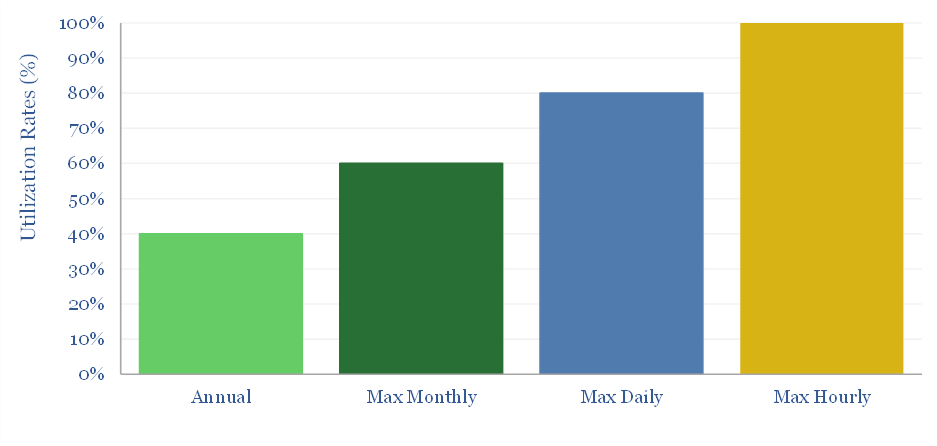
The US has >400GW of large gas-fired power plants running at 40% average annual utilization. Could they help power new loads, e.g., 60GW of AI data-centers by 2030? This 5-page note shows why low utilization does not entail spare capacity, and in turn, estimates the true spare capacity for loads such as data-centers.
-
Bill of materials: electronic devices and data-centers?
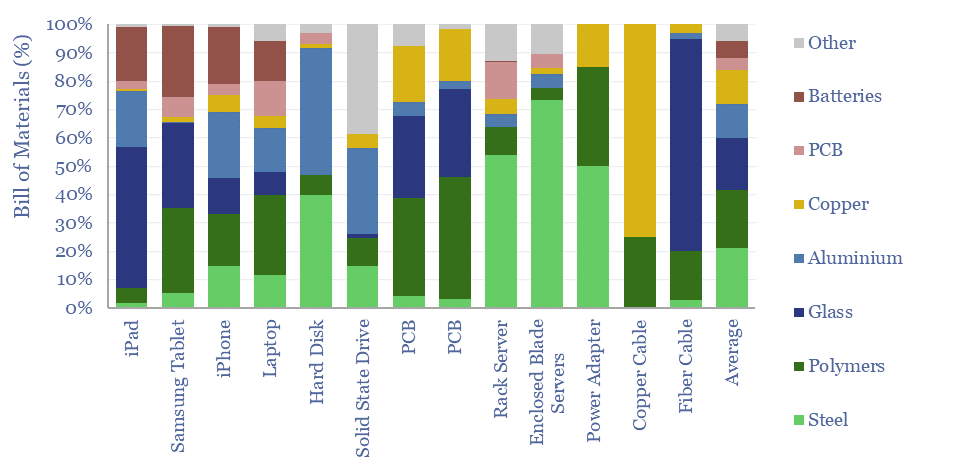
Electronic devices are changing the world, from portable electronics to AI data centers. Hence what materials are used in electronic devices, as percentage of mass, and in kg/kW terms? This data-file tabualates the bill of materials, for different devices, across different studies.
-
Electromagnetic energy: Planck, Shockley-Queisser, power beaming?
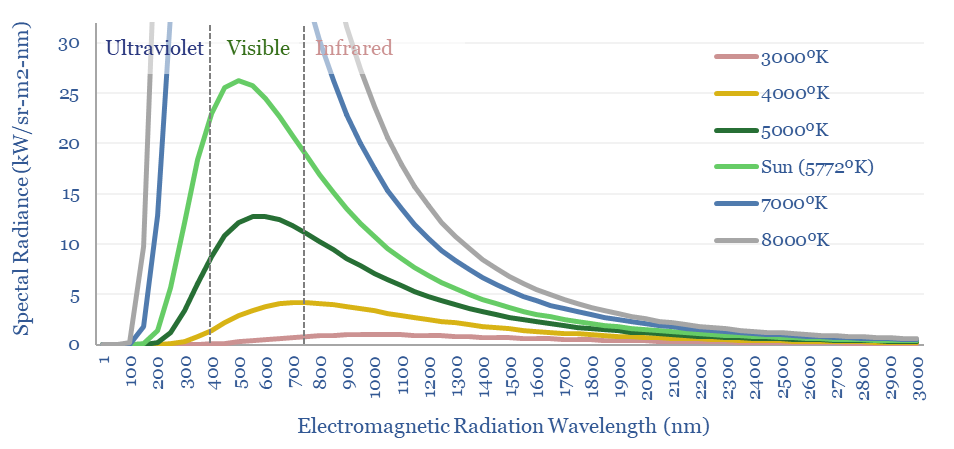
Electromagentic radiation is a form of energy, exemplified by light, infrared, ultraviolet, microwaves and radiowaves. What is the energy content of light? How much of it can be captured in a solar module? And what implications? We answer these questions by explaining the Planck Equation and Shockley-Queisser limit from first principles.
Content by Category
- Batteries (96)
- Biofuels (44)
- Carbon Intensity (48)
- CCS (64)
- CO2 Removals (9)
- Coal (44)
- Commentary (65)
- Company Diligence (105)
- Data Models (929)
- Decarbonization (163)
- Demand (132)
- Digital (92)
- Downstream (47)
- Economic Model (222)
- Energy Efficiency (76)
- Hydrogen (63)
- Industry Data (311)
- LNG (56)
- Materials (86)
- Metals (89)
- Midstream (45)
- Natural Gas (163)
- Nature (76)
- Nuclear (28)
- Oil (179)
- Patents (39)
- Plastics (44)
- Power Grids (157)
- Renewables (153)
- Screen (139)
- Semiconductors (36)
- Shale (58)
- Solar (73)
- Supply-Demand (53)
- Vehicles (94)
- Video (24)
- Wind (46)
- Written Research (411)