Shale
-
Ten Themes for Energy in 2020
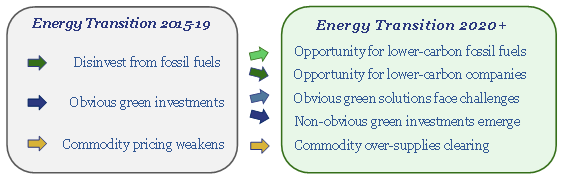
Energy transition is maturing as an investment theme. ‘Obvious’ portfolio tilts are beginning to look over-crowded. Non-obvious ones are looking over-looked. This note outlines the ‘top ten’ themes that excite us most in 2020, among commodities, drivers of the energy transition, market perceptions and corporate strategies.
-
Shale growth: what if the Permian went CO2-neutral?
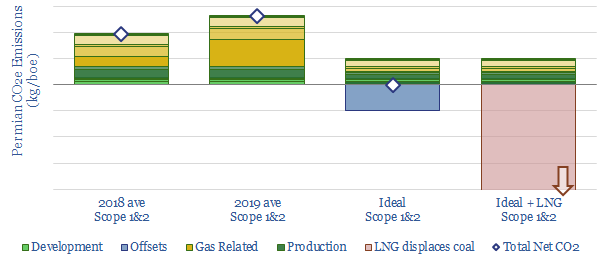
Shale growth is slowing due to fears over the energy transition, as Permian upstream CO2 emissions reached a new high this year. We have disaggregated the CO2 across 14 causes. It could be eliminated by improved technologies and operations: making Permian production carbon neutral, uplifting NPVs by c$4-7/boe, re-attracting a vast wave of capital and…
-
CO2 intensity of shale: breakdown by category?
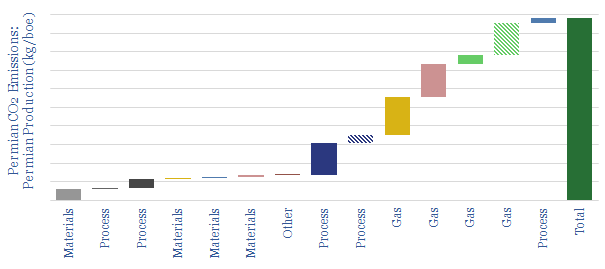
This model disaggregates the CO2 emissions of producing shale oil, across 14 different contributors: such as materials, drilling, fracturing, supply chain, lifting, processing, methane leaks and flaring. CO2 intensity can be flexed by changing the input assumptions. Our ‘idealized shale’ scenario follows in a separate tab, showing how Permian shale production could become ‘carbon neutral’.
-
Screen of companies detecting methane leaks?
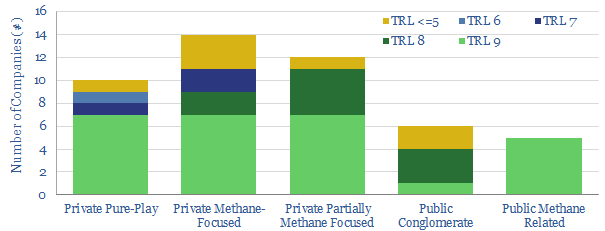
This data-file screens the methods available to monitor for methane emissions. Notes and metrics are tabulated. Emerging methods, such as drones and trucks are also scored, based on technical trials. The best drones can now detect almost all methane leaks >90% faster than traditional methods. c34 companies at the cutting edge are screened.
-
US E&Ps turn to ESG?
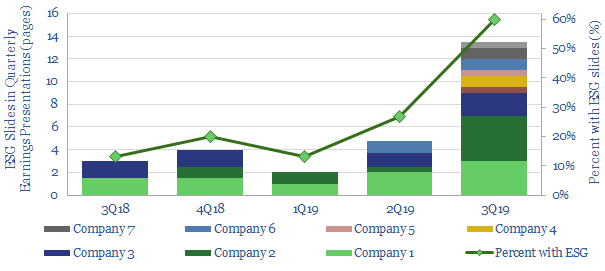
Of the largest 15 shale E&Ps, the proportion with ESG slides in their quarterly presentations has exploded by 4.5x in the trailing twelve months, from 13% in 3Q18 to 60% in 3Q19. The progress is tracked in this short data-file.
-
CO2 Intensity of Oilfield Supply Chains
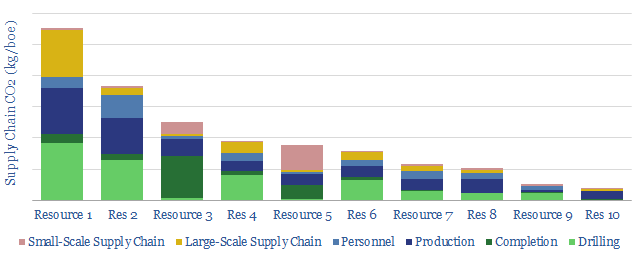
What is more CO2-intensive: the c4,000 truck trips needed to complete a shale well, or giant offshore service vessels (OSVs), which each consume >100bpd of fuel? This data-file quantifies the CO2 intensity of supply-chains, for 10 different resource types, as a function of 30 input variables.
-
Permian CO2 Emissions by Producer
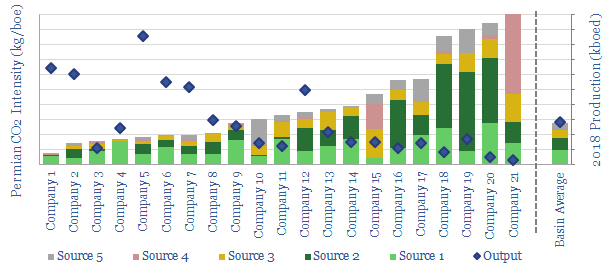
This data-file tabulates Permian CO2 intensity, based on regulatory disclosures from 20 of the leading producers to the EPA. The data are disaggregated by company, across 18 different categories, such as combustion, flaring, venting, pneumatics, storage tanks and methane leaks. There are opportunities to lower emissions.
-
Oil industry CO2 per barrel?
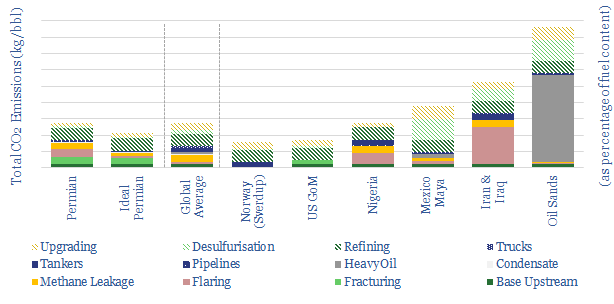
We have constructed a simple model to estimate full-cycle CO2 emissions of an oil resource, as a function of its flaring, methane leakage, gravity, sulphur content, production processes and transportation to market. A c10x energy return on energy investment is estimated. Relative advantages are seen for well-managed resources offshore and in shale; relative disadvantages are…
-
US Shale: No Country for Old Completion Designs
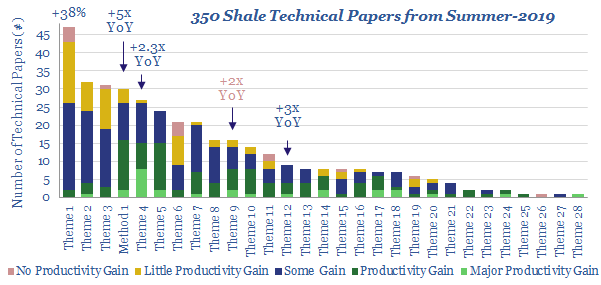
2019 has evoked resource fears in shale, after some E&Ps posted disappointing results, and implied productivity data fell 20% YoY, according to the EIA’s data. We find the data-issues are benign. They reflect changes to completion design, as a bottlenecked industry increased its use of cube development and flowback control.
-
US Shale Gas to Liquids?
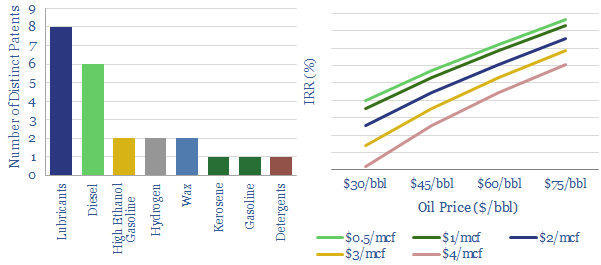
Shell filed 42 distinct new patents around GTL in 2018. This data-file reviews them, showing how the broad array of GTL products confers defensiveness and downstream portfolio benefits. Hence, we have modeled the economics of “replicating” Pearl GTL in Texas. Our base case is a 11% IRR taking in 1.6bcfd of stranded gas from the…
Content by Category
- Batteries (96)
- Biofuels (44)
- Carbon Intensity (48)
- CCS (64)
- CO2 Removals (9)
- Coal (41)
- Commentary (65)
- Company Diligence (104)
- Data Models (922)
- Decarbonization (162)
- Demand (129)
- Digital (86)
- Downstream (47)
- Economic Model (221)
- Energy Efficiency (76)
- Hydrogen (63)
- Industry Data (308)
- LNG (56)
- Materials (86)
- Metals (88)
- Midstream (45)
- Natural Gas (161)
- Nature (76)
- Nuclear (28)
- Oil (176)
- Patents (39)
- Plastics (44)
- Power Grids (156)
- Renewables (153)
- Screen (137)
- Semiconductors (35)
- Shale (58)
- Solar (72)
- Supply-Demand (53)
- Vehicles (95)
- Video (24)
- Wind (47)
- Written Research (407)