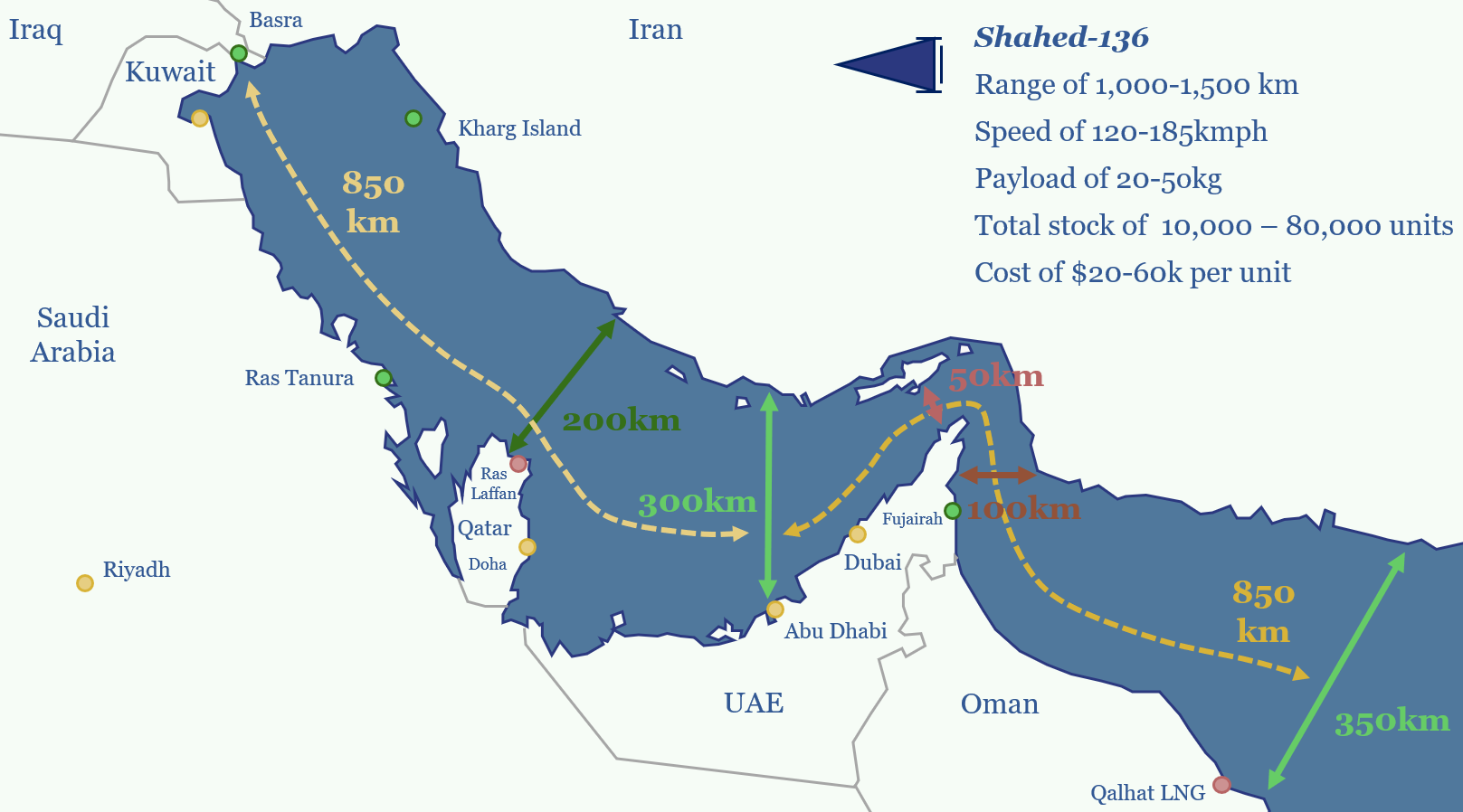
Is it possible to re-open shipping in the Strait of Hormuz, and protect broader Persian Gulf energy infrastructure from thousands of Iranian Shahed drones? Today’s 9-page report reviews Shahed drones, counter-Unmanned Aerial Systems (cUAS), and implications across global energy markets.
US and Israeli forces attacked Iran on the 28th of February 2026, killing Iran’s Supreme Leader Ali Khamenei, and initiating a new conflict in the Middle East. This has disrupted regional energy infrastructure and the infamous Strait of Hormuz. Key numbers are on page 2.
Ras Laffan makes for a crucial case study, one of the most important industrial assets in the world, extracting gas from the 9,700km2 and 1,260 TCF North Field, impacting LNG markets in 2026 and beyond. Nut also, the 6.5bcf pa global helium market is vital to the AI value chain, as an inert cooling gas for making semiconductors (14%) and fiber-optics. Numbers on page 3.
Iran may have calculated that it can break the resolve of its assailants by blockading the Strait of Hormuz, or possibly induce other countries globally to break ties with the US, in return for “passporting” their cargoes through the Strait of Hormuz, as discussed on page 4.
So can Iran blockade the Straits for months-years? And can the US unblockade the Straits? To answer this question, we have revisited last year’s review of drones, and assessed the performance of recent counter-Unmanned Aerial Systems (c-UAS) technologies, especially in combating Shahed drones, on pages 5-8.
Learnings and leading companies are noted along the way, including in high-grade radars, inertial navigation, and other counter-drone technologies. This informs our conclusions over the likely trajectory of the conflict, and implications for global energy and the world, on page 9.