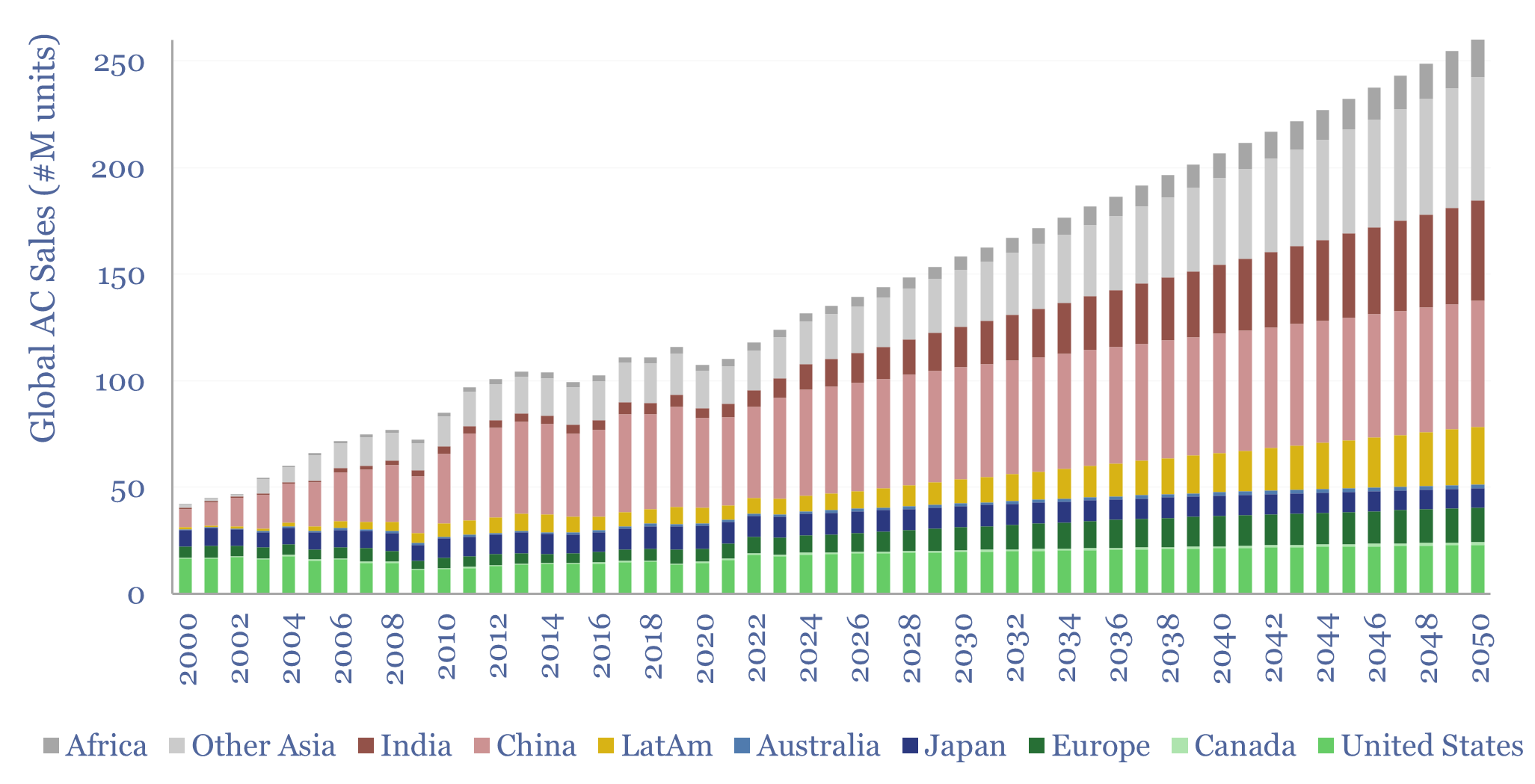
Global air conditioning consumed 2,600 TWH of electricity in 2024, which is 8% of total global electricity demand, and is seen rising +3% pa to 6,000 TWH by 2050. This data-file quantifies global AC sales by country, the global AC unit stock by country, and global AC electricity demand by country, to 2050.
Global air conditioning sales reached 132M units, rising at a 10-year CAGR of +2.4% pa, according to excellent data, published by The Japan Refrigeration and Air Conditioning Industry Association (JRAIA), which we have consulted in our analysis. The largest market is now China.
In 2024, there were 0.26 Air Conditioning Units in use per global person. Hot developed countries such as the US and Japan have 1.2 and 1.5 AC units per capita. Cool developed regions such as Europe and Canada have 0.2 and 0.3 units per capita.
However, less developed regions such as India and Africa have just 0.04 and 0.03 AC units in use per capita, despite having 2-4x more cooling-degree days than the US. Similarly, LatAm has 10x more cooling-degree days than Europe, yet one-half of the AC unit stock. These numbers point to demand growth.

Our forecasts for global AC unit sales are driven by a multi-variate regression between GDP per capita and cooling degree days in each region, which determine the demand for air conditioning. Global AC sales will double by 2050 and the global stock of AC units will rise by 2.5x to reach 5bn units.

We then multiply by the annual electricity consumption per AC unit, which is informed by granular data into US electricity by category and our own bottom-up analysis of AC electricity per household. The total model runs to 100 lines. We have also written a history of Air Conditioning and stress-tested demand sensitivity.

Hence over 90% of the increase in global AC energy demand by 2050 is seen coming from the emerging world, especially India (30%), Other Asia (25%), China (20%), LatAm (10%) and Africa (7%).
Global electricity demand for air conditioning rises at +3% pa to 6,000 TWH by 2050. This informs our outlook for global electricity demand. AC units also use copper, aluminium and Rare Earth magnets, as part of our metals demand forecasts.