Industrial heat consumes over 10% of all global primary energy. This data-file is a summary of processes that use industrial heat, the specific heating technologies, temperatures, residence times, reactor designs, energy intensity (in kWh/ton) and efficiency, ranging across 20 process technologies and heating technology types.
Industrial heat consumes over 10% of all global primary energy in our breakdowns of global energy demand, especially for blast furnaces, cement kilns, hydrogen production via steam-methane reforming, and 20 other processes tabulated in this data-file.
Different industrial processes use heat in very different ways and for very good reasons. For example, for cement-making, lime (CaO) is “sticky” and prone to agglomerating. Hence, pulverized coal/coke is burned in direct contact with pulverized limestone, in a well-mixed rotary kiln, that is thus very hard to electrify.
Conversely, for cracking in the petrochemical industry ethane or naphtha is super-heated to 600-900°C, but then very rapidly “quenched” after <1-second, to prevent unwanted side reactions. And you still end up with inseparable “tail gases” in the plant, which are thus economical to combust as a heat source. It does not make economic sense to electrify heat that is fed by tail gases.
For mono-crystalline polysilicon, at the other end of the spectrum, pure silicon crystals are grown very slowly, at 25mm per hour, via the Czochralski method; in a quartz crucible, heated uniformly by inducing eddy currents in a surrounding graphite susceptor, using water-cooled copper coils. This process is also electric, as it is the best way to generate very uniform heat.
This data-file covers 20 processes that use industrial heat, explaining precisely how they use heat, why they use the heating source that they do, alongside reaction temperatures, residence times, reaction vessel sizes, and heating intensity factors (kWh/ton of product).

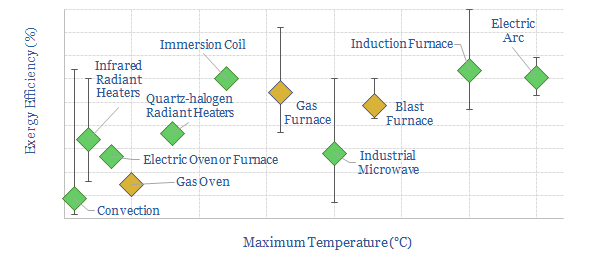
The file also covers convection heating, infrared radiant heat, immersion coils, electric ovens and furnaces, industrial microwaves and di-electric heating, induction and electric-arc. In each case, we summarize the technology, typical temperature ranges, efficiencies, exergy, advantages and disadvantages.
Generally process heat is 90% efficient at converting incoming energy to heat and c40% efficient in achieving useful exergetic output from the heat. But the range is very broad, from 10-90% depending on the system.
Many electric heating technologies can also undertake demand shifting, in order to help backstop increasingly renewable-heavy grids. But it is not always possible to electrify process heat directly.