Leading companies in transformer monitoring, and broader substation monitoring around the T&D network, are screened in this data-file. Real-time sensors and AI may reduce unplanned outages and repair costs by 30-60%, while most optimistically, high-quality monitoring can help flow 15% more power through existing infrastructure.
Transformers are deployed around power grids to step-up voltage for long-distance transmission, or step-down voltage for smaller-scale distribution, and as covered in our transformer research.
Excitingly, we are now seeing AI help to unlock dynamic line ratings, which can typically uprate pre-existing T&D lines to carry 35% more power. If the lines can carry 35% more power, this may simply shift the bottlenecks to electrical substations, and thus could it motivate more transformer upgrades, and also more transformer monitoring?
The challenge with flowing more power through pre-existing transformers is that this may compromise the integrity of the dielectric and insulation, causing partial discharging and arcing inside the tank, which in turn further accelerates degradation, including for the cellulose insulators around transformer windings.
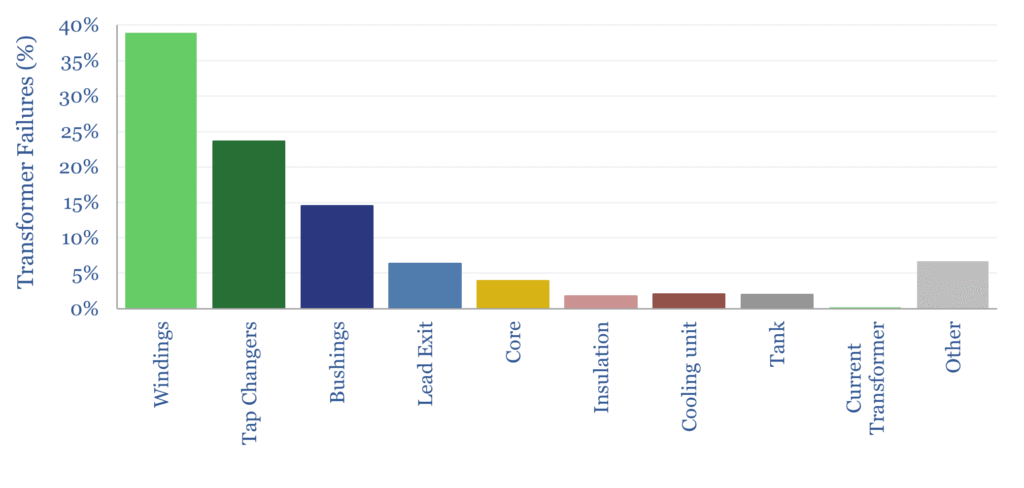
Moreover transformers have historically not been well instrumented or well monitored. Perhaps once or twice per year, a small sample of insulating oil is gathered and chemically tested for signs of degradation. Specifically, partial discharging will tend to degrade the insulating oil in the transformer, thereby evolving hydrogen, methane, ethane, ethylene and acetylene.
The first wave of solutions for improved transformer monitoring has involved in situ devices for dissolved gas analysis, especially based around chromatograms. Even these sensors only took a reading every 1-4 hours. And they required maintenance/calibration, and were prone to false positives.
Companies in transformer monitoring are increasingly developing solutions for real-time monitoring of transformers, gathering large quantities of data (sometimes Dissolved Gas Analysis via infrared sensing, sometimes temperature, vibration and other markets of electrical stress, especially via fiber optics). In turn, these data can often be interpreted by algorithms, and most recently, AI.
Advantages that are cited include greater visibility, the ability to diagnose specific faults, 30-60% fewer unplanned outages, 65% fewer safety incidents, c15% increases in lifespan, 30-50% reduced repair costs and 15% reduced cooling costs. One company cites an 18-24 month payback period for deploying its sensors. In one case, the data appears to allow for c15% additional throughput at pre-existing transformer stations. These numbers are drawn from case studies in our data-file.
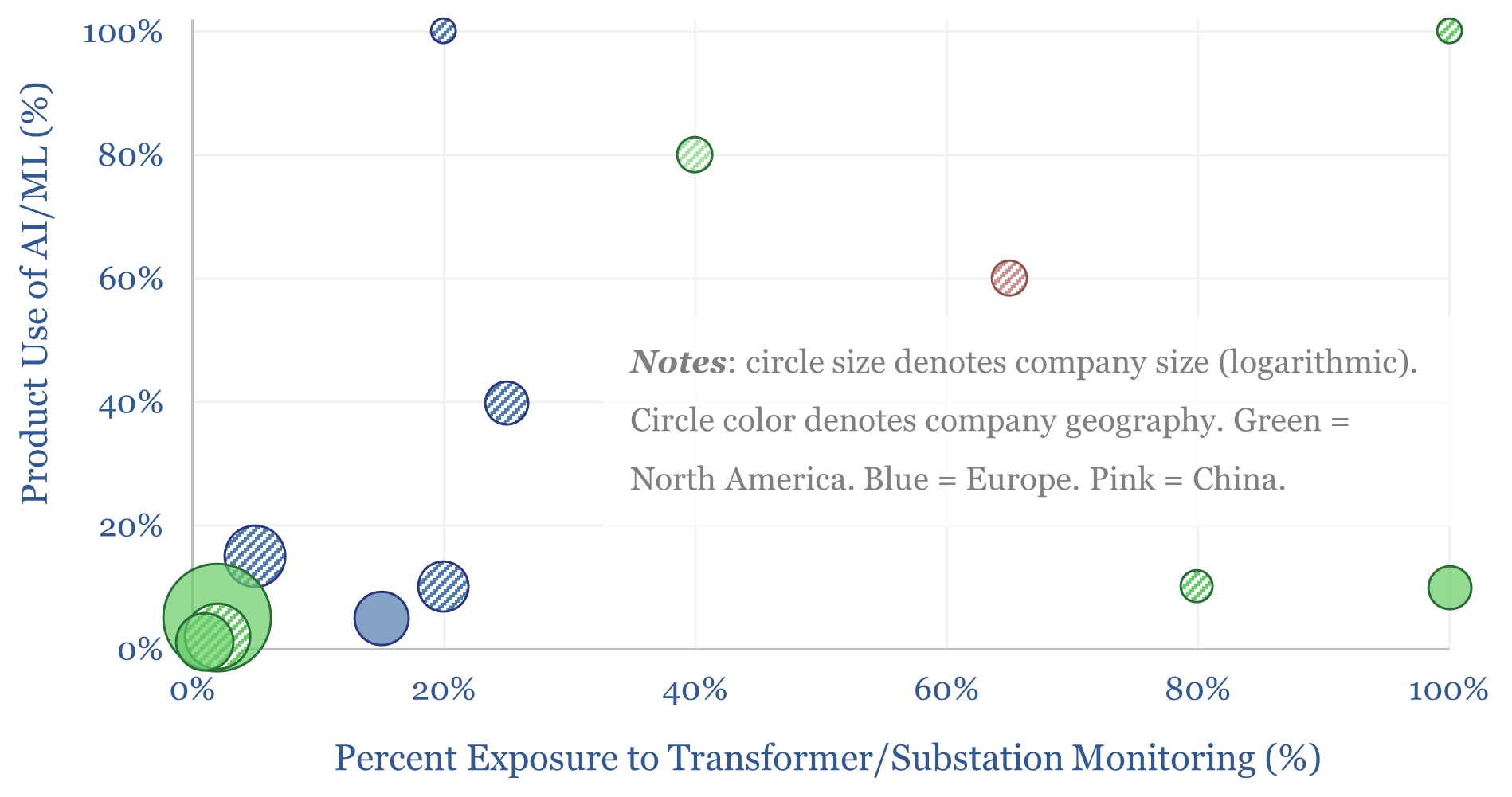
A sample of a dozen leading companies in transformer monitoring are screened in this data-file, plotting their size, product offering, concentration to the theme of transformer monitoring and relevancy of AI to their product offering. Companies range from large-cap power electronics giants such as GE Vernova to early-stage AI start-ups. Two relatively concentrated public companies also stood out.