The carrying capacity of the power grid is not fixed, but varies with wind speeds and ambient temperatures. AI is now helping to enable Dynamic Line Ratings, unlocking 10-100%+ more capacity on some lines, effectively for free. This 18-page report explores the implications. Could DLRs avoid $100-300bn pa in future global grid capex, and thus debottleneck the rise of AI itself?
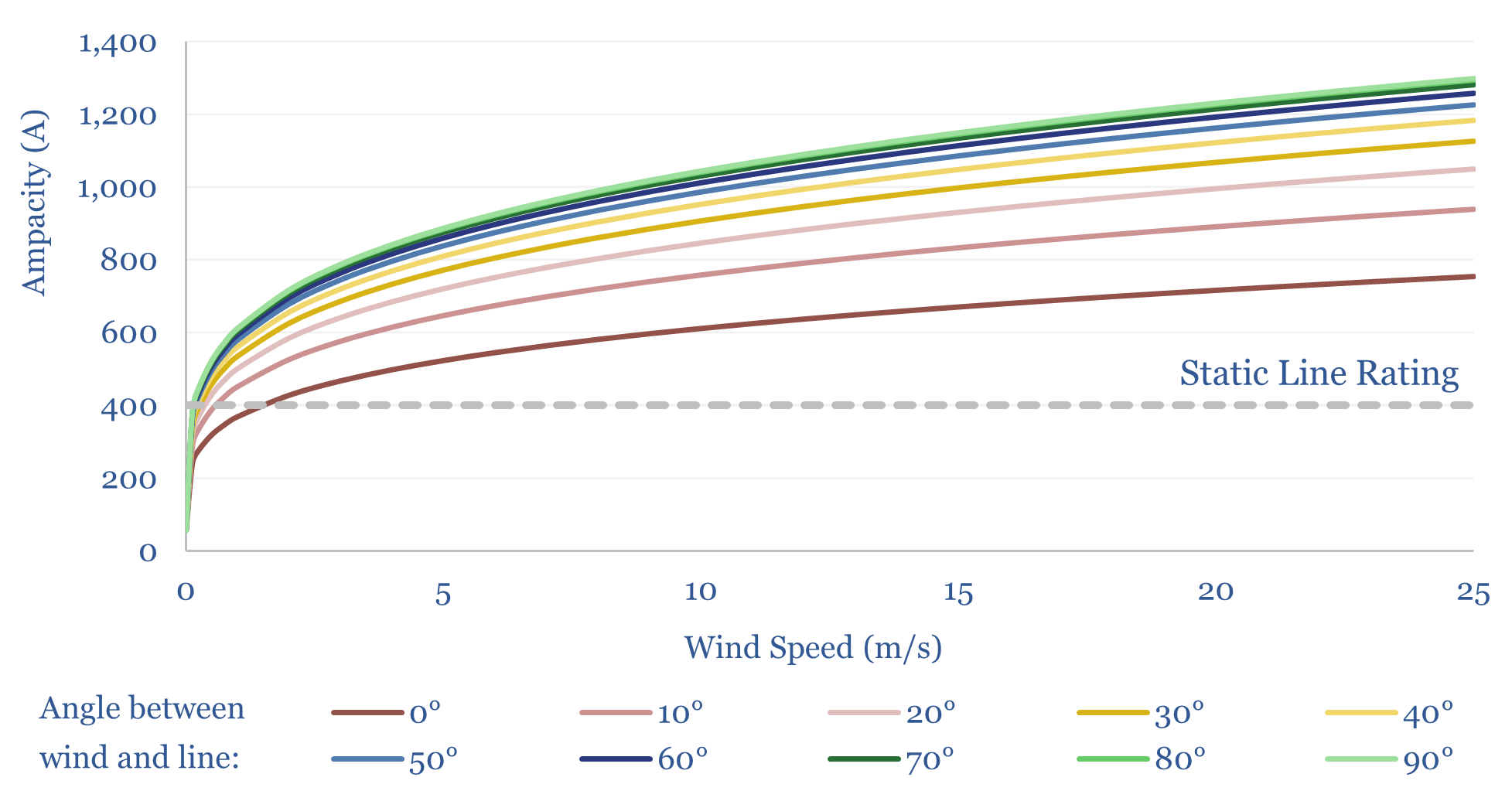
What are Dynamic Line Ratings (DLRs) and how do they work? In short, the carrying capacity of a power line depends on wind speeds and temperatures, which if known, can be used to unlock more carrying capacity on pre-existing power lines. Power transmission and distribution line ratings are explained from first principles on pages 2-3 of this report.
Dynamic Line Ratings present an amazing opportunity for grids, because they can unlock at least 10% more capacity, at least 90% of the time, and an average of 34% more capacity, while avoiding the very long lead times and costs of building new transmission lines. And this is now being increasingly enabled by AI.
The relative economics of sensor-based DLR versus reconductoring and new transmission line construction is already transformational, as discussed on pages 4-6.
Even lower cost is sensorless DLR, which does not require any new hardware at all, but pure AI algorithms. Sensorless DLR has other operational advantages, which are discussed on pages 7-9.
The key challenge with DLR is how it deals with system peaks, as outlined on page 10. So while we do see DLR transforming power grids in the AI era, it will do so in combination with other technologies.
What capex implications? Our outlook sees lower overall grid capex, especially for transmission lines, secondarily for grid-scale batteries and integrating renewables, especially wind. Conversely, some substation/power electronics capex could be accelerated, including for some quite niche categories. This is all discussed on pages 11-15.
Specific case studies, product details and overall market positioning of leading companies deploying DLRs are discussed on pages 16-18, ranging from earlier-stage start-ups to large-cap industrial conglomerates.