
Power electronic devices are used to transform and control the flow of electricity, especially at large, commercial and industrial scale. Different types of power electronic equipment, their costs are described in this data-file. We see a $600bn capital goods market accelerating to an 8% CAGR and reaching $1trn pa by 2030, amidst electrification, energy transition and the rise of AI.
The market for power electronic capital goods is estimated at $600bn pa in 2024, in this data-file, growing at 8% pa, to reach $1trn pa by 2030.
These estimates are based on reviewing over 30 categories separately, with a gross market value of $1.5 trn pa, and stripping out the double-counting, smaller-scale/retail use of power electronic components, and some edge categories (e.g., data servers, electric motors).
The need for these devices is for stepping voltage up and down (transformers), re-shaping AC waveforms (inverters, converters) and filtering out distortions (transients, harmonics). All of these challenges are amplified by electrification, solar, wind, batteries, heat pumps and the rise of AI.
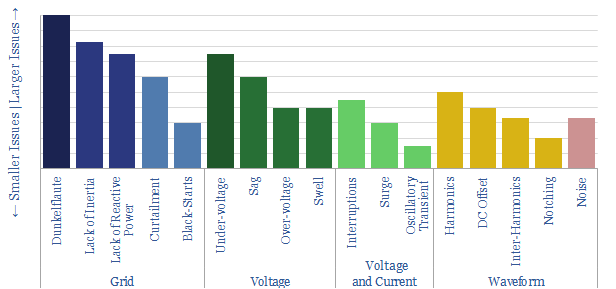
Our main question mark over these numbers is over the trajectory of pricing. There are ten power electronic capital goods categories where the 2024 market size has fallen short of our expectations from 2021, by a median average of -13.5%. For inverters and some DC/DC converters, the shortfall is -50%. Large volume growth coincided with, or perhaps was driven by, price deflation.
The costs of power electronic components are therefore tracked in another tab of the data-file, ranging from $10/kVA for simple devices through to $200-500/kVA for more active power electronic equipment, and around $1,000/kW for energy storage such as grid-scale batteries.

Categories of equipment covered in the data-file include switchgear, variable frequency drives, inverters, batteries, meters, logic controllers, harmonic filters, sensors, surge arresters, EV charging, capacitor banks, STATCOMs, other voltage regulators, synchronous condensers, and other categories that matter in commercial and industrial power.
As a more detailed case study, there is an entire tab devoted to the costs of circuit breakers, showing an average cost of $20/kW, wide variation in costs depending on specs, but generally costs (in $/kW) decline for larger units.
Power electronics is a complex topic. To help decision-makers save time and quickly gain a good understanding, we have published a primer into energy, a primer into electricity, a primer into power quality, and an overview of renewables volatility.