
This data-file is a screen of leading LiDAR companies. Ten LiDAR companies have 85% share of this market, which was worth $1.7bn in 2024, and will support ADAS/autonomous vehicles, robotics and next-generation mining technologies. Pricing and profitability are compared for Chinese and US suppliers.
The global LiDAR market increased from $300M in 2020 to $1.6bn in 2024, according to Hesai. Although other market forecasting studies range from $2-3bn pa, our own company screening suggests a LiDAR market size closer to $1.7bn pa, of which 85% is concentrated among the top ten companies.
But the key surprise was the intensity of price competition. LiDAR deflation has been staggering, with costs per unit falling by 99% over the past decade to just $500 per sensor today, narrowing the price gap with CMOS-based cameras to only around 10x.
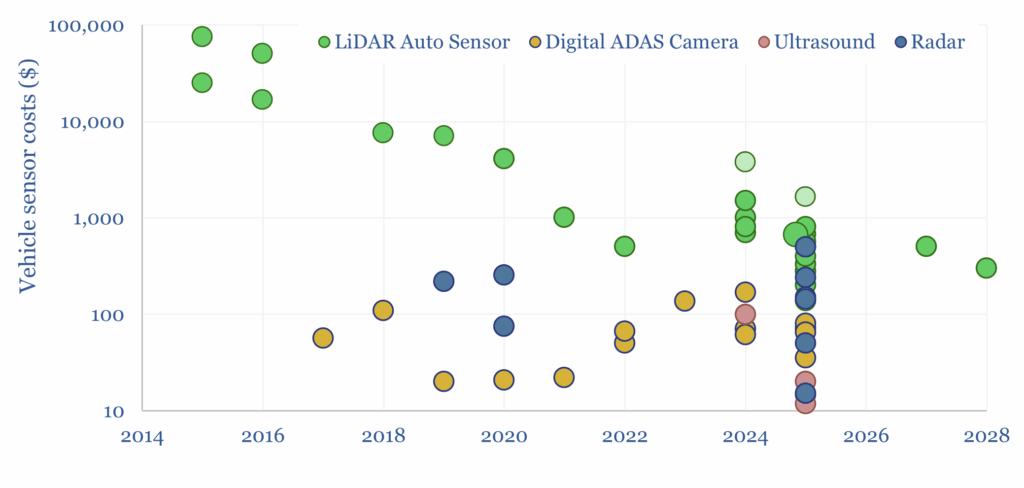
Deflation has challenged profitability. Especially as four large Chinese LiDAR companies have scaled up output. Thus every single company in our screen was loss-making at the EBIT level, and some companies are even loss-making at the gross margin level.
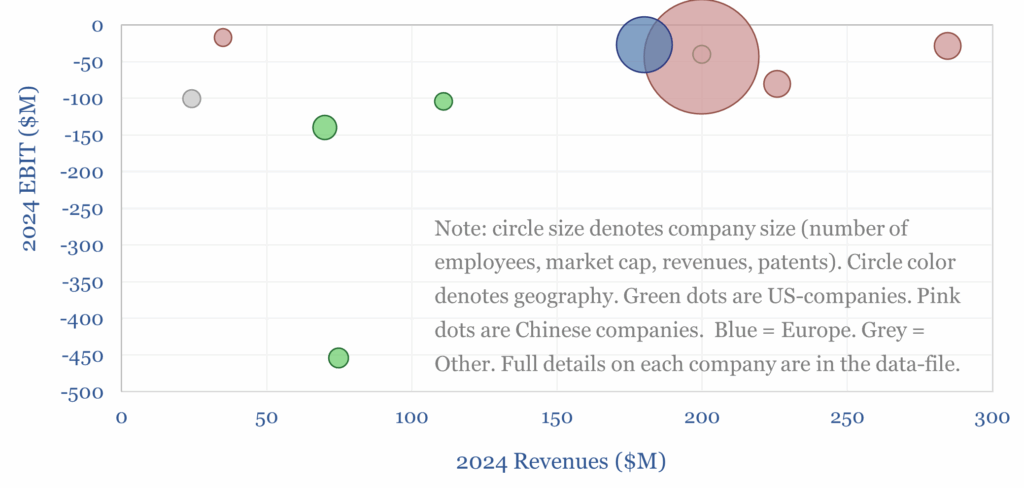
The data-file contains an overview of each company, its size, geographic footprints, revenues, EBIT margins, key product highlights and corporate highlights.
The costs of LiDAR products, ADAS cameras, radar units and ultrasound sensors are also tabulated on a backup tab, in terms of $ per sensor, and power consumption per sensor.
The power consumption of LiDAR units is also quantified. While a LiDAR unit might use 10x more power than a camera, the key source of power consumption in autonomous vehicles and robotics is in computing, which is 100-1,000x higher. And it is an order-of-magnitude simpler to compute locations and distances of objects via LiDAR than via machine vision.
Hence our recent 17-page report concludes that LiDAR will find a use in more autonomous vehicles, robotics and next-generation mining concepts, due to improved performance and allowing for simpler overall perception algorithms. High-quality hardware underpins the rise of AI, and does not all get eroded by gains in software.