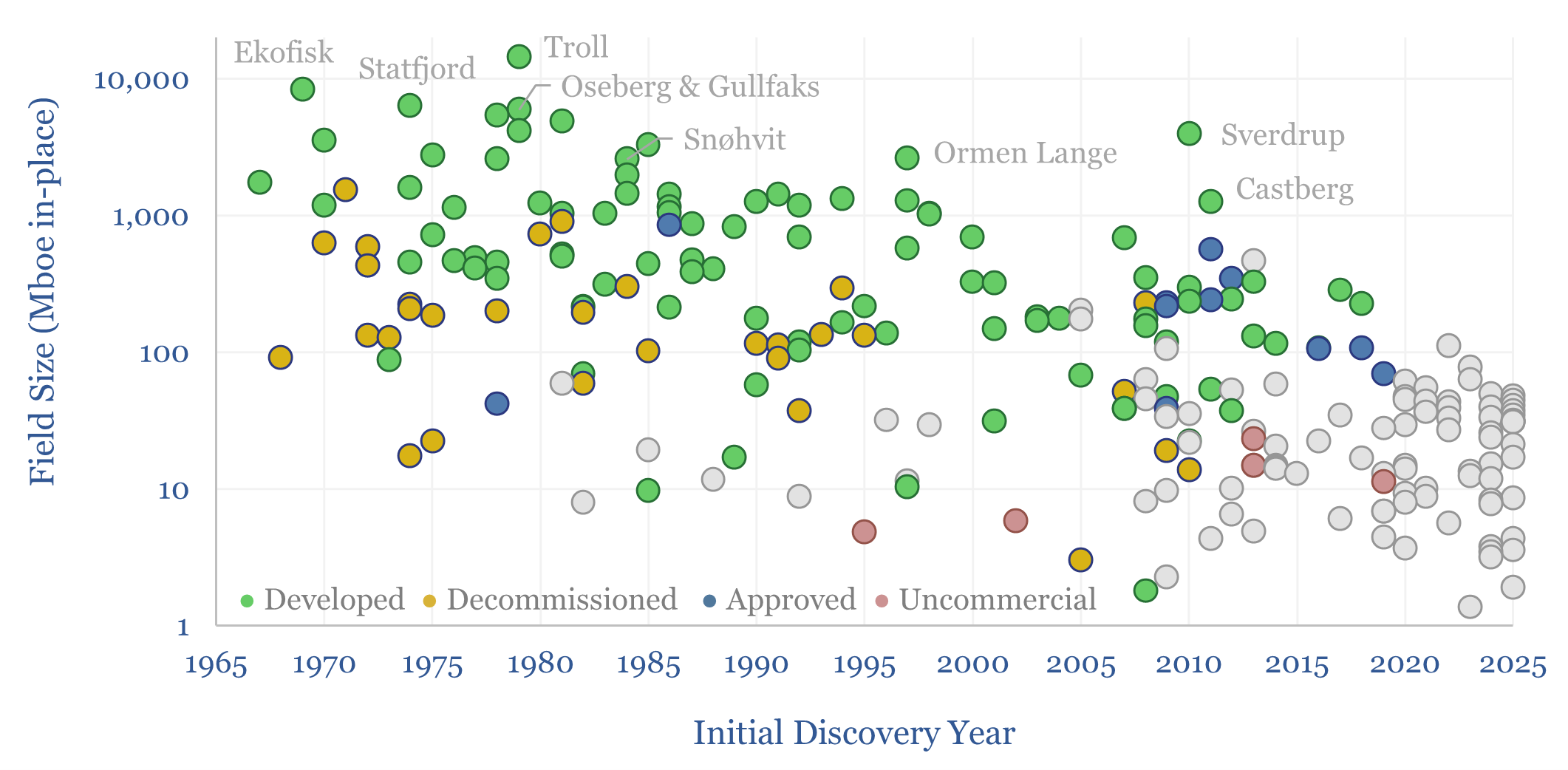
There is an ocean of oil (and gas) still to find, even in some of the most mature hydrocarbon basins in the world, but finding it will almost certainly require improved seismic, possibly enhanced by AI, as shown by this case study, tracking the sizes of oil resources, discovered off Norway, from 1969 to present.
Norway found its first oilfield, Balder, in 1969 and produced its first oil from Ekofisk, in 1971. It has since produced 54bn boe of oil and gas, has 13bn boe of reserves, 6bn boe of contingent resources. Yet an estimated 21bn boe (90% confidence interval = 11-36bn boe) remains undiscovered.
But do we believe this undiscovered resource estimate? Especially when the mean discovery size off Norway has been getting 5% pa smaller? (title chart above).
Statistically we might be tempted to rank all of the discovered fields by size (green line below), observing that the distribution is perfectly lognormal. Our fitted mean and standard deviations are in the data-file.
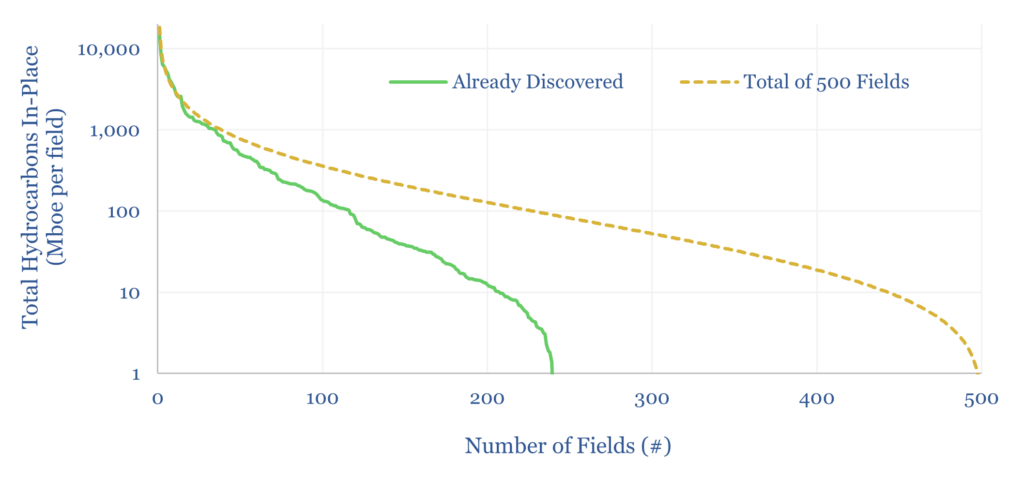
If we assume c500 fields are out there to find, off Norway, with the same lognormal parameters as the green line, there would be 60bn boe undiscovered (!). But this is much too high as most of the ‘big bumps’ have already been drilled.
Let us smooth the parameters of our lognormal distribution, to assume all of the fields with >3bn boe in-place have already been discovered, and 90% of the >1bn boe fields have too. Now we are left with the yellow line, which says that 54bn of hydrocarbons in-place, or 25bn boe on a recoverable basis, still remains undiscovered, across 250 undiscovered fields.
Of these 250 undiscovered fields, our statistical distribution suggests that 3 have >1bn boe in-place, 80% are <300Mboe, 60% are <100Mboe and 40% are <65Mboe in-place. A sizeable prize thus remains for ongoing exploration in mature basins.
Improved seismic is needed to unlock these discoveries, and we think this is borne out by the ‘anomalously large’ 2011 discovery of Johan Sverdrup, with 4bn boe in place. We have picked a cross-section through this reservoir off of well logs in the chart below.
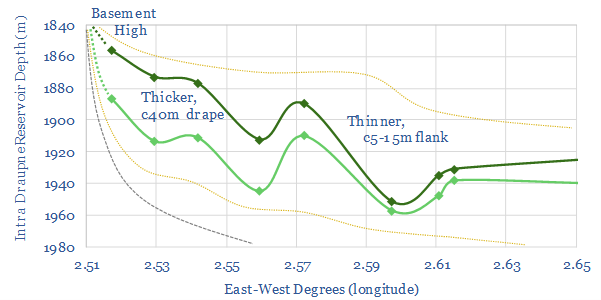
Sverdrup is not like Ekofisk with a 300m thick anticline. Indeed, the flanks of Sverdrup are just 5-15m thick. This giant field was not found on seismic, but by accident, when Equinor and Lundin, respectively, noticed that their two separate exploration wells in separate blocks around the Utsira High — at Aldous Major South and Avaldsnes — happened to be in pressure communication.
Enhanced seismic, supplemented by AI, could reveal thin reservoir facies that have been overlooked as blurriness in earlier seismic studies. So we can believe that even Norway has over 20bn boe, or 30% more resource still to find. Greater visibility will unlock value across E&P and Services. Underlying data for our Norwegian resource tracker files comes from the Norwegian Offshore Directorate.