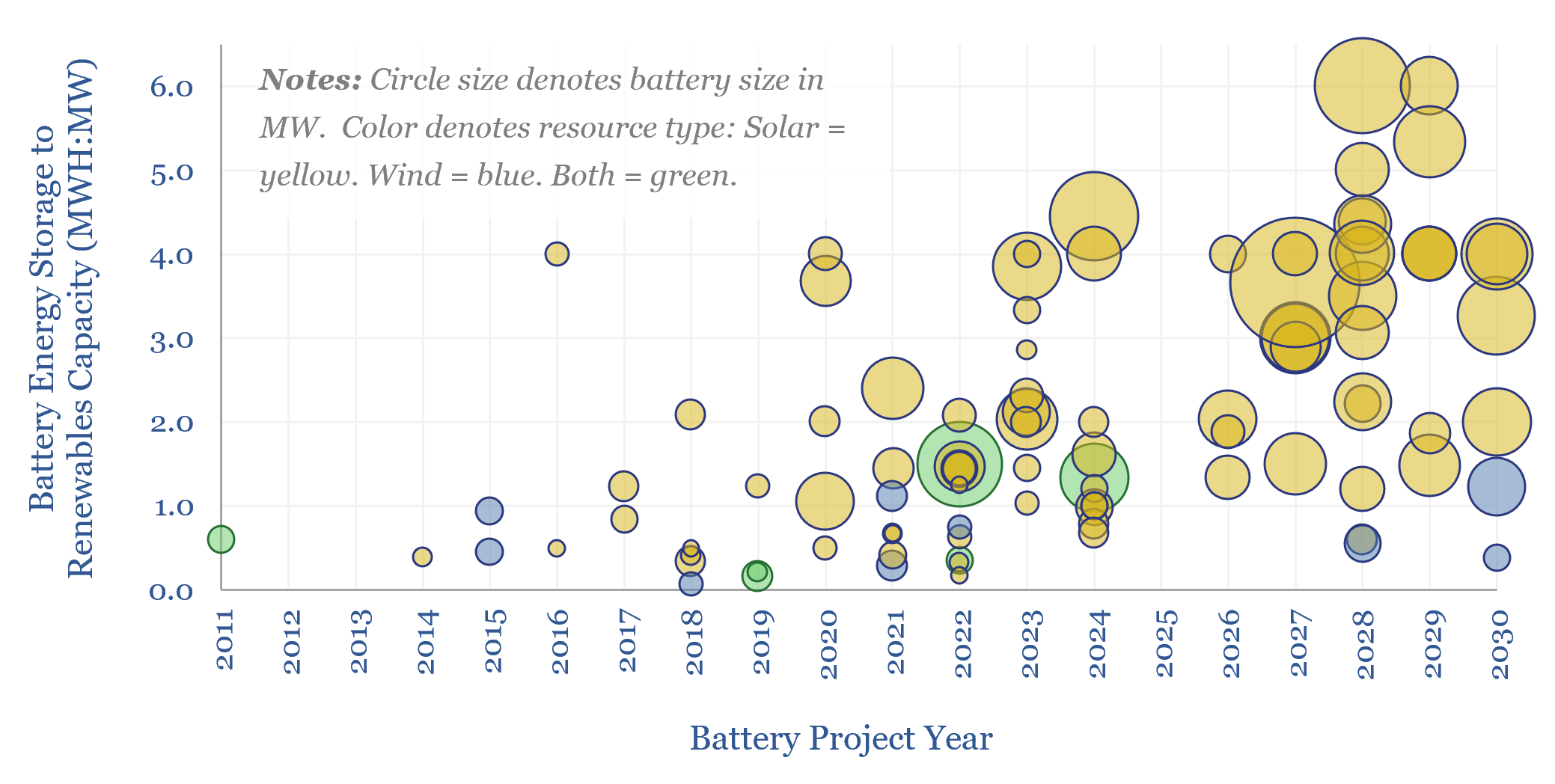
More and more renewables projects are being co-developed with battery storage. On average, projects in 2026-30 that co-deploy batteries will supplement each MW of renewables capacity with 0.8MW of battery capacity, which in turn offered 4-hours of energy storage per MW of battery capacity, for 3.3 MWH of energy storage per MW of renewables.
Co-deployments of renewables and batteries are tracked in this data-file, tabulating the details of over 100 projects that combined a grid-scale battery with their construction of wind and/or solar assets. The average of these projects in 2022-24 added 0.5MW of battery capacity per MW of renewables, with 3.5 hours of energy storage, for 1.7 MWH of energy storage per MW of renewables.
These numbers have quadrupled versus a decade ago when the co-development of renewables plus batteries was a rarity, and tended to occur at smaller scale. And the numbers have doubled since 2022-24. This suggests that rising interconnection costs and risks of curtailment are motivating greater deployment of batteries.
For example, the largest batteries we can find from pre-2017 are c30-50MW in size, and many of the technical papers over this timeframe are consciously considering different battery chemistries — lead-acid, sodium-sulphide — rather than today’s projects that are predominantly LFP lithium ion.
Conversely, the largest batteries being built for 2026-30 are GW-scale. The world’s largest integrated solar+storage project is being built in Abu Dhabi, with 19GWH of capacity. At the Almholme Energy Hub in the UK, a 50MW solar project is being co-developed with a 1GW/2GWH battery, which in theory offers 41-hours of storage.
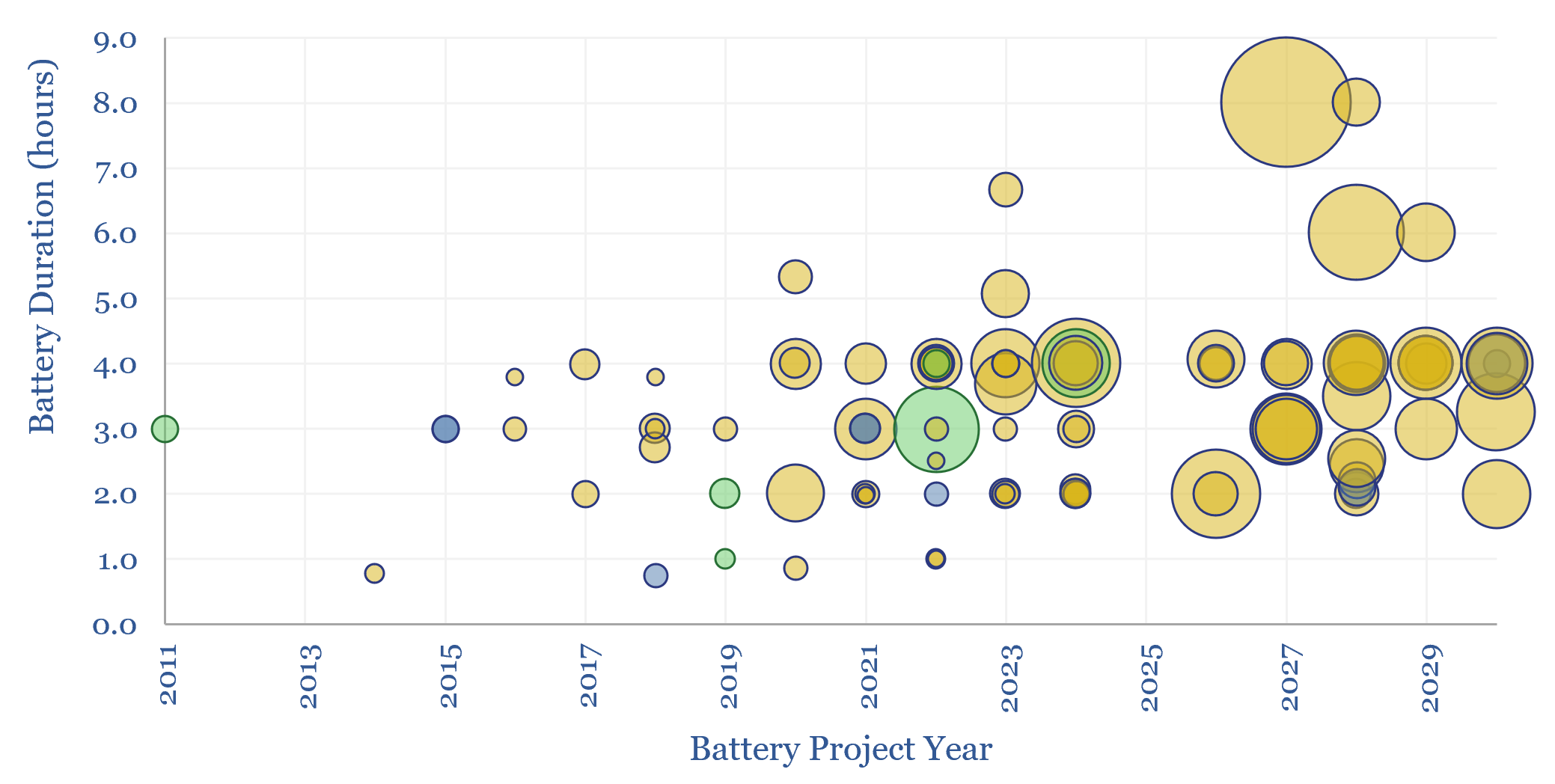
The duration of these grid-scale batteries has also increased from 2.6 hours prior to 2020 to 3.5 hours in 2022-25 and 4.1 hours in 2026-30, with the upper decile projects having over 6-hours of storage (chart below).
It is fine to co-develop renewables with batteries, but it is also more costly. A utility-scale solar project might cost $1,000/kW. A grid-scale battery might cost $1,500/kW. Hence combining 0.5MW of batteries per MW of solar might cost $1,750/kW in total, re-inflating levelized costs of solar by around 50-75%, but still possibly less costly than funding network upgrades.
Our long-term forecasts for power grid capex assume that 0.2MW of grid-scale batteries will be deployed per MW of renewables capacity, comprising a mixture of standalone renewables projects and renewables projects that are co-developed with batteries. And there could be upside?
We also find many data-centers are now co-deploying c5-hours of batteries, for faster interconnects. 20 case studies of co-deploying batteries at data centers are tracked in the second tab of the model.
Our other data-files covering the rise of BESS also include leading battery integrators, a cost breakdown for BESS and projections for future battery demand by application.