
This data-file captures helicopter economics. For an Airbus SuperPuma, which can carry c20 passengers, helicopter costs are estimated at $4,000/hour and $30/mile, for a c10% IRR on c$30M of capex costs. Economics can be stress-tested for different helicopter models and operating assumptions.
Helicopters achieve lift via large rotating blades, rather than fixed wings, which allows for vertical landings in confined spaces, but materially higher energy consumption, ranging from 10-30 passenger-miles per gallon, whereas a large jet plane can achieve 80-90 passenger-miles per gallon.
Hence as rough estimate might be that the world’s fleet of 70,000 active helicopters is consuming around 500kbpd of jet fuel, in addition to the consumption from planes and jet aircraft.
Capex costs for helicopters and jet planes are more comparable, ranging from $0.4-1.3M per passenger. Economics of fixed-wing aviation can be stress-tested in our passenger jet economic model.
However this data-file captures the economics of helicopter transport, with a breakdown of helicopter costs, both per hour (in $/hour) and per mile ($/mile), as shown in the charts above for a SuperPuma.
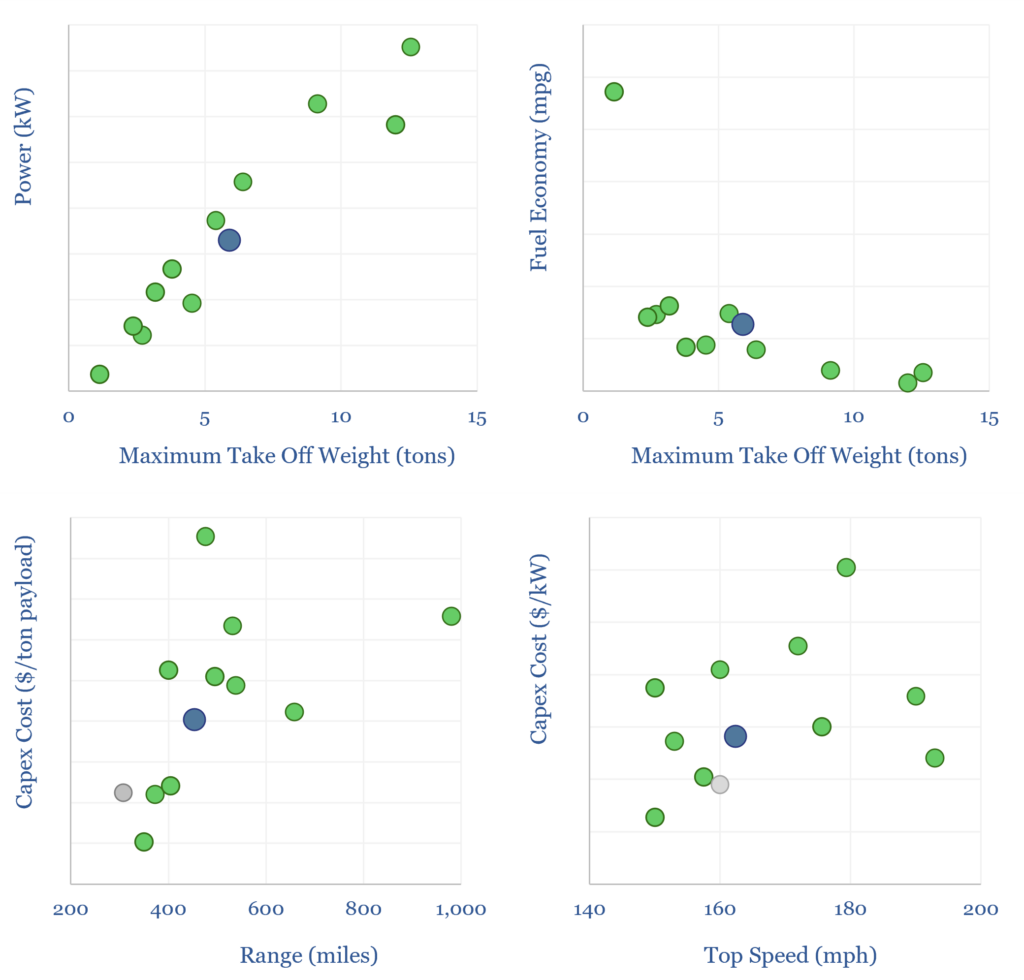
Helicopter costs depend on the precise model, and its operating parameters, which are compared in a back-up tab for a model, cross-plotting capex (in $M), power (in kW), range (in miles/kilometers) and maximum take-off weight (in tons).
As an example, the smaller Bell 407 helicopter, with capacity for 7 passengers, might cost closer to $1,000/hour to run, or about one-quarter the cost of our base case estimates for the SuperPuma.
Helicopter operating costs also depend on capex costs, utilization rates, fuel cost, crew costs, airport charges, maintenance, insurance and CO2 taxes (if applicable). All of these can be stress-tested in the model.
As AI emerges, opening up robotic inspections and more de-manned offshore facilities, it is interesting to think that saving $20-40k per year can unlock 10-20% returns on deploying $200-400k in robotics.