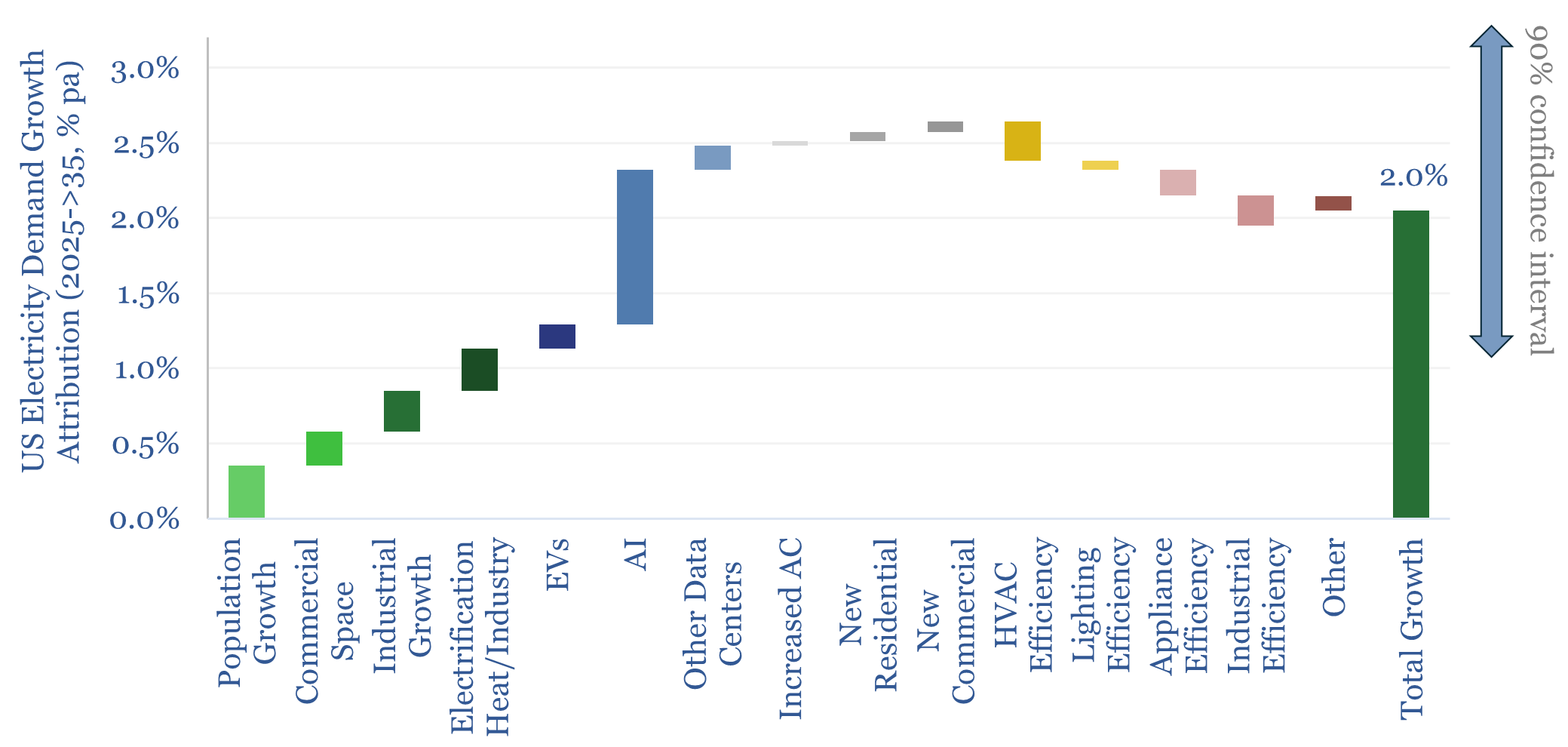
US electricity demand growth is a crucial debate. It affects everything. To bound the uncertainty, we assessed twenty input variables, and ran a Monte Carlo, in this 16-page report. Our new base case sees +2.0% pa demand growth to 2035. Our 90% confidence interval is 1-3% pa. What implications for gas and power?
US electricity demand growth seems like a crucial debate in 2026, as it affects everything, from the prospects of IPPs, to gas turbines, to grid expansion capex, broader US energy markets, and the ability to deliver the benefits of AI.
Hence our goal in this note is to break down US electricity demand growth across 20 variables, fit a range of plausible bounds onto each variable, and then run a Monte Carlo simulation, to derive a confidence interval for US electricity demand growth.
US net electricity generation, as reported by the EIA, rose by +3% pa in 2025, but paradoxically gas generation declined by -3% YoY. The latest numbers and controversies are reviewed on pages 2-4.
Our updated base case forecasts for US electricity demand are set out and explained, across residential, commercial, industrial, AI and transportation, on page 5.
Probability distributions for the twenty variables that impact US electricity demand growth are then discussed in turn — everything from AI data centers to EVs to new robotics — including the key conclusions from across our research, on pages 6-11.
Our 90% confidence interval sees US electricity demand growing at 1.0% pa to 3.4% pa over the next decade from 2025 to 2035. In other words, there is likely less than 10% chance of demand growth exceeding 3% pa over the next decade?
Could US electricity demand actually decline? Our Monte Carlo model assumes all variables are independent. But we have also seen increasing evidence for AI unlocking huge, non-linear efficiency gains, which could impact multiple variables simultaneously. So perhaps there is a 5-10% risk, not captured in our models, that demand in 2035 is lower than today, per page 13.
Implications are spelled out for power markets in 2026, medium-term gas demand, and medium-term gas-fired power generation, on pages 14-16.