-
What oil price is best for energy transition?
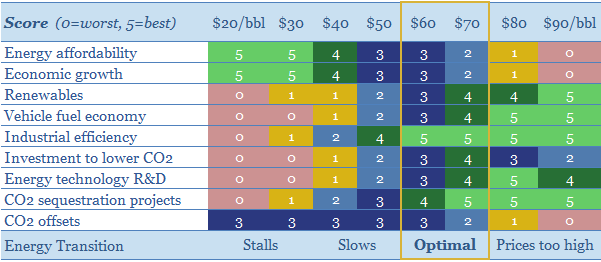
It is possible to decarbonize all of global energy by 2050. But $30/bbl oil prices would stall this energy transition, killing the relative economics of electric vehicles, renewables, industrial efficiency, flaring reductions, CO2 sequestration and new energy R&D. This 15-page note looks line by line through our models. We find stable, $60/bbl oil is ‘best’…
-
CO2 disposal in geologic formations: the economics?
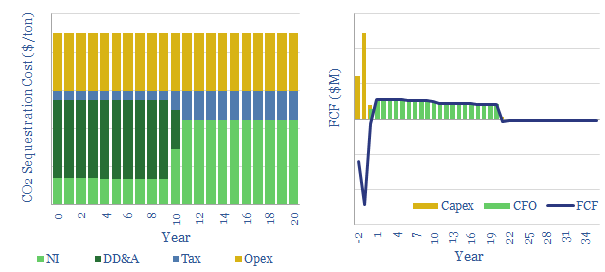
Costs of disposing of CO2 are extremely variable and project-dependent, ranging from $5-50/ton, with a base case of $22.5/ton. This is the disposal price needed to earn a 10% post-tax IRR, transporting, injecting and monitoring CO2 in the subsurface.
-
Biofuel, green diesel, renewable diesel: where’s the IP?
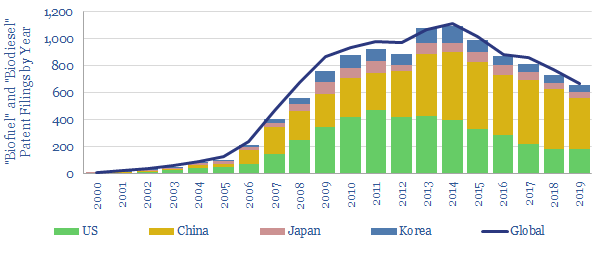
This data-file tracks 5,000 patents filed into biofuels: by geography, by company and particularly in 2017-20. The pace of research activity has been waning since 2014. Sinopec screens as the technology leader. The data-file also identifies the ‘Top Ten’ Western companies, ranked by recent patent filings.
-
Screen of Large Public Fertilizer Companies
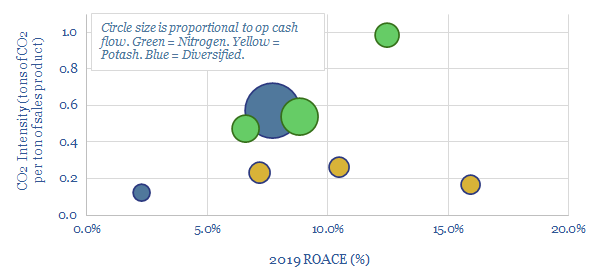
This data-file screens the large, listed fertilizer companies, comparing their CO2 intensity, ROACE, cash flow and recent patent filings. The industry could be disrupted by the rise of conservation agriculture, eroding thee 186MTpa global fertilizer market, which also comprises c1% of global emissions.
-
Turn the Plastics into Roads?
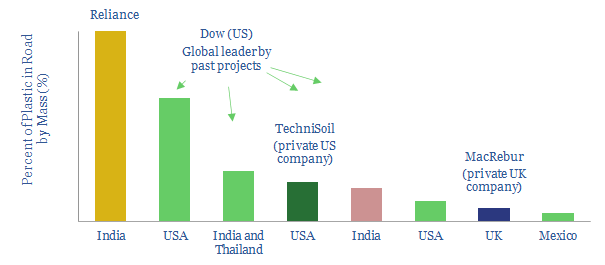
An opportunity is emerging to absorb mixed plastic waste, displacing bitumen from road asphalts. We find strong economics, with net margins of $200/ton of plastic, deflating the materials costs of roads by c4%. The challenge is scaling the opportunity beyond 20MTpa, as unrecycled waste plastics surpass 320MTpa. Leading companies include Dow (US, public) and MacRebur…
-
Upstream technology leaders: weathering the downturn?
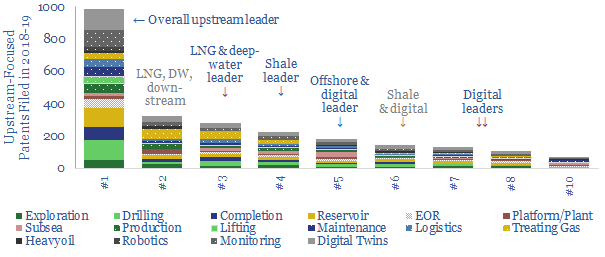
Leading technologies correlate 50-80% with ROACEs and -88% with costs in the energy industry. Hence, we assessed 6,000 patents from 2018-19, to determine which Energy Majors are best-placed to weather the downturn, benefit from dislocation and thrive in the recovery. We find clear leaders in onshore, offshore, shale, LNG and digital.
-
Qnergy: reliable remote power to mitigate methane?
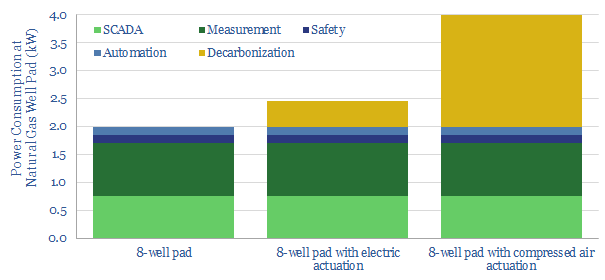
This short note profiles Qnergy, the leading manufacturer of Stirling-design engines, which generate 1-10 kW of power, in remote areas, where a grid connection is not available. The units are particularly economical for mitigating methane emissions, with a potential abatement cost of $20/ton.
-
Digitization after the crisis: who benefits and how much?
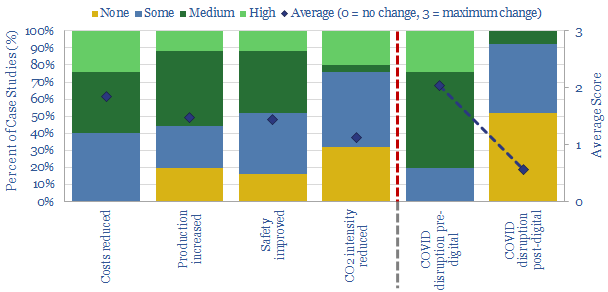
We have constructed a database of digitization case studies around the energy industry to quantify the benefits, screen the most digital operators and identify longer-term winners in the supply chain. The theme will accelerate. Just 8% of digitized industrial processes will be materially disrupted due to COVID-19, compared to 80% of non-digitized processes.
-
Fiber Optic Cables: Patents and Leading Companies?
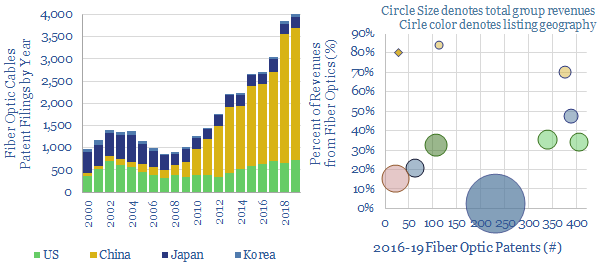
This data-file screens for the technology leaders in fiber-optic cables, which are crucial for the digitization of industries and the world’s structural shift towards remote-working, based on screening 37,000 patents. Revenues and market shares are summarized for the leaders.
-
Remote possibilities: working from home?
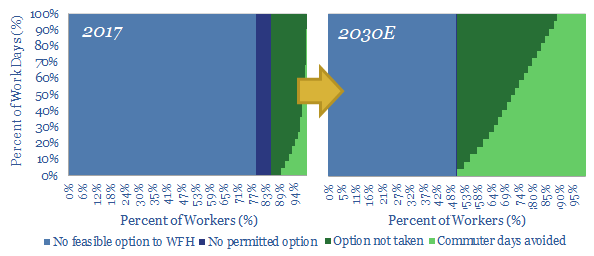
The COVID-19 crisis will structurally accelerate remote working. The opportunity can save 30% of commuter journeys by 2030, avoiding 1bn tons of CO2 per year, for a net economic benefit of $5-16k per employee. This makes remote work materially more impactful than electric vehicles.
Content by Category
- Batteries (96)
- Biofuels (44)
- Carbon Intensity (48)
- CCS (64)
- CO2 Removals (9)
- Coal (41)
- Commentary (65)
- Company Diligence (104)
- Data Models (922)
- Decarbonization (162)
- Demand (129)
- Digital (86)
- Downstream (47)
- Economic Model (221)
- Energy Efficiency (76)
- Hydrogen (63)
- Industry Data (308)
- LNG (56)
- Materials (86)
- Metals (88)
- Midstream (45)
- Natural Gas (161)
- Nature (76)
- Nuclear (28)
- Oil (176)
- Patents (39)
- Plastics (44)
- Power Grids (156)
- Renewables (153)
- Screen (137)
- Semiconductors (35)
- Shale (58)
- Solar (72)
- Supply-Demand (53)
- Vehicles (95)
- Video (24)
- Wind (47)
- Written Research (407)