-
Screen of companies detecting methane leaks?
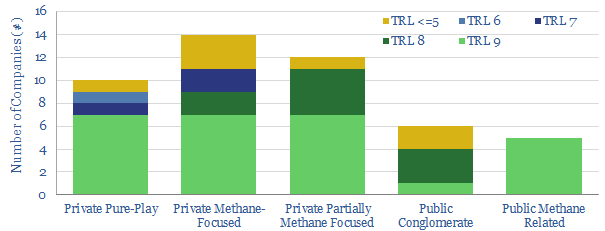
This data-file screens the methods available to monitor for methane emissions. Notes and metrics are tabulated. Emerging methods, such as drones and trucks are also scored, based on technical trials. The best drones can now detect almost all methane leaks >90% faster than traditional methods. c34 companies at the cutting edge are screened.
-
US E&Ps turn to ESG?
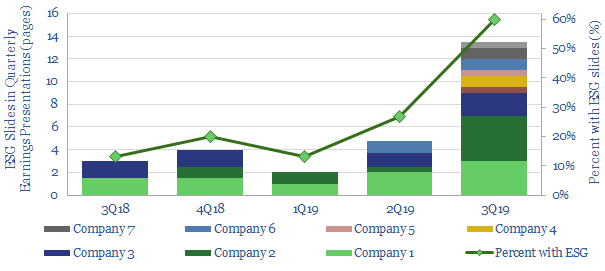
Of the largest 15 shale E&Ps, the proportion with ESG slides in their quarterly presentations has exploded by 4.5x in the trailing twelve months, from 13% in 3Q18 to 60% in 3Q19. The progress is tracked in this short data-file.
-
Methane emissions detract from natural gas?
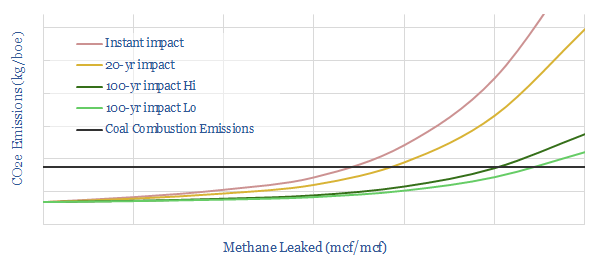
With methane emissions fully controlled, burning gas is c60% lower-CO2 than burning coal. However, taking natural gas to cause 120x more warming than CO2 over a short timeframe, the crossover (where coal emissions and gas emissions are equivalent) is 4% methane intensity. The gas industry must work to mitigate methane.
-
Carbon Offsets vs Renewable Diesel?
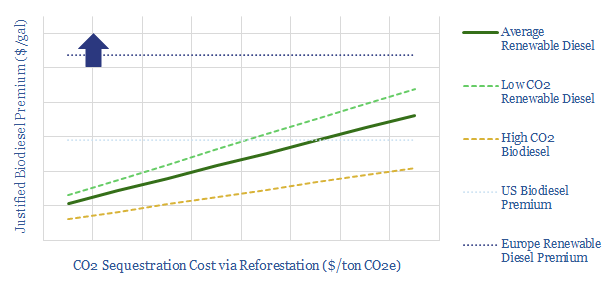
Could the rise of reforestation initiatives erode the value of renewable diesel? This data-file calculates purchasing CO2-credits to decarbonise diesel could cost 60-90% less than purchasing renewable diesel, at current pricing. Economically justified premia for biofuels are calculated.
-
Gas Gathering: how much CO2 and Methane?
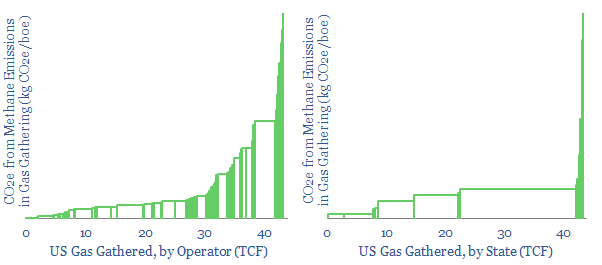
Gas gathering and gas processing are 50% less CO2 intensive than oil refining. Nevertheless, these processes emitted 18kg of CO2e per boe in 2018. Methane matters most, explaining 1-7kg/boe of gas industry CO2-equivalents. This data-file assesses 850 US gas gathering and processing facilities, to screen for leaders and laggards, by geography and by operator.
-
Power from Shore: the economics?
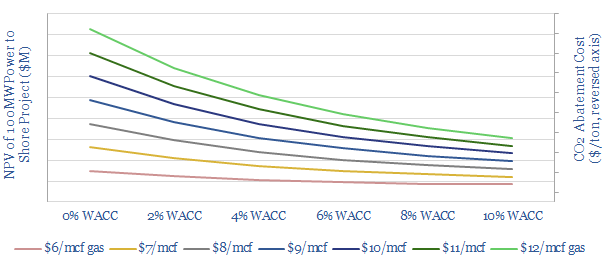
We model the economics of powering an oil platform from shore, using cheap renewable power instead of traditional gas turbines. This can lower upstream CO2 emissions by by around 70%, saving 5-15kg/bbl, for a cost of $50-100/ton. NPVs can be positive with low WACCs and high gas prices, but the primary aim is low-cost decarbonisation.
-
Carbon Credentials drive Capital Costs?
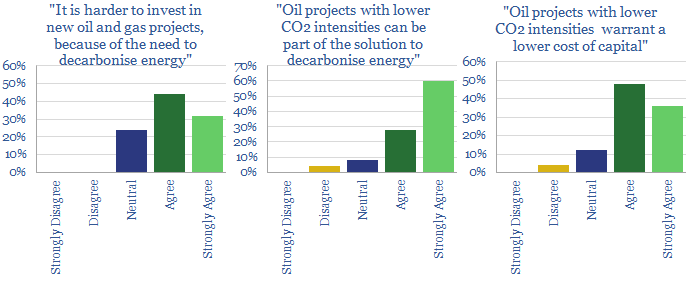
Lower carbon oil and gas may be increasingly valued by investors, earning higher multiples and lower costs of capital, according to our recent survey. 80-90% find it harder to invest in oil and gas today but view lower carbon barrels as an investable part of the solution. Capital costs are quantified for higher- and lower-carbon…
-
Ramping Renewables: Portfolio Perspectives?
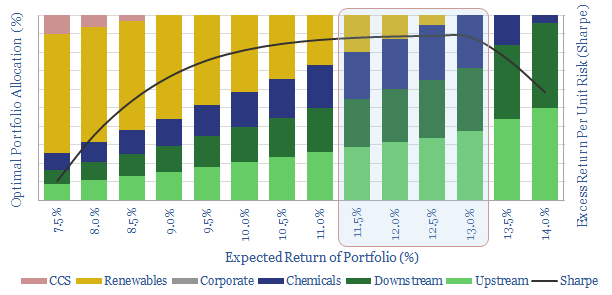
It is often said that Oil Majors should transition to renewables and become Energy Majors. But what is the best balance based on modern portfolio theory? Our 7-page paper answers this question by constructing a mean-variance optimisation model. We find a c0-20% weighting to renewables can maximise risk-adjusted returns. 5-13% is ideal. But beyond a…
-
CO2 Intensity of Oilfield Supply Chains
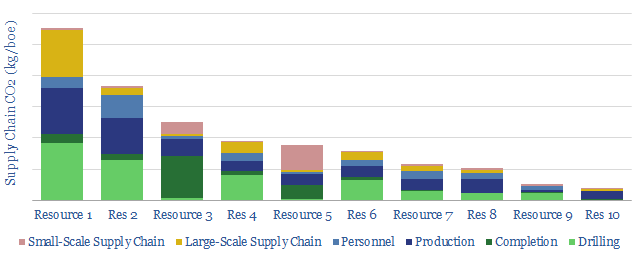
What is more CO2-intensive: the c4,000 truck trips needed to complete a shale well, or giant offshore service vessels (OSVs), which each consume >100bpd of fuel? This data-file quantifies the CO2 intensity of supply-chains, for 10 different resource types, as a function of 30 input variables.
-
CO2-Labelling for an Energy Transition?
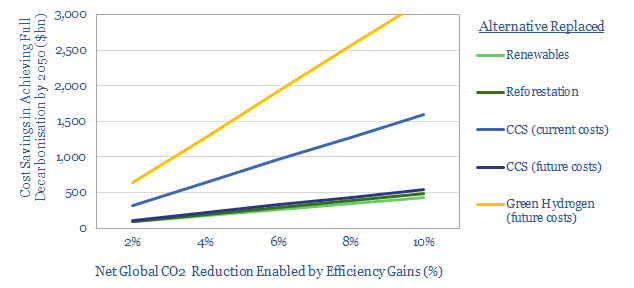
CO2-labelling is the most important policy to accelerate the energy transition: making products’ CO2-intensities visible, so they can sway purchasing decisions. Expect 4-8% savings across global energy, which will lower the net costs of decarbonisation by $200-400bn pa. Digital technologies also support wider eco-labelling compared. Leading companies are preparing their businesses.
Content by Category
- Batteries (96)
- Biofuels (44)
- Carbon Intensity (48)
- CCS (64)
- CO2 Removals (9)
- Coal (41)
- Commentary (65)
- Company Diligence (104)
- Data Models (922)
- Decarbonization (162)
- Demand (129)
- Digital (86)
- Downstream (47)
- Economic Model (221)
- Energy Efficiency (76)
- Hydrogen (63)
- Industry Data (308)
- LNG (56)
- Materials (86)
- Metals (88)
- Midstream (45)
- Natural Gas (161)
- Nature (76)
- Nuclear (28)
- Oil (176)
- Patents (39)
- Plastics (44)
- Power Grids (156)
- Renewables (153)
- Screen (137)
- Semiconductors (35)
- Shale (58)
- Solar (72)
- Supply-Demand (53)
- Vehicles (95)
- Video (24)
- Wind (47)
- Written Research (407)