-
De-Carbonising Cars. Can Oxy-Combustion Save Gasoline?
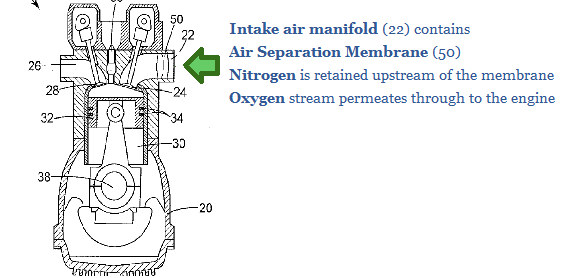
Could next-generation combustion technologies be used to decarbonise oil-fired transportation, raising the trajectory of long-term oil demand? We review a leading oil company’s patents to commercialise oxy-combustion in vehicles, along with the challenges. The outlook remains more positive for gas than for oil.
-
Can super-computers lower decline rates?
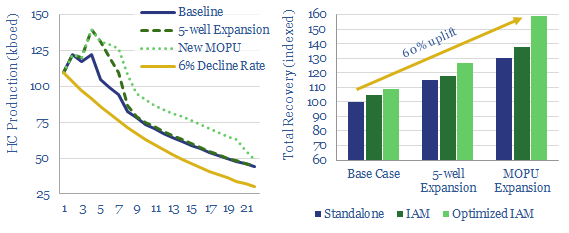
Advanced reservoir modelling can stave off production declines at complex offshore assets. This data-file illustrates how, tabulating production estimates based on a technical paper using Eni’s high-speed computer assets. 60% uplifts in LT production and EUR are achieved.
-
Johan Sverdrup: Don’t Decline
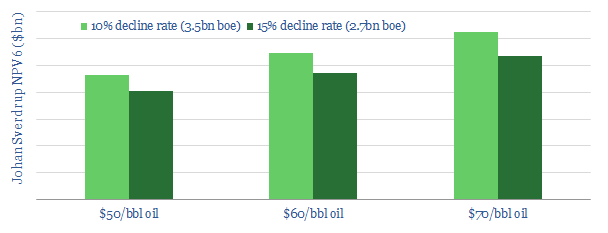
Equinor is deploying three world-class technologies to mitigate Johan Sverdrup’s decline rates, based on reviewing c115 of the company’s patents and dozens of technical papers. This 15-page note outlines how its efforts may unlock an incremental $3-5bn of value from the field, as production surprises to the upside.
-
Johan Sverdrup: Economic Model
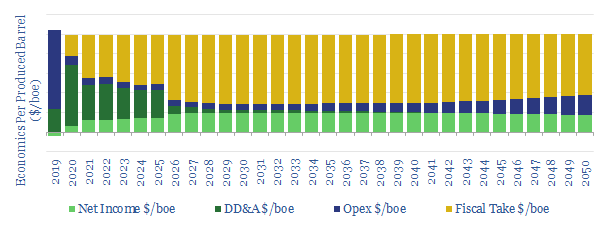
We have modelled the economics of Equinor’s Johan Sverdrup oilfield. Our model spans >250 lines of inputs and outputs, so you can flex key assumptions. In particular, we have tested the impact of different decline rates and recovery factors on the field’s ultimate value.
-
Technology Leaders Get Bought?
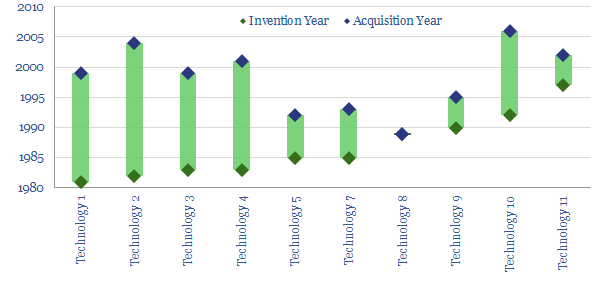
This data-file tabulates the fate of companies that invented the most impactful new oil technologies of the 1980s and 1990s. Nine out of ten were ultimately acquired, for a 3-32% take-over premium. However, timing is long-dated.
-
Electric cars slow the energy transition?
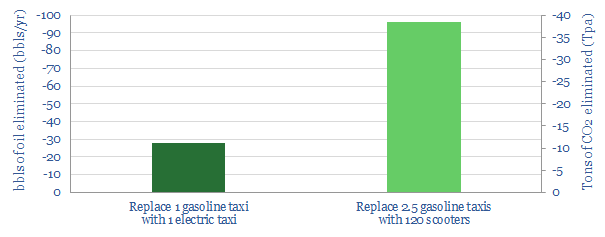
Electric Cars are being overtaken by new electric vehicles, which achieve c3x greater decarbonisation per unit of battery material. This is shown by comparing the relative impacts of deploying 400kg of battery materials into a single EV, versus a fleet of c120 electric scooters. It matters as battery materials are a limiting factor in the…
-
Scooter Wars?
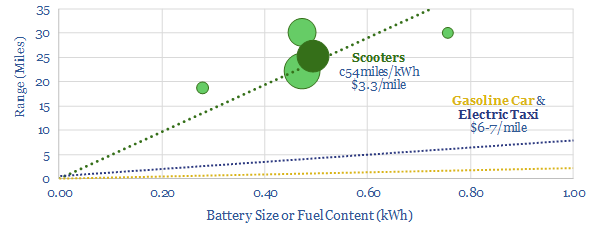
E-scooters can re-shape urban mobility, eliminating 2Mbpd of oil demand by 2030, competing amidst the ascent of “electric vehicles” and re-shaping urban economies. These implications follow from e-scooters having 25-50x higher energy efficiencies, higher convenience and c50% lower costs than gasoline vehicles, over short 1-2 mile journeys. Our 12-page note explores the consequences.
-
Energy Economics of e-Scooters
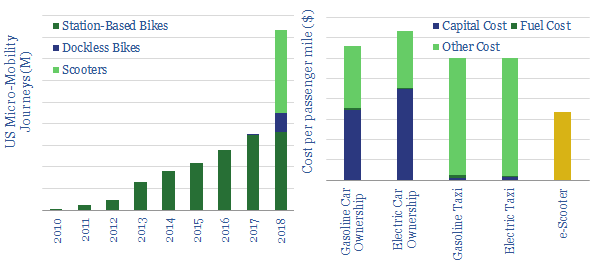
This workbook contains all our modelling on the energy economics of e-scooters; a transformational technology for urban mobility. Included are our projections of per-mile costs, energy-economics, battery charging times, new electricity demand and displacement of oil demand.
-
Offshore Capex for Technology Leaders?
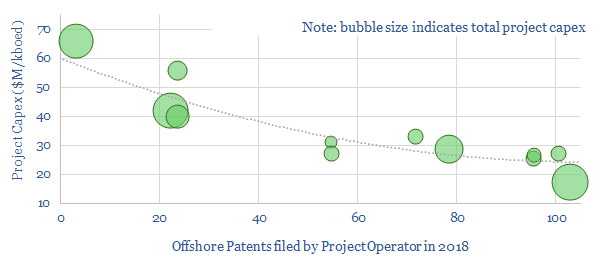
The lowest-cost offshore projects are not “easy oil”. They are the ones being developed with leading technologies. This data-file measures a -88% correlation coefficient between different Major’s offshore patent filings in 2018 and their most recent projects’ capex costs.
Content by Category
- Batteries (96)
- Biofuels (44)
- Carbon Intensity (48)
- CCS (64)
- CO2 Removals (9)
- Coal (41)
- Commentary (65)
- Company Diligence (104)
- Data Models (922)
- Decarbonization (162)
- Demand (129)
- Digital (86)
- Downstream (47)
- Economic Model (221)
- Energy Efficiency (76)
- Hydrogen (63)
- Industry Data (308)
- LNG (56)
- Materials (86)
- Metals (88)
- Midstream (45)
- Natural Gas (161)
- Nature (76)
- Nuclear (28)
- Oil (176)
- Patents (39)
- Plastics (44)
- Power Grids (156)
- Renewables (153)
- Screen (137)
- Semiconductors (35)
- Shale (58)
- Solar (72)
- Supply-Demand (53)
- Vehicles (95)
- Video (24)
- Wind (47)
- Written Research (407)