CCS
-
Enhanced Weathering: Simple Economics?
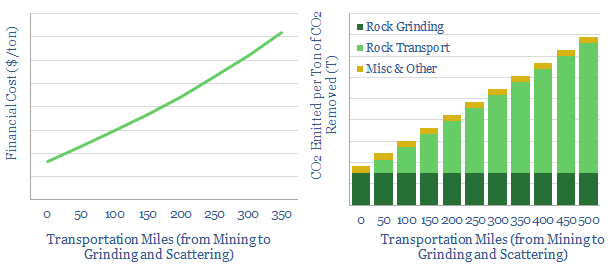
Enhanced Rock Weathering removes CO2 from the atmosphere by dispersing silicate dusts. It has recently been ascribed potential to sequester 2 bn tons of CO2 per year, with costs ranging from $60-250/ton. Our own numbers suggest this is optimistic. Our workings and top three charts are presented in this data-file.
-
CO2 Storage: the top ten challenges in CCS?
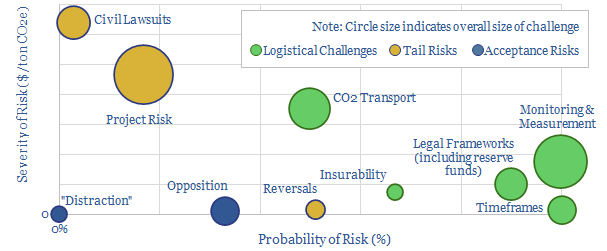
This data-file tabulates the “top ten” challenges for geological storage of CO2, based on reviewing the technical literature. There is c$8-30/ton of tail-risk for a typical CO2 storage operation. 25 monitoring and measurement technologies are summarized. We conclude CCS is no ‘less risky’ than nature based solutions to climate change.
-
Gas pipelines, CO2 pipelines, hydrogen pipelines?
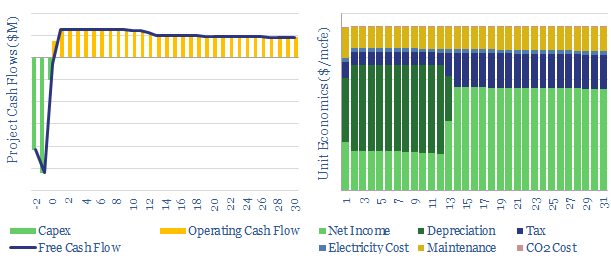
This model captures the energy economics of a pipeline carrying natural gas, CO2 or hydrogen. It computes the required throughput tariff (in $/mcf or $/kg) to earn a 10% IRR. Hydrogen tariffs must be 2x new gas pipelines and 10x pre-existing gas pipelines. CO2 disposal is more economic at scale.
-
Energy Transition Technologies?
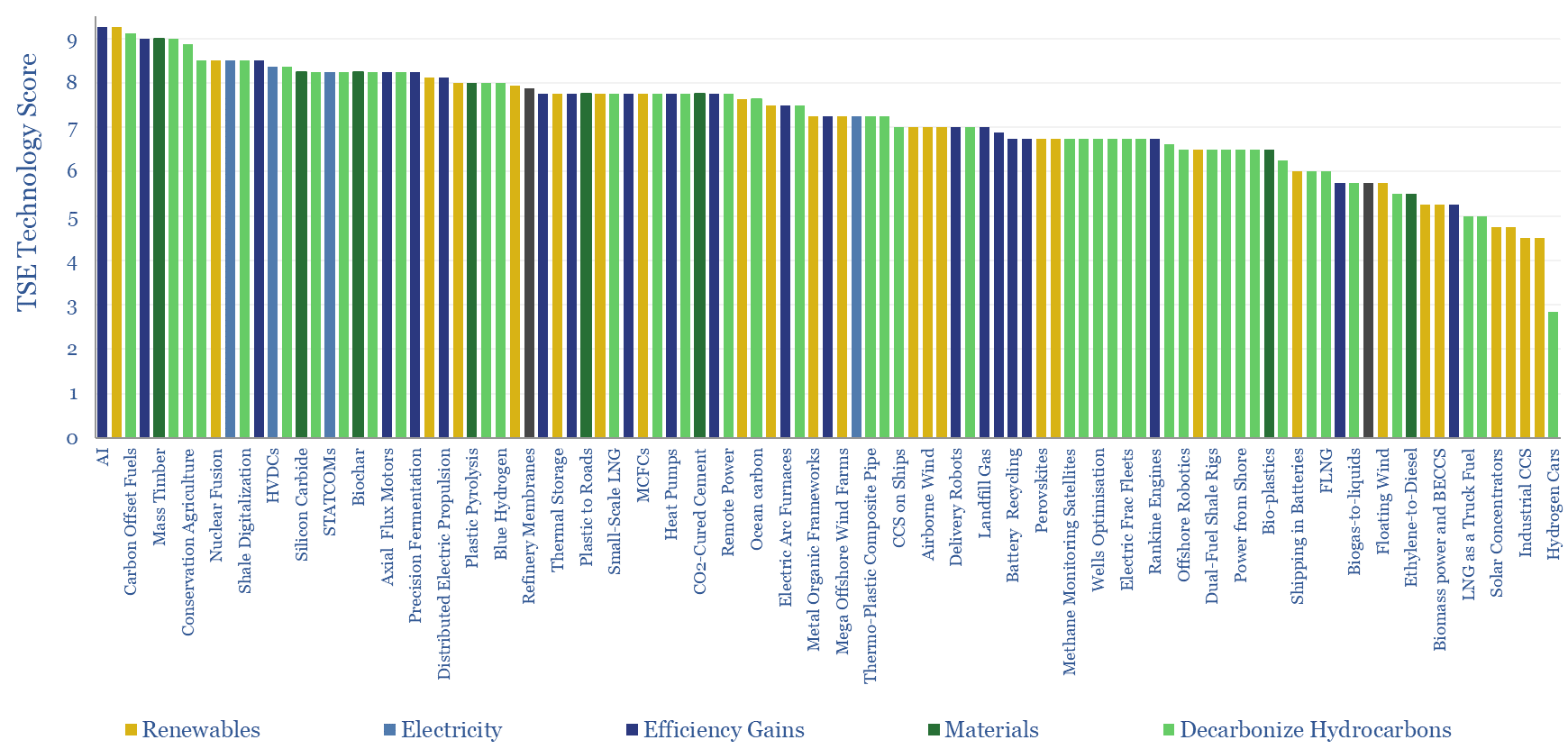
This data-file “scores” the top technologies to transform the global energy industry and the world, as assessed by Thunder Said Energy. Each one is scored based on technical readiness, economic impact and the level of work we have conducted.
-
CO2 disposal in geologic formations: the economics?
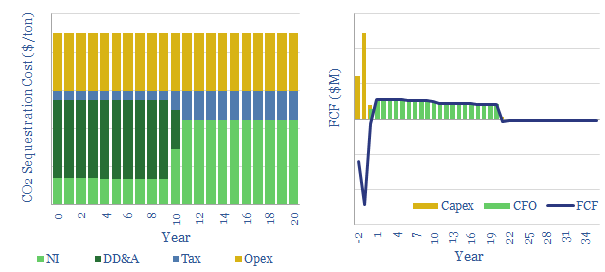
Costs of disposing of CO2 are extremely variable and project-dependent, ranging from $5-50/ton, with a base case of $22.5/ton. This is the disposal price needed to earn a 10% post-tax IRR, transporting, injecting and monitoring CO2 in the subsurface.
-
Oxycombustion: economics of zero-carbon gas?
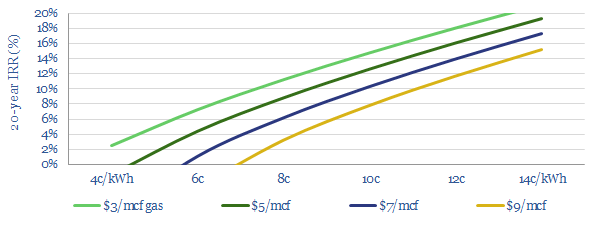
Oxy-combustion is a next-generation power technology, burning fossil fuels in an inert atmosphere of CO2 and oxygen. It is easy to sequester CO2 from its exhaust gases, helping heat and power to decarbonise. We argue that IRRs can be competitive with conventional gas-fired power plants.
-
Molten Carbonate Fuel Cells: capture carbon, generate electricity?
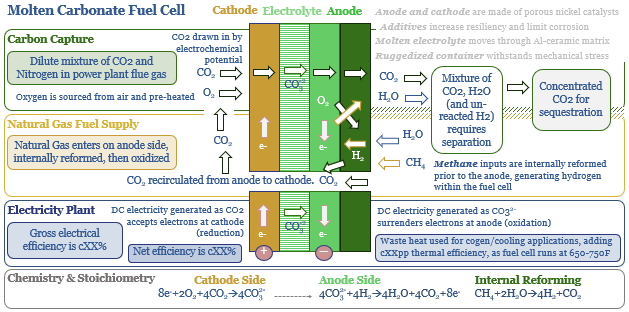
Molten carbonate fuel cells (MCFCs) could be a game-changer for CCS, and fossil fuels. They are electrochemical reactors with the unique capability to capture CO2 from the exhaust pipes of combustion facilities; while at the same time, efficiently generating electricity and heat from natural gas. The first pilot plant was due to be tested in…
-
Molten Carbonate Fuel Cells: CCS plus Power? The Economics?
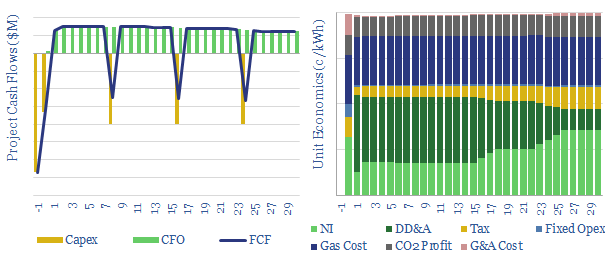
Molten Carbonate Fuel Cells could be extremely promising, generating electrical power from natural gas as an input, while also capturing CO2 from industrial flue gases through an electrochemical process. We model competitive economics. Our model runs of 18 input variables, which you can stress-test.
-
Carbon Capture Costs at Refineries?
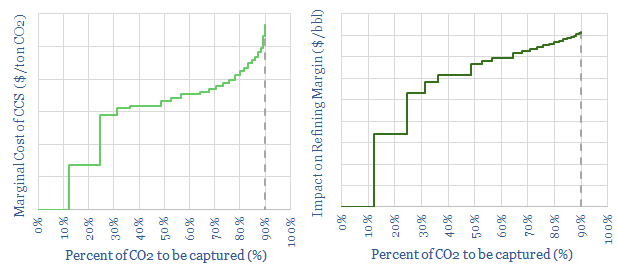
Refineries emit 1bn tons pa of CO2, or around 30kg per bbl of throughputs. Hence this model tests the relative costs of retro-fitting carbon capture and storage (CCS), to test the economic impacts. c10-20% of emissions will be lowest-cost to capture. The middle c50% will cost c3x more. But the final 25% could cost up…
-
Northern Lights CCS: the economics?
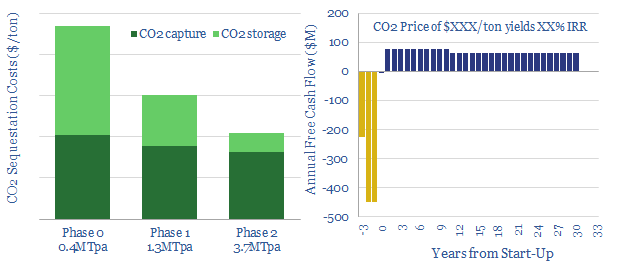
We have modeled out simple economics for Northern Lights, the most elaborate CCS scheme proposed by the energy industry (Equinor, Shell, TOTAL). The project involves capturing 1.3-1.5MTpa of industrial CO2, shipping it, piping it 110km offshore, then injecting it 3,000m below Norway’s seabed. Costs are expensive. But phase 2 could benefit from scale, offering “CO2…
Content by Category
- Batteries (96)
- Biofuels (44)
- Carbon Intensity (48)
- CCS (64)
- CO2 Removals (9)
- Coal (44)
- Commentary (65)
- Company Diligence (105)
- Data Models (927)
- Decarbonization (162)
- Demand (131)
- Digital (89)
- Downstream (47)
- Economic Model (222)
- Energy Efficiency (76)
- Hydrogen (63)
- Industry Data (310)
- LNG (56)
- Materials (86)
- Metals (89)
- Midstream (45)
- Natural Gas (163)
- Nature (76)
- Nuclear (28)
- Oil (178)
- Patents (39)
- Plastics (44)
- Power Grids (156)
- Renewables (153)
- Screen (138)
- Semiconductors (35)
- Shale (58)
- Solar (72)
- Supply-Demand (53)
- Vehicles (94)
- Video (24)
- Wind (46)
- Written Research (409)