Power Grids
-
Superconductors: distribution class?
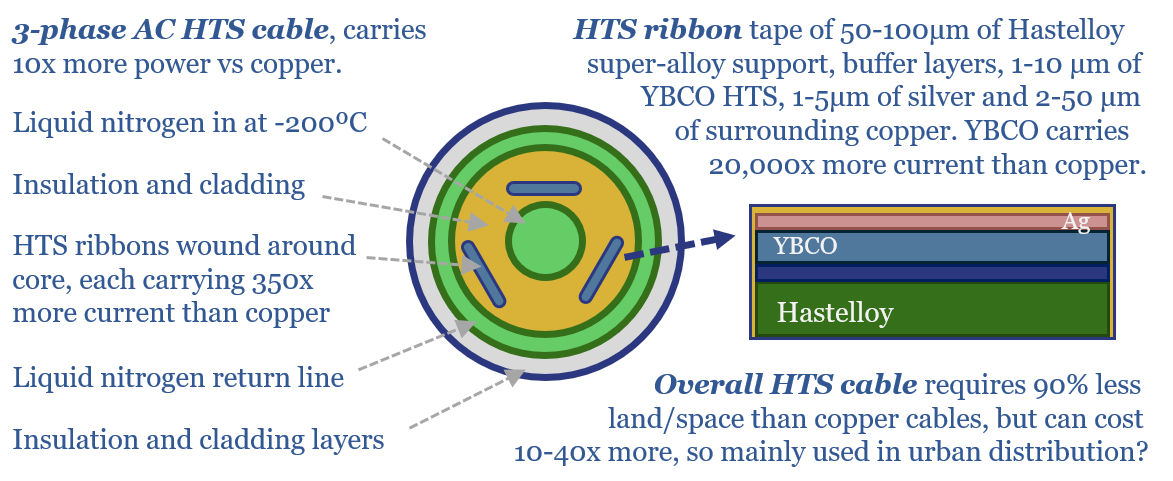
High temperature superconductors (HTSs) carry 20,000x more current than copper, with almost no electrical resistance. They must be cooled to -200ºC. So costs have been high at 35 past projects. Yet this 16-page report explores whether HTS cables will now accelerate to defray power grid bottlenecks?
-
Superconductor screen: projects, materials, companies?
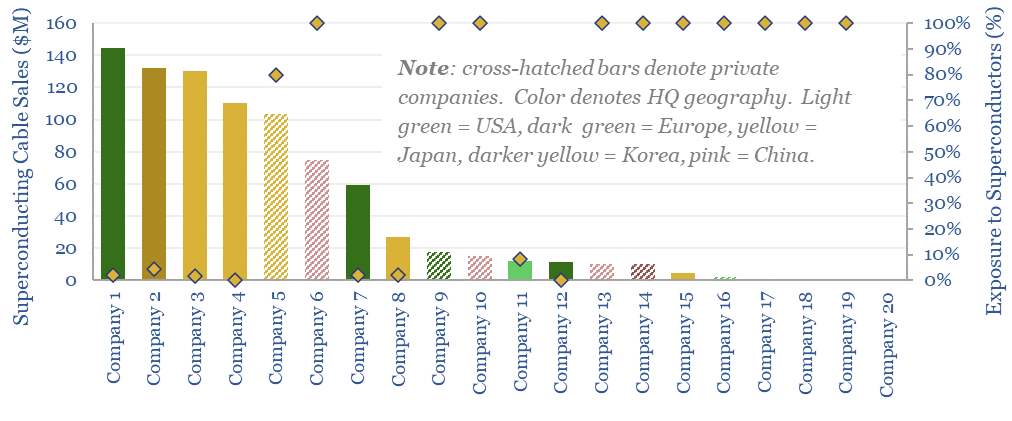
This superconductor screen summarizes all of our work into superconductors, screening past projects, active companies, superconductor materials and the properties of commercial HTS tapes. Five listed companies in Europe, Japan and the US are particularly important for superconducting cable projects to relieve grid bottlenecks?
-
Moving targets: molecules, electrons or bits ?!
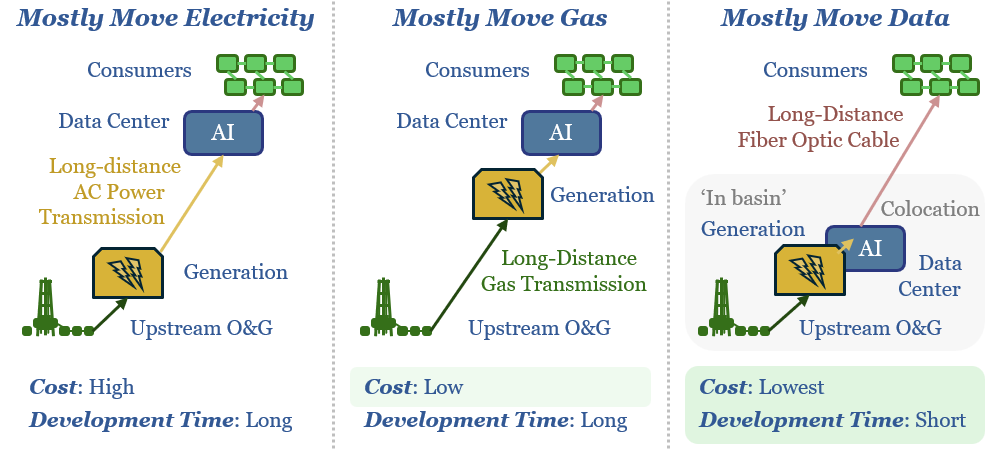
New AI data-centers are facing bottlenecked power grids. Hence this 15-page note compares the costs of constructing new power lines, gas pipelines or fiber optic links for GW-scale computing. The latter is best. Latency is a non-issue. Thus AI reshapes the future of US shale, midstream and fiber-optics?
-
Advanced Conductors: current affairs?
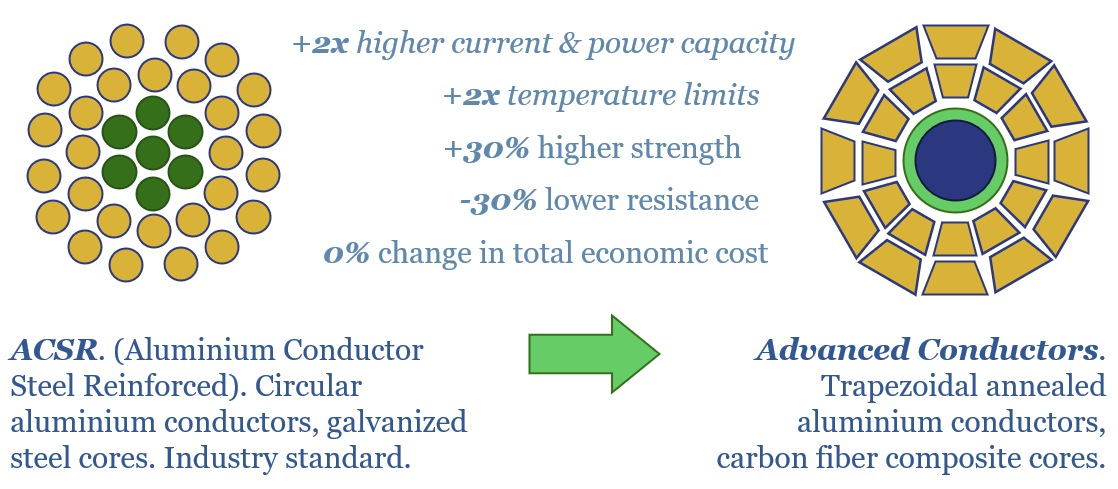
Can today’s 7M circuit kilometers of transmission lines be upgraded to re-lieve power grid bottlenecks, thus avoiding the 10-year ordeal of permitting a new line? Raising voltage may have hidden challenges. But advanced conductors stand out in this 16-page report. And the theme could double carbon fiber demand?
-
Gas power: does low utilization entail spare capacity?
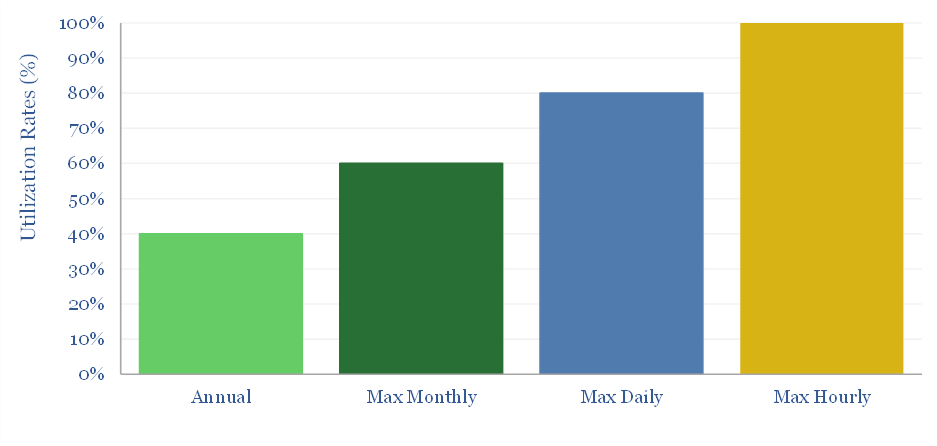
The US has >400GW of large gas-fired power plants running at 40% average annual utilization. Could they help power new loads, e.g., 60GW of AI data-centers by 2030? This 5-page note shows why low utilization does not entail spare capacity, and in turn, estimates the true spare capacity for loads such as data-centers.
-
Power distribution: the economics?
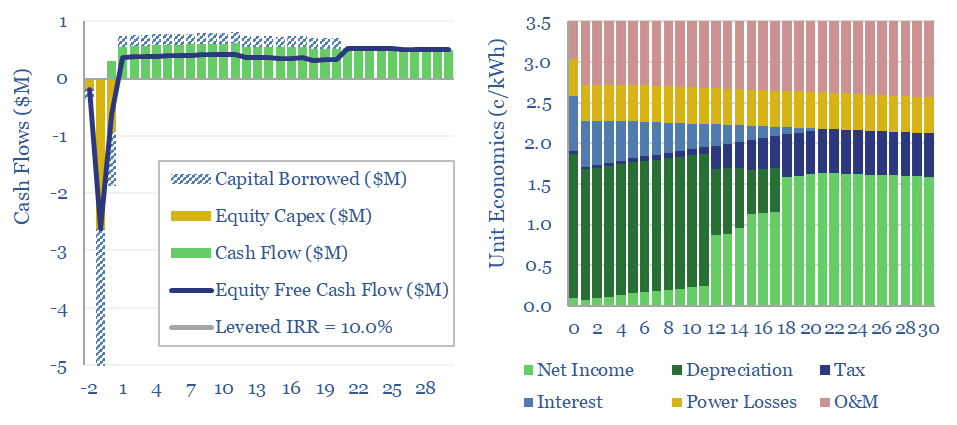
Power distribution costs to residential, commercial and industrial consumers are estimated at 3.5 c/kWh in this model, to generate a 10% levered return, in a 5km x 10MW distribution line, at 17kV, rated up to 400A, with a capex cost of $150/kW-km, a 5% line loss and 40% annualized utilization. All of these inputs can…
-
Power transmission: the economics?
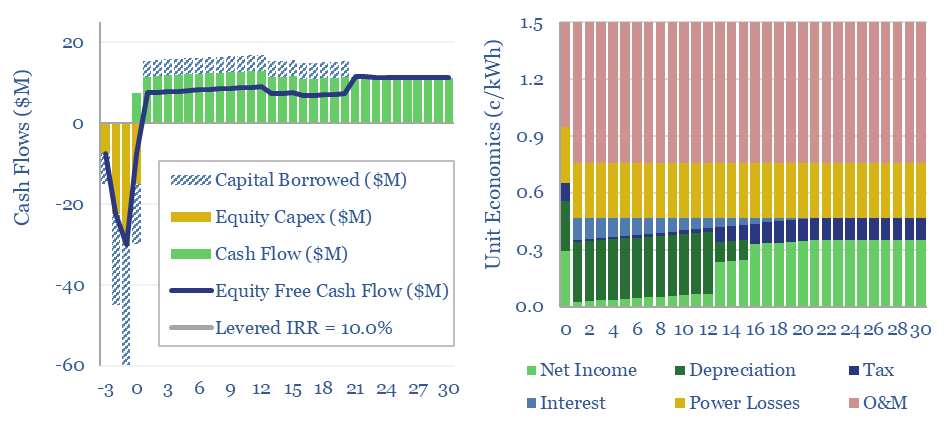
This data-file captures the costs of AC power transmission, requiring a 1.5c/kWh spread to earn a 10% levered IRR on a new 100km and 1,000MW transmission line, with capex costs of $1.5/kW-km. These numbers are supported by backup tabs, tabulating the costs of recent projects and a full granular breakdown for the capex costs of…
-
Advanced Conductors versus ACSR: costs and companies?
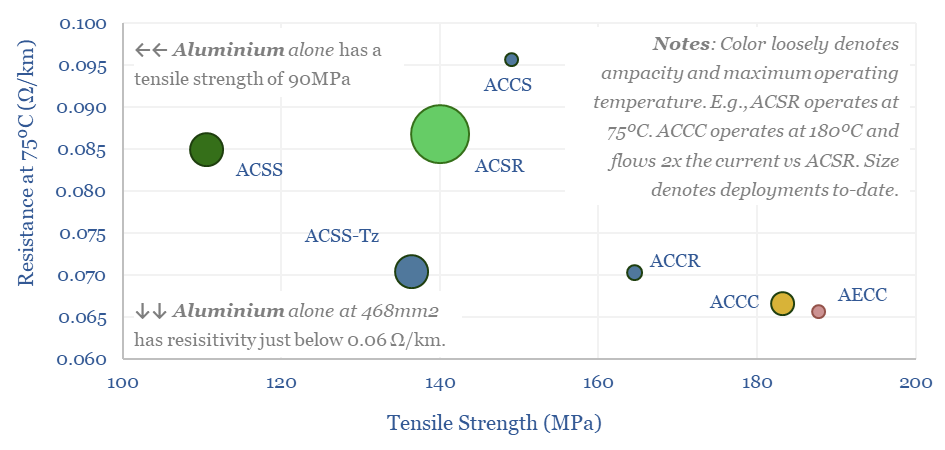
Advanced conductors have 2x higher amperage capacities and temperature limits than standard Aluminium Conductor Steel Reinforced (ACSR) used in AC transmission lines. This data-file screens Advanced conductors versus ACSR on dimensions such as tensile strength, performance and costs, and also screens leading companies.
-
US electric utilities: transmission and distribution costs?
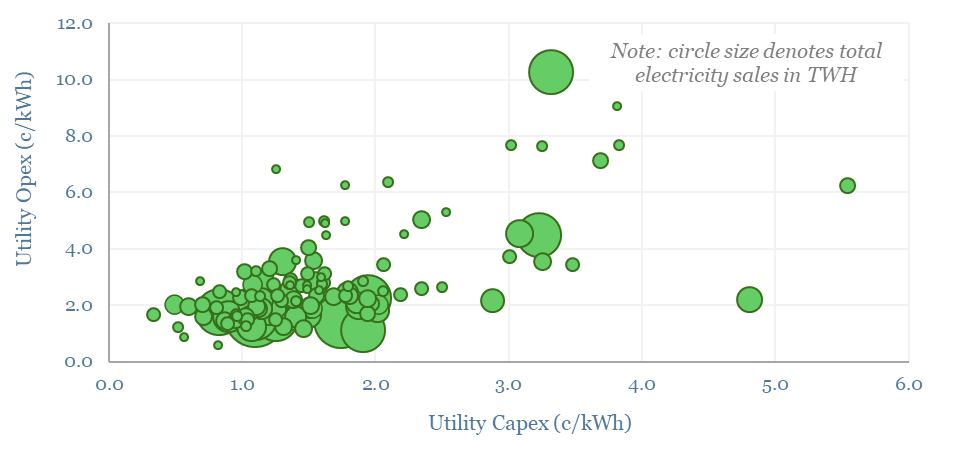
This data-file evaluates transmission and distribution costs, averaging 7c/kWh in 2024, based on granular disclosures for 200 regulated US electric utilities, which sell 65% of the US’s total electricity to 110M residential and commercial customers. Costs have doubled since 2005. Which utilities have rising rate bases and efficiently low opex?
-
Into thin air: beaming power as microwaves?
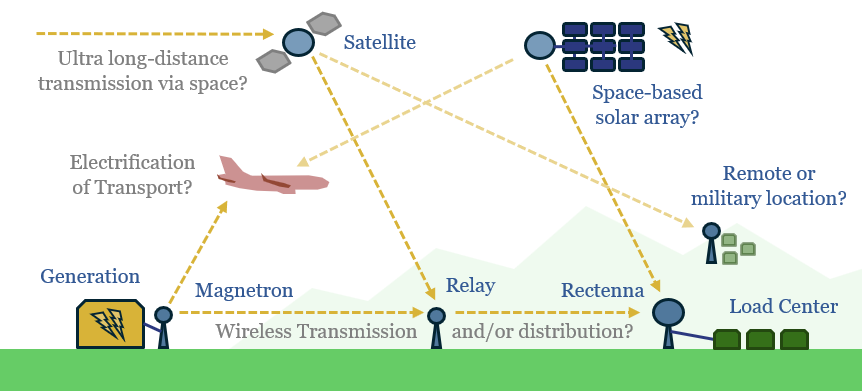
What if large quantities of power could be transmitted via the 2-6 GHz microwave spectrum, rather than across bottlenecked cables and wires? This 12-page note explores the technology, advantages, opportunities, challenges, efficiencies and costs. We still fear power grid bottlenecks.
Content by Category
- Batteries (96)
- Biofuels (44)
- Carbon Intensity (48)
- CCS (64)
- CO2 Removals (9)
- Coal (41)
- Commentary (65)
- Company Diligence (105)
- Data Models (924)
- Decarbonization (162)
- Demand (131)
- Digital (87)
- Downstream (47)
- Economic Model (221)
- Energy Efficiency (76)
- Hydrogen (63)
- Industry Data (308)
- LNG (56)
- Materials (86)
- Metals (88)
- Midstream (45)
- Natural Gas (161)
- Nature (76)
- Nuclear (28)
- Oil (176)
- Patents (39)
- Plastics (44)
- Power Grids (156)
- Renewables (153)
- Screen (138)
- Semiconductors (35)
- Shale (58)
- Solar (72)
- Supply-Demand (53)
- Vehicles (94)
- Video (24)
- Wind (47)
- Written Research (407)