Vehicles
-
Nio: EV-charging breakthrough?
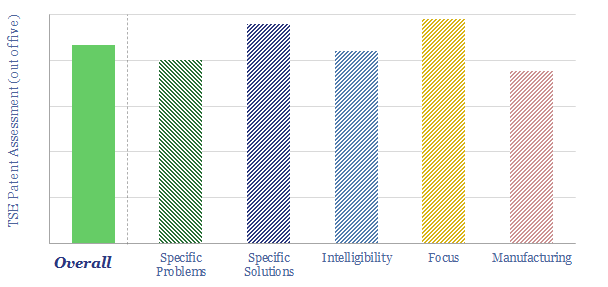
Nio is a listed, electric vehicle manufacturer, headquartered in Shanghai. It operates over 200 “battery swap” stations, and the 2-millionth battery swap was completed in March-2021, with swap times soon falling to 3-minutes. Our patent analysis suggests a genuine moat in swappable batteries, which could only have been built up by an auto-maker.
-
Oil demand: the rise of autonomous vehicles?
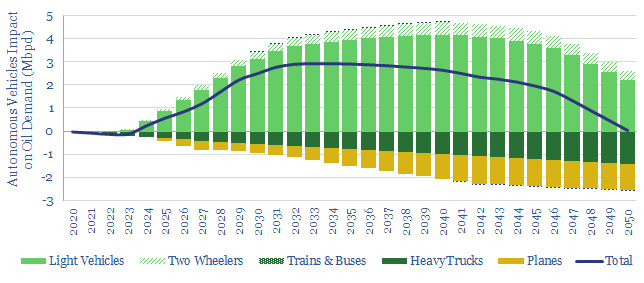
We are raising our medium-term oil demand forecasts by 2.5-3.0 Mbpd to reflect the growing reality of autonomous vehicles. AVs improve fuel economy in cars and trucks by 15-35%, and displace 1.2Mbpd of air travel. But their convenience also increases travel. This note outlines the opportunity.
-
Energy costs of lithium ion batteries?
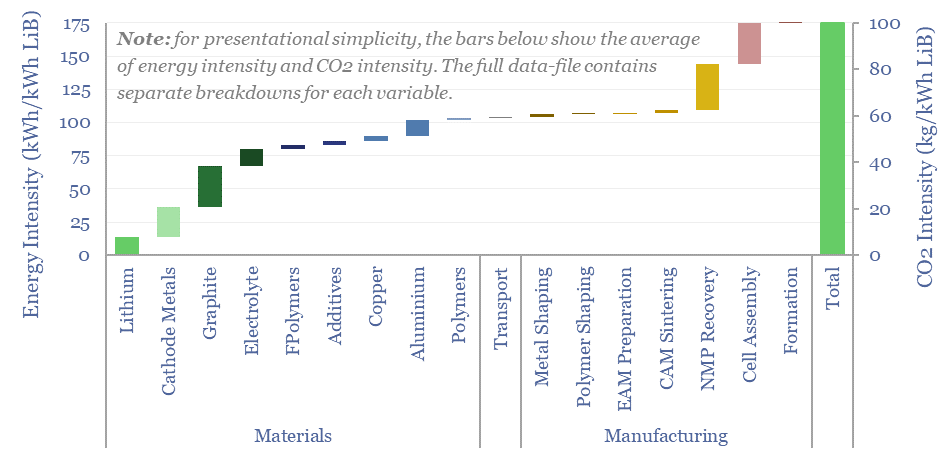
This data-file estimates the energy costs of lithium ion batteries across 17 lines. Our best estimate in 2024 is that manufacturing 1 kWh of lithium ion batteries requires 175 kWh of useful energy and emits 100kg of CO2. When a lithium ion battery is used in an electric vehicle, these up-front energy and CO2 costs…
-
Electric trucks: what battery sizes?
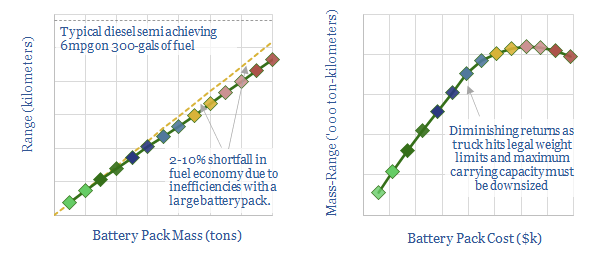
An electric truck would need a 15 ton battery to match the c2,500-mile range of a diesel truck. However, larger batteries above c8-tons detract 10% from fuel economy and may cause trucks to exceed regulatory weight limits, lowering their payload capacities. 4-6 ton batteries with 700-1,000km ranges are optimal.
-
Proton exchange membrane fuel cells: what challenges?
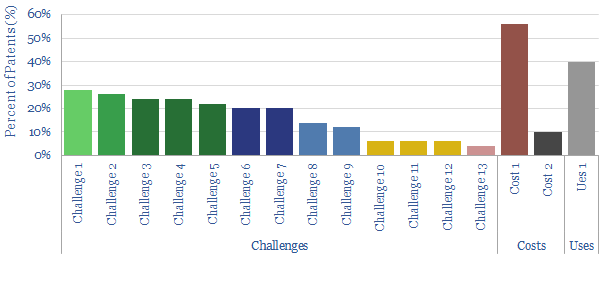
This data-file reviews fifty patents into proton exchange membrane fuel cells, filed by leading companies in the space in 2020, in order to understand the key challenges the industry is striving to overcome. The key focus areas are controlling temperature, humidity and longevity, but unfortunately this will tend to increase costs.
-
Electric vehicle charging: what challenges?
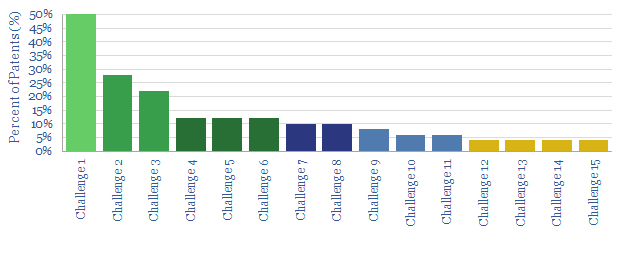
We review fifty patents from leading companies in EV charging. Complex algorithms will be required to ensure grid stability. Vehicle-manufacturers are concerned about balancing convenience and costs. While interestingly, “fast charging” does not appear to be a primary focus.
-
The ascent of drones?
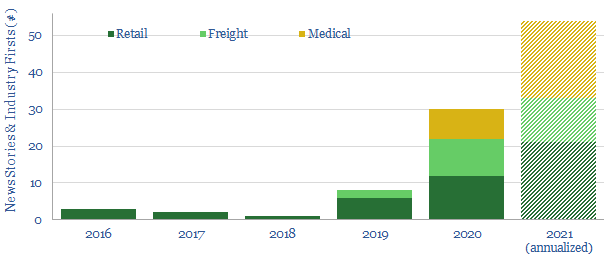
In 2019, we argued drones would be the single most disruptive technology to gain share in the 2020s, with potential to save over 500MTpa of CO2 emissions, while re-shaping urban consumption, retail and manufacturing. This data-file aims to tabulate key news flow and data-points.
-
Tesla: where’s the IP?
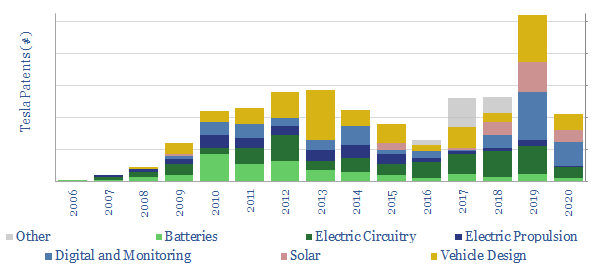
This data-file compiles all of Tesla’s patents, classifies them across 1,000 patent families, and describes their innovations. Our conclusion is that Tesla holds less patented IP than rival auto-companies. However, where it has filed patents, it is more focused on pure EV innovations, including recently, big data solutions and improved batteries in 2019-20.
-
Hydrogen: lost in transportation?
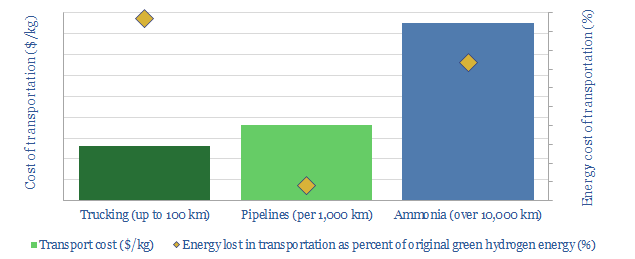
Transporting hydrogen will be more challenging than any other energy commodity ever commercialised. This 19-page note reviews the costs and complexities of cryogenic trucks, pipelines and chemical carriers (e.g., ammonia). Midstream costs will be 2-10x higher than natural gas, while up to 50% of hydrogen’s embedded energy may be lost in transit.
-
Green hydrogen trucks: delivery costs?
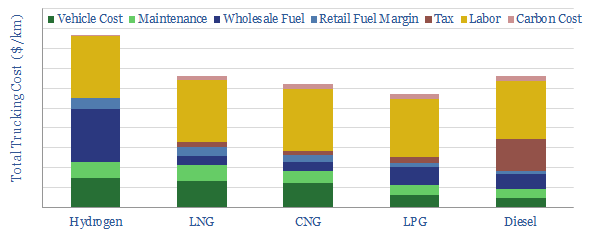
We have modelled full-cycle economics of a green hydrogen value chain to decarbonize trucks. In Europe, at $6/gallon diesel, hydrogen trucks will be 30% more expensive in the 2020s. They could be cost-competitive by the 2040s. But the numbers are generous and logistical challenges remain. Niche adoption is more likely than a wholesale shift.
Content by Category
- Batteries (96)
- Biofuels (44)
- Carbon Intensity (48)
- CCS (64)
- CO2 Removals (9)
- Coal (41)
- Commentary (65)
- Company Diligence (104)
- Data Models (921)
- Decarbonization (162)
- Demand (129)
- Digital (86)
- Downstream (47)
- Economic Model (220)
- Energy Efficiency (76)
- Hydrogen (63)
- Industry Data (308)
- LNG (56)
- Materials (86)
- Metals (88)
- Midstream (45)
- Natural Gas (161)
- Nature (76)
- Nuclear (28)
- Oil (175)
- Patents (39)
- Plastics (44)
- Power Grids (155)
- Renewables (153)
- Screen (137)
- Semiconductors (35)
- Shale (58)
- Solar (72)
- Supply-Demand (53)
- Vehicles (95)
- Video (24)
- Wind (47)
- Written Research (406)