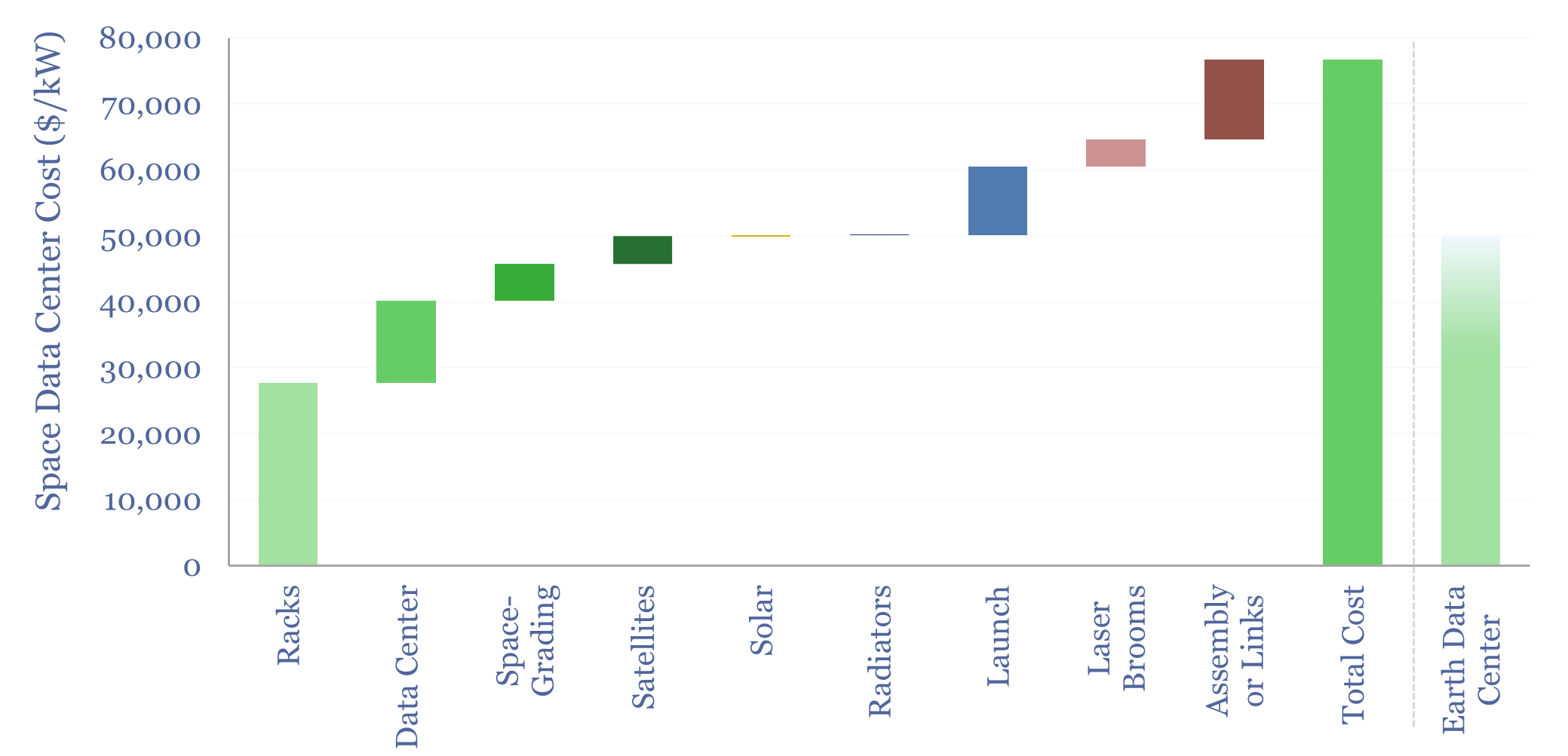
Data centers in space are a cool science fiction concept. This 17-page report explores how they would work. We think the costs will be 2x higher than Earth-based AI data centers. Amidst many logistical challenges, the biggest potential show-stopper is space debris, given the size of the structures, especially their solar arrays.
Space is cool. Data centers are cool. Maybe their common coolness is enough to wonder whether data centers could be built and run in space, energized by near infinite quantities of low-cost, round-the-clock solar?
Where are we today? As context for the feasibility of space-based AI data centers, an overview of the space, satellite and rocket-launch industry, outlining all of the key numbers, is provided on pages 2-3.
The rationale for space-based data-centers is critiqued on pages 4-5. As a reminder, we also have huge solar resources on Planet Earth and round-the-clock power costs are deflating.
The costs to beat are those of an Earth-based AI data center, both in capex terms (in $/kW) and in levelized cost of compute terms ($/EFLOP), as broken down on pages 5-6.
How would we actually build AI data centers in space? Key parameters, and operational challenges, for the compute architecture are discussed on pages 7-8.
How big would the solar array need to be? We tackle this question, from first principles, starting with today’s solar modules, then seeing how much mass we can remove from the solar bill of materials, on pages 9-10.
How big would the radiators need to be? In space, there is no atmosphere for convective cooling, so we would also need giant radiators, as modeled via the Stefan-Boltzmann equations, on page 11.
What would be the costs for data centers in space? Our estimates, built up from first principles, via the analysis above, are around 2x higher than Earth-based data centers, per page 12.
The biggest challenge for space-based data centers, however, on our analysis, derives from the cost and the size of the hardware being deployed into orbit. This magnifies the risks of being impacted by space debris, which either degrades the capacity of the system, or could destroy it outright. Risks are modeled and quantified on pages 13-15.
Ultimately, we think that deploying AI data centers in space, or large-scale solar in space, requires first developing AI-controlled space lasers, to neutralize incoming space debris, per page 16.
Otherwise, putting $75bn of hardware into orbit is not only itself hard to under-write, but also risks triggering ‘Kessler Syndrome’, a catastrophe scenario where space debris rises exponentially, and destroys the entire $600bn pa global satellite industry.
Our conclusion is that if you want somewhere big, and sparse, and full of low-cost energy, the Permian basin is more hospitable than space, for at least another 20+ years.