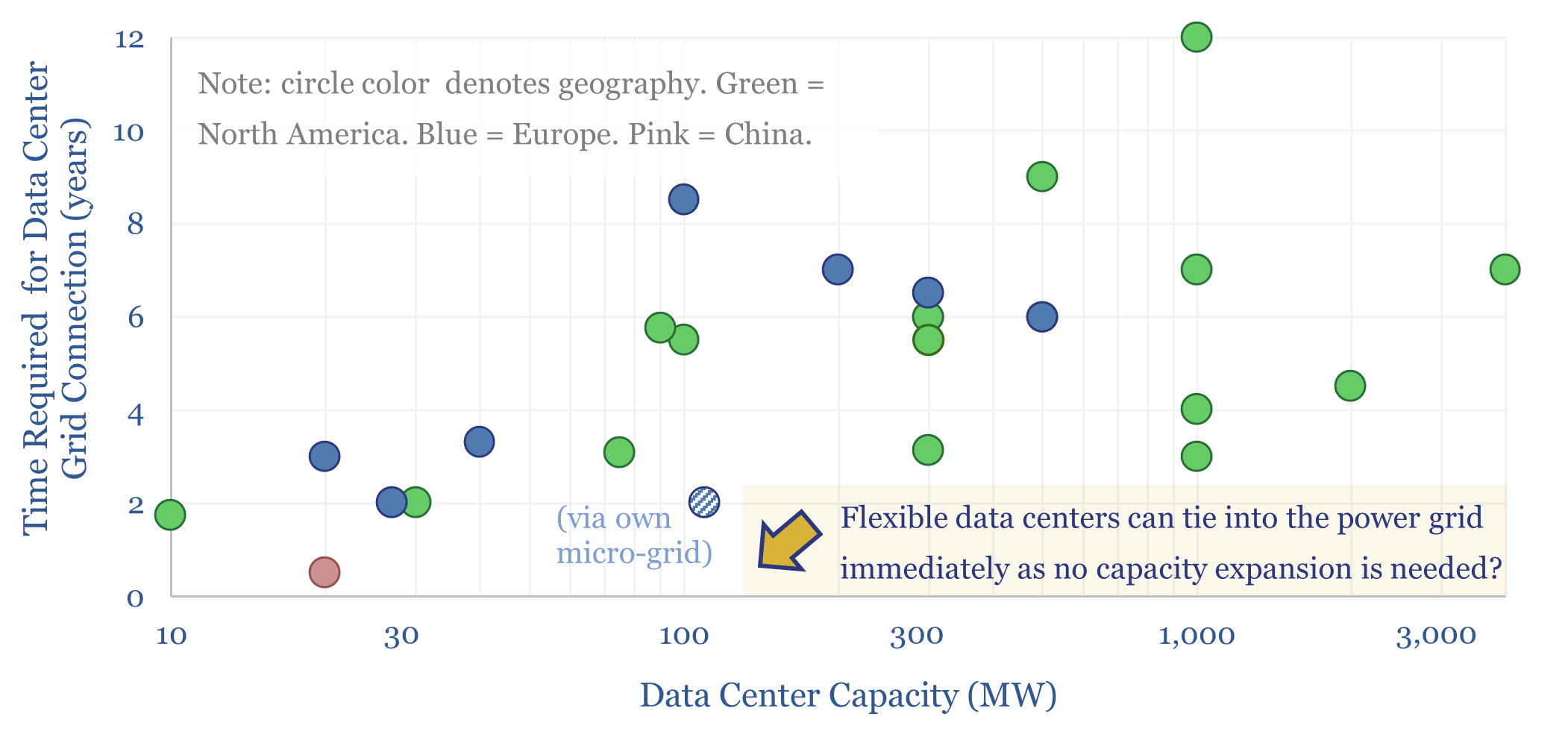
It can take 4-12 years to expand the grid and accommodate large new AI data centers. But what if more flexible data centers could be energized mostly via the pre-existing grid? This 15-page report shows how flexible AI data centers, which engage in demand shifting, are technically feasible, economically justified, and accelerating?
In January-2026, a Google executive told an audience how a recent application to connect a data center to the US grid was rebuffed with a 12-year wait time. This kind of anecdotal data-point has further stoked fears of major grid bottlenecks in the AI era, including to build new generation and transmission capacity, as discussed on page 2.
So what actually is the interconnect time for data-centers and other grid-connected assets? We tabulated 20 data-points for data centers, hundreds for renewables, and reviewed some prior studies on pages 3-4.
How can interconnect times be sped up? A fascinating prospect is load-shifting. If we take the PJM grid territory, as an example, 15% additional demand could be served, with no additional generation or transmission capacity, as long as the new demand would itself scale back during the 1% most strained grid hours per year. And this actually lowers costs across the PJM region by over 1 c/kWh, as shown on pages 5-7.
So could you build a flexible data center that simply agreed not to undertake non-crucial activities — e.g., training, blockchain mining — during peak grid hours? The economics are promising per page 8.
Flexible data centers can also be operated via prioritizing inferencing loads (see page 9), geographic shifting (page 10), or control-based approaches such as Dynamic Voltage and Frequency Scaling (page 11).
And is this happening? Momentum behind flexible data centers that can shift demand is clearly accelerating. Some fascinating examples and case studies, including from Google and Emerald AI, are charted on pages 12-15.