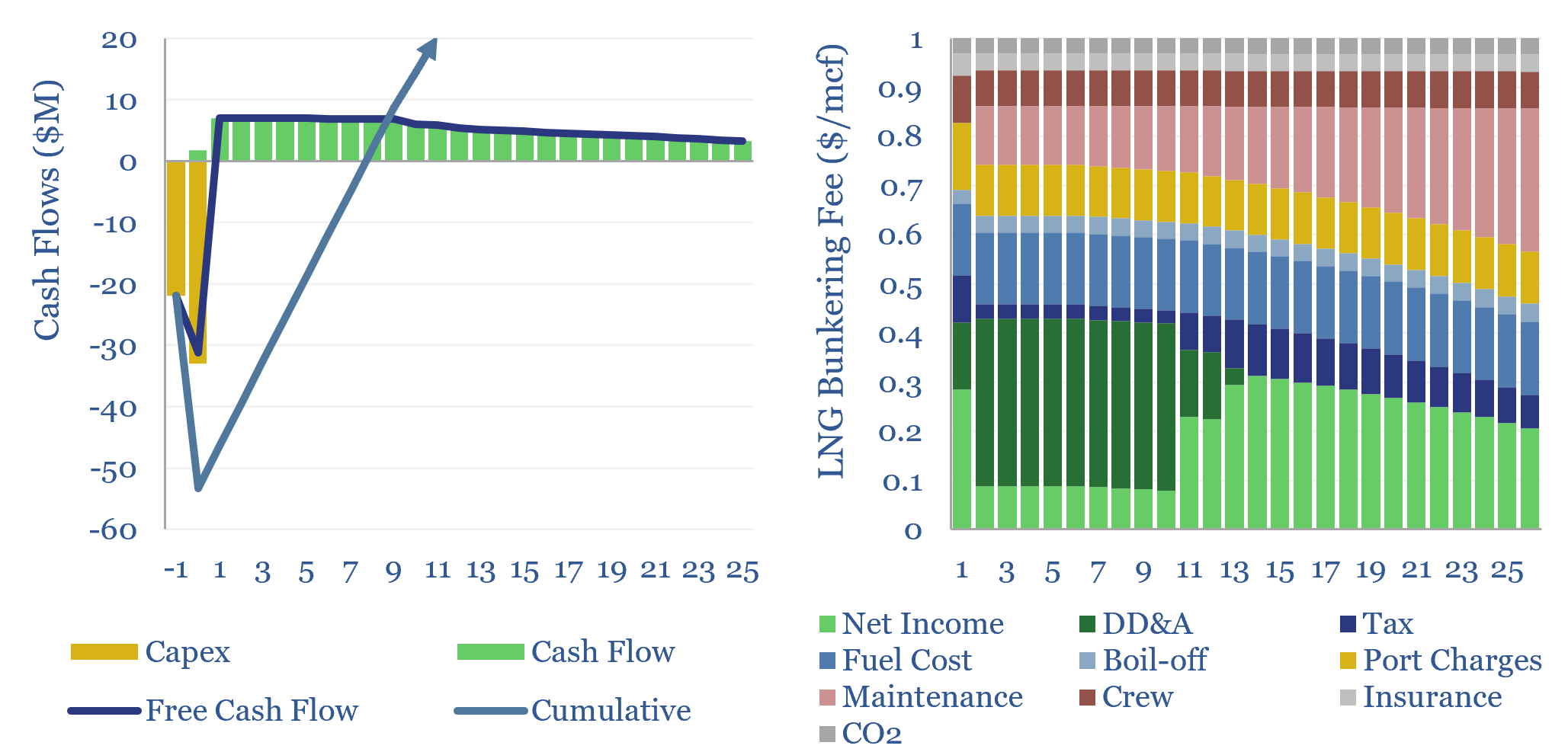
This data-file captures the economics of LNG bunkering vessels. LNG bunkering costs $1/mcf in well-utilized contexts, enabling LNG ship fueling at $8-10/mcf, which is 35% below $2/gal oil products at $70/bbl oil. A 1.5-year payback on dual-fuel vessels could thus see another 10MTpa of LNG used in shipping by 2030, displacing 250kbpd of oil?
As of 2026, there are 1,600 LNG-fueled marine vessels operating globally, fueled from over 200 LNG-ready ports, of which over 60 have dedicated LNG bunkering vessels for ship-to-ship fueling.
LNG-fueled shipping is an alternative to oil-fueled shipping over long-distance routes, much as electric ships are an alternative on short-distance routes.
Increasing deployment of LNG dual-fuel vessels makes economic sense, especially in regions that might have an abundance of low-cost gas and LNG infrastructure, but a shortage of oil products. This might include the US, Australia, some parts of MENA and Asia.
For example, if we take container vessels as a test case, the capex costs of dual-fuel LNG vessels is c10% higher than an oil-only vessel, but fuel costs are c35% lower (at $8-10/mcf delivered LNG costs and $70/bbl or $2/gal-e liquid fuel prices). This returns a 1.5-year payback, plus added flexibility, and superior air quality. And more if oil prices are higher.
Hence this data file captures the economics of LNG bunkering vessels, to shore up our estimates for the bunkering fee, and confirm that $8-10/mcf delivered really can be achievable.
A 10,000 m3 LNG bunkering vessel, costing $55M, needs to charge a bunkering fee of $1/mcf, if it provides about 0.33MTpa of fuel per year to LNG-fueled ships, which equates to a full filling and emptying of the bunkering vessel every 5 days.
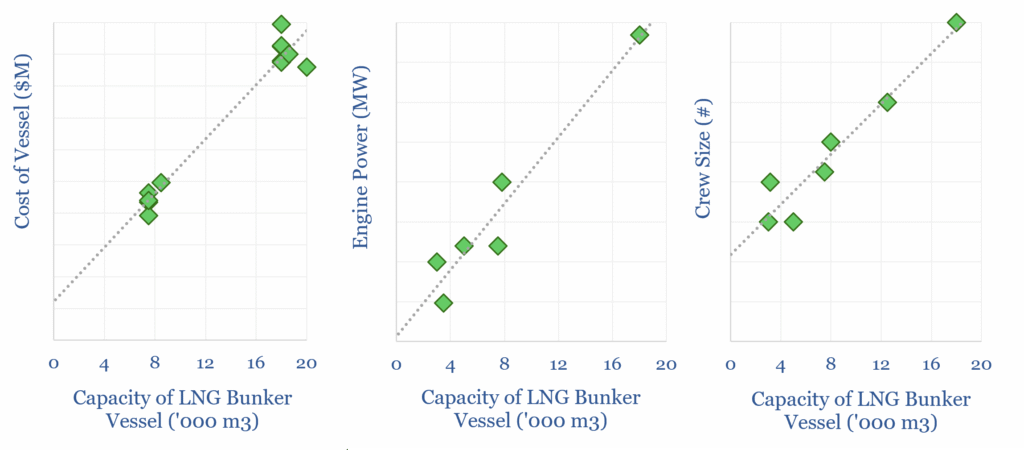
We have also tabulated the parameters of past LNG bunkering vessel deliveries, noting their capacity, capex costs ($M), crew size, engine capacity (MW) and fuel consumption (boed).
Bunkering economics are most sensitive to utilization rate and can thus vary from $0.1-$5.0/mcf at a 10% IRR hurdle rate, and $0.1-$8/mcf at a 20% IRR hurdle rate. Numbers can be stress-tested in the model tab.
A Reuters article recently estimated that LNG bunkering could increase from 4MTpa in 2025 to absorb 15MTpa of global LNG supplies by 2030. Another 5MTpa is likely used today in dual-fuel LNG carriers in addition to the 4MTpa bunkering number in the Reuters article. Altogether LNG-fueled vessels are displacing 220kbpd of oil demand, which could rise to 500kbpd in 2030.