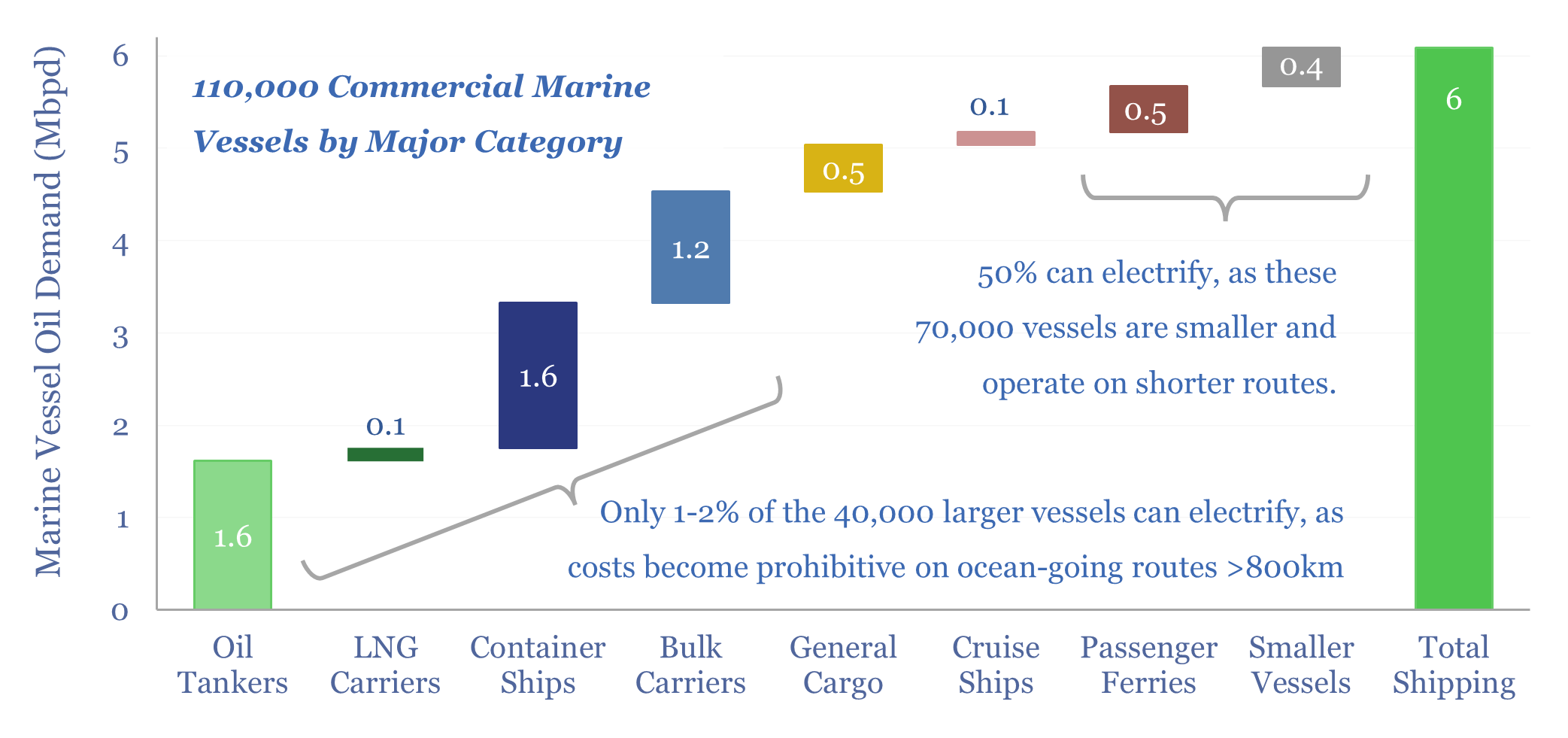
Over 15% of the world’s marine vessels could electrify in the next decade, accelerated by higher oil prices, and as Europe/Asia seek self-sufficiency. This 16-page report explores electric ships, across leading concepts, 30 flagship deployments to-date, the economics, and the implications for companies/commodity markets.
Commodity shocks tend to induce new behaviours. After the oil shocks of 1973-74 and 1979-80, for example, vehicles became more fuel-efficient and there was a boom in nuclear construction. Hence pages 2-3 of this report explore macro factors that might support the deployment of electric ships, especially in Europe/Asia.
110,000 commercial ships are in operation globally, including 7,000 large container ships, 12,000 oil tankers, 13,200 bulk carriers, 750 LNG carriers. But amazingly, over 1,000 vessels have already electrified in the past decade. We reviewed 30 case studies of electric ships, and have drawn out key milestones and momentum on pages 4-7.
Most of the electric ships in our screen operate at small scale: smaller vessels on shorter routes. But why is this? Using our model of a large container ship as a basis, we find that economics can be competitive in the <500km range, but above >800km of range, the costs of battery-energized shipping explode, per pages 8-10.
We stress test the economics of electrified ships, at different distances, oil prices, electricity prices, and with more frequent stops for charging, on pages 11-12.
Our conclusions are that electric shipping is gaining momentum, likely to be amplified by macro trends, and thus we have aimed to quantify the impacts on global oil demand and global electricity demand (page 13) and on the demand for batteries and lithium (page 14).
A handful of companies stood out in our review of electrified shipping, supplying specialized marine battery systems, charging infrastructure, or other components for the electrified marine segment. Details of these companies, including their patents, are on pages 15-16.