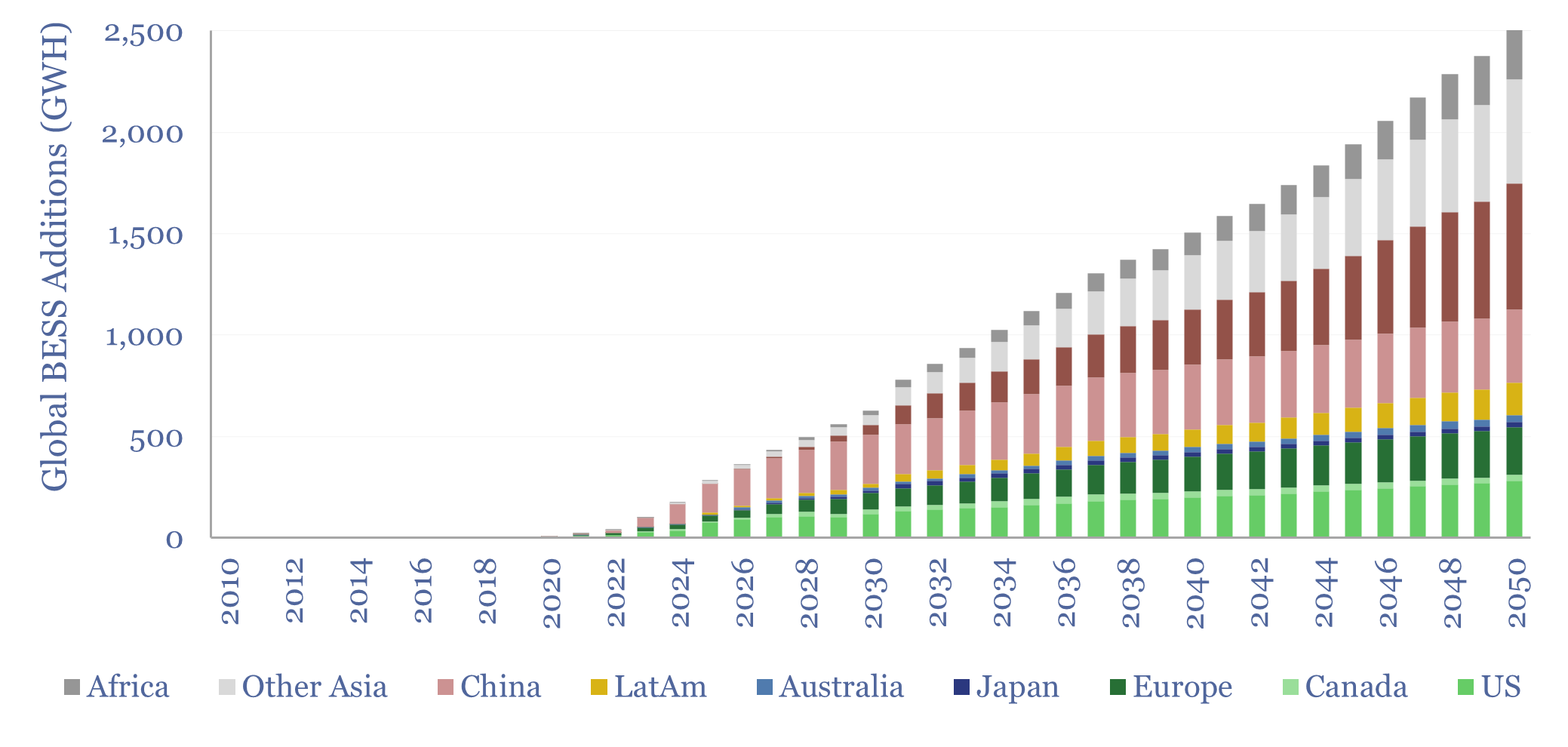
Battery energy storage systems (BESS) encompass grid-scale batteries, and smaller commercial and residential battery storage systems. Both are captured in this 100-line data-file, globally, by region, over time, in annual terms, in cumulative terms, in GWH terms and in GW terms.
Battery energy storage systems (BESS) include grid-scale batteries and smaller-scale systems, which provide stability to grids by storing and re-releasing excess energy, smoothing out transmission bottlenecks and providing ancillary services to promote power quality.
Global battery additions for BESS-related applications reached 72GW and 172GWH in 2024, on our numbers, which remarkably, is up 20x from 2019 in GW terms, and up 50x in GWH terms.
Different sources give different numbers for battery deployments, and it is not always clear whether reported numbers are annual/cumulative, grid-scale only or all BESS, and thus the purpose of this data-file is to give clear numbers by region.
BESS deployments are also forecast to grow at 11% pa to 2,500 TWH by 2050, based on this new work, which is 2x our previously published forecasts.
A key reason for the upgrade is increasing interest in co-deploying renewables+batteries in combination, for round-the-clock power, to circumvent transmission bottlenecks, and to enable more load-shifting in the AI era.
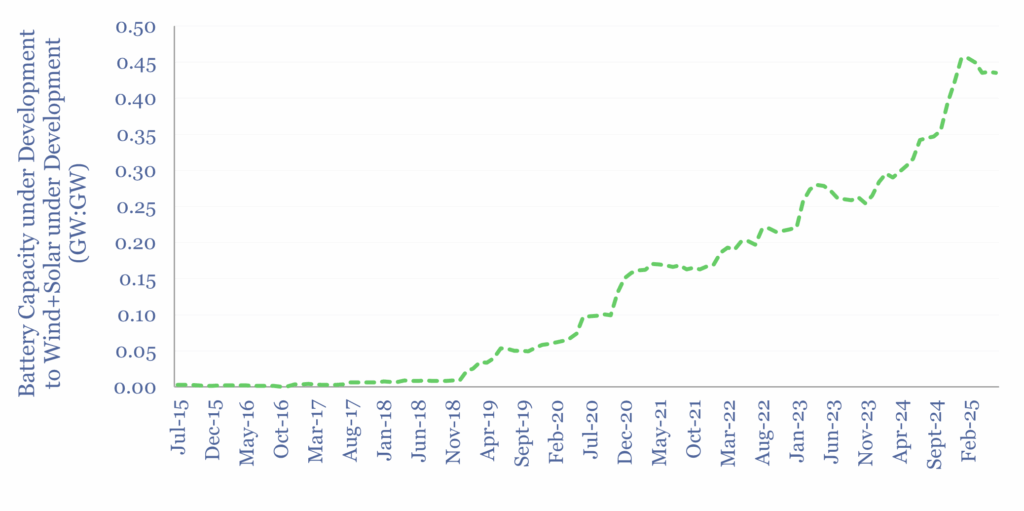
Another key reason for the upgrade is simply that we are seeing a larger ratio between battery additions and renewable additions in our grid tracker files, such as in the US power project pipeline (chart below).
BESS additions were about 85% grid-scale, and 15% smaller residential/commercial systems, on a global basis. The data-file contains forecasts for the share of grid-scale and residential batteries, by region, and over time.
By geography, 2024’s battery additions were about 55% China, 20% in the US and 12% in Europe, as the three largest markets. The data-file contains forecasts for the US, Canada, Europe, Japan, Australia, LatAm, China, India, other Asia and Africa.
Today, BESS capacity is equivalent to 2% of total global grid load, and this is seen rising to 6% by 2050, due to higher battery deployments, rising global electricity demand, and rising average battery duration.
Numerically, our forecasts are geared off of wind and solar capacity additions, with different scaling ratios in each region over time. Numbers can be stress-tested in the data-file.