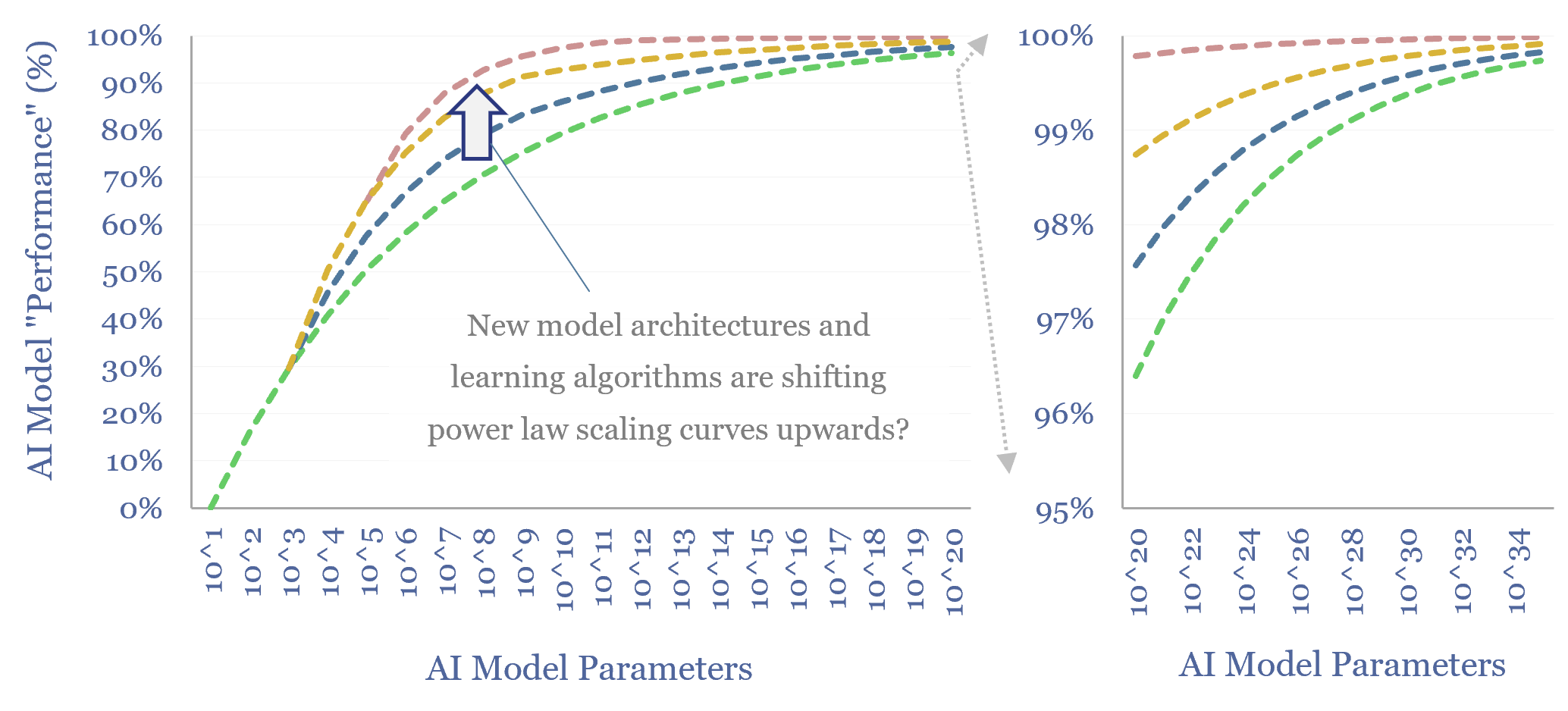
An argument for runaway energy use by AI is that performance follows a power law: incrementally better performance requires exponentially more model parameters, training data and compute. But this 13-page note finds evidence for greater efficiency gains, and considers whether AI scaling laws are set to slow down, meaning less energy consumption?
Everyone is still bluntly guessing at the future energy consumption of AI. The latest numbers, both for training and inference, are quantified on pages 2-3.
But something is fascinating in the recent data. There are famous AI scaling laws, also known as “power laws”, which state that incrementally better AI performance requires exponentially more training compute, and thus exponentially more training energy. But are these power laws now starting to slow down?
AI training energy is a crucial line item, when trying to estimate future global electricity demand, and slower growth in training energy could weaken US load growth.
An overview of AI scaling laws, from Kaplan to Chinchilla to real-world models, is thus provided from first principles on pages 4-6.
Software-driven jumps in the AI performance curve seem to have accelerated in 2024-25. Specific examples, and numbers, are reviewed on pages 7-8.
Hardware-driven jumps in the performance curve, or fundamentally new approaches to AI computing include neuromorphic computing and photonic computing, as briefly reviewed on pages 9-10.
Analogies might give a good roadmap for the efficiency gains ahead in AI. We present some read-acrosses from how shale ramped up, or how solar ramped up, on pages 11-12.
If AI training energy does reach 300 TWH pa by 2030, per our internet energy forecasts, then our best guess at what this will look like – by model count and model size – is presented on page 13.