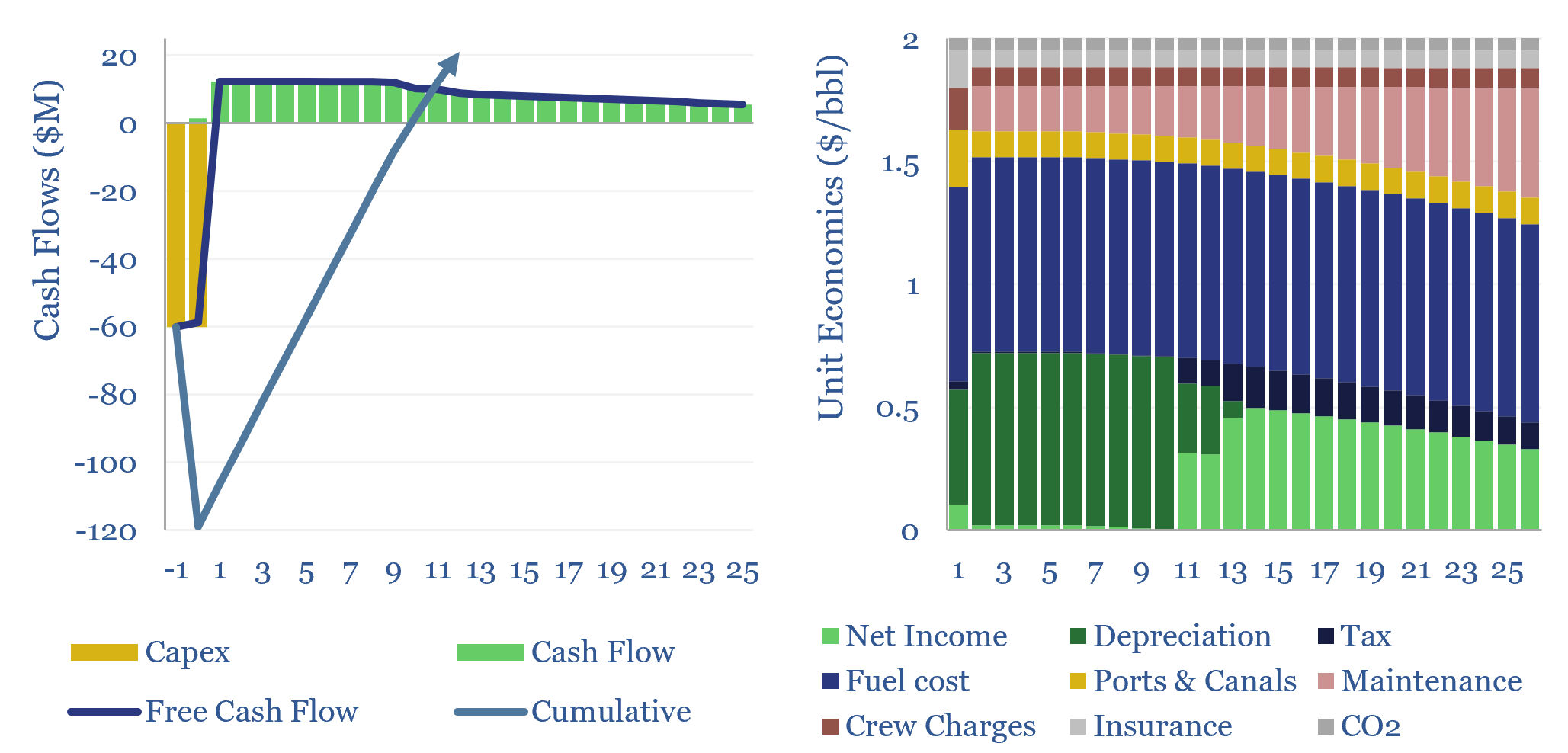
Oil tanker economics are captured in this model. A VLCC that carries 2.2Mbbls requiring a day rate of $100k/day to earn a 7-10% IRR, which equates to $2/bbl on cargoes moving from the Persian Gulf to China. Capex costs, fuel uses, engine sizes and other costs correlate with vessel size. The costs of oil tankers can be stress-tested.
A Very Large Crude Carrier (VLCC) might take 45-days to move 2.2Mbbls of crude from the Persian Gulf to, say, China and then complete the return journey.
We have modeled the economics in this data-file, complementing our other models into container vessels, bulk carriers and LNG carriers.
At recent average shipping rates of $2/bbl, an 8% IRR might be achieved on a new $120M VLCC; rising +1pp if you domicile in a low-tax geography, +2-3pp with leverage, falling -1pp for each future $15/ton in CO2e pricing.
Correlations between vessel size (in dwt, or in kbbls) and capex cost (in $M), fuel consumption (in bpd), engine size (in MW) and crew size (in # persons) are given on the capex costs tab.
A VLCC might consume 600-700bpd of fuel, which is high relative to other offshore vessels’ fuel usage, hence the entire global fleet of oil tankers itself consumes 1.6Mbpd of hydrocarbons, as part of our breakdown of global oil demand. Most routes are too long to electrify.
There is also no way a tanker, in pure economic terms, can be expected to traverse the Strait of Hormuz if there is even a 0.1% chance of being attacked.
Hence, tanker rates from the Persian Gulf to Asia, which normally average $80-100k/day ($2/bbl), blew out to $420-440k/day in March-2026 ($9/bbl), which perhaps makes it economically rational to ship even if there is a 3% chance of being attacked. But even then, credible threats to shipping are likely enough to stall almost all maritime shipping.
Please download the data-file to stress-test oil tanker economics. Other vessel sizes are also captured, such as Suezmax, Aframax and product tankers. Similar economics will also apply to moving other liquid bulk commodities.