Hyperspectral imaging captures 30-100x more data from a visual scene than cameras or the human eye, binned into narrower bands, across a wider spectral range. These data, available in real-time, and inherently dovetailing with AI models, are increasingly valuable in food, agriculture, mining, waste-management, oil and gas and manufacturing. This data-file screens leading hyperspectral imaging companies and case studies.
A typical camera, e.g., based on CMOS image sensors, captures the intensity of light in the red (610-700nm wavelength), green (500-570nm) and blue (450-495nm) color bands. This configuration closely matches the sensitivities of different types of cone cells on the human retina, at 500-690 nm, 534-545 nm, and 420-440 nm. Hence ‘color’, as we perceive it, is effectively a three-dimensional simplification of a much richer world.
Hyperspectral imaging cameras capture this richness, by illuminating the world across over 100, possibly over 300 spectral bands, spanning from 250nm ultraviolet to 15μm far-infrared. Each band is very narrow. There is 30-100x more data to process. But from the data, more useful information can be extracted.
For example, the case studies in this data-file use hyperspectral imaging cameras to distinguish between items that might look identical to the human eye: e.g., different black plastics, textile fibers, specific minerals in rocks, or precise chemical compounds in pharmaceuticals.
This is useful. For example, real-time mineral mapping is possible during mining or from the cuttings in oil and gas drilling. Real-time quality control is possible in manufacturing, e.g., for semiconductor wafers. And several companies in our screen of next-gen waste management are using hyperspectral imaging to sort otherwise indistinguishable black plastics and fibers.
Another major application is in monitoring food quality and plant health, which in turn, is being used to improve crop yields in precision agriculture, pick produce closer to its ideal ripeness, and develop varietals that are more resistant to drought, salinity and disease. This matters for global food production and possibly also for biofuels.
The global market for hyperspectral imaging systems is estimated at c$500M, and growing at 13% per year, based on a survey of half-a-dozen market sizing studies from other research firms.
Hyperspectral imaging cameras can cost $10-300k, depending on quality, but medium-grade systems are mostly in the range of $50-100k. Power consumption is mostly below 10W, but can be as high as 50W.
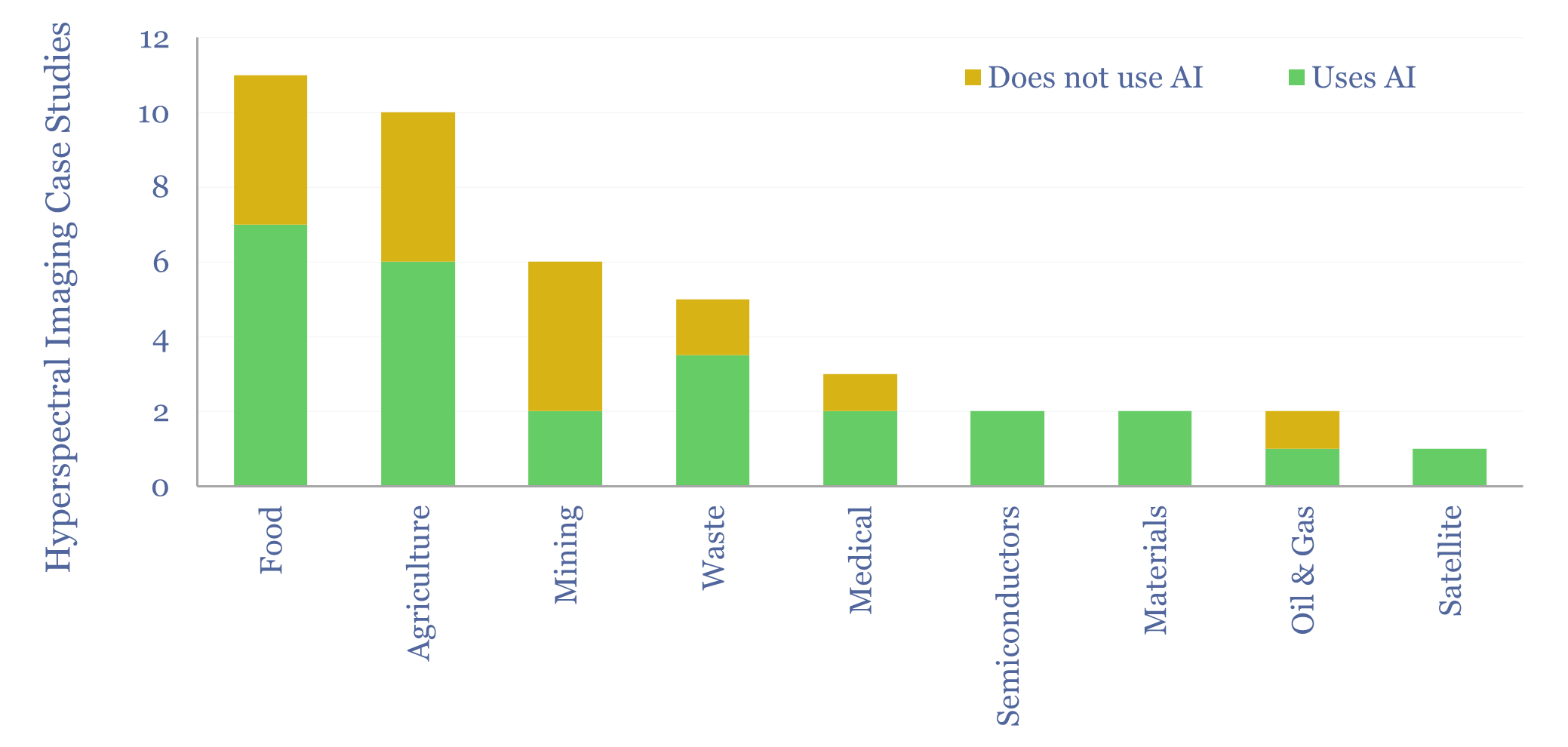
AI is a crucial enabler. 60% of the case studies in our data-file use AI to translate the complex data outputs from hyperspectral imaging cameras into useful inferences. You might even infer that until the AI era, growth in hyperspectral imaging has been held back by the inability to rapidly process rich data into actionable insights.
Hyperspectral imaging and AI should thus grow in tandem, and mutually support one another. For example, you might not intuitively think that AI would be doing much in the $33bn pa potato chip industry. But in one case study from Resonon, a hyperspectral imaging scans potato chips across 68 wavelengths, and feeds an AI, which then infers the oil content of the potato chips in real time (prior methods require destructive testing of the sample, and are slow, and expensive). In turn, this can be used to improve food processing, avoiding excessive oil usage, which has health, taste and cost implications. This weird and wonderful example does help to de-risk our long-term forecasts for AI energy demand.
Leading hyperspectral imaging companies are profiled in the data-file. Effectively all are private companies, although one of the leaders, Specim, which is headquartered in Finland, is a subsidiary of Japan’s Konica Minolta Group.
We found the hyperspectral imaging case studies in this data-file to be fascinating, deepening our view that AI is going to have broad-reaching opportunities around industry, which no company can afford to ignore; and to lift demand for several categories of high-grade sensors, especially data-rich sensors, such as hyperspectral imaging systems.