Inertial Measurement Units (IMUs) comprise accelerometers, gyroscopes and possibly magnetometers. These inertial sensors tell you how fast you are traveling, how far, and in which direction. The market is worth $30bn pa today and expands to $80bn by 2035, due to the rise of physical AI. This 14-page report is our overview of inertial sensing and leading sensor companies.
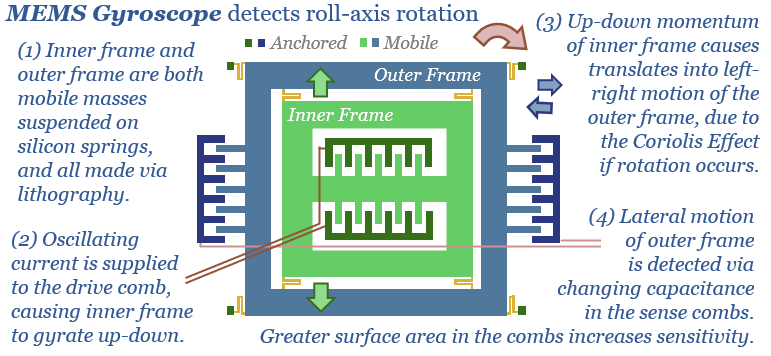
MEMS accelerometers and gyroscopes are mass-manufactured at μm-scale via Deep Reactive Ion Etching and lithography. Their importance and their functioning is explained from first principles on pp 2-4.
Gyroscopes tell a device how far it has tilted in a particular axis. Accelerometers tell the device it sped up or slowed down. This aids user experience in consumer electronics, safety in vehicles and heavy equipment, and balance in robots/drones.
Dead reckoning uses IMUs for navigation in areas without GPS coverage. Location can be deduced from your starting point, distance traveled, and direction of travel.
MEMS Inertial Measurement Units are increasingly economical, sensitivity, compact and capable, helped by advances in lithography and processing power.
We compare and contrast the costs and performance of IMUs against fiber-optic gyroscopes and other precision instrumentation on pages 5-7.
We can envisage the IMU market rising by 2.5x over the next decade to surpass $80bn pa by 2035, especially due to physical AI, and most especially robots and drones, as part of an AI energy transition, per pages 8-9.
In the physical AI eco-system, every robots and drone will feature an IMU. Perhaps as many as 2-8. Thus physical AI expands the IMU market by 60% by 2035.
In defense, allocating $200M of spending to 10,000x high-grade drones, rather than say to 1x large fighter jet, would also increase underlying IMU demand by up to 10,000x.
Hence we have screened leading inertial sensor companies. Our observations on this company landscape are on page 10.
Key details on individual companies in inertial measurement, inertial sensing, and their inertial sensor deployments in specific contexts, follow on pages 11-14.