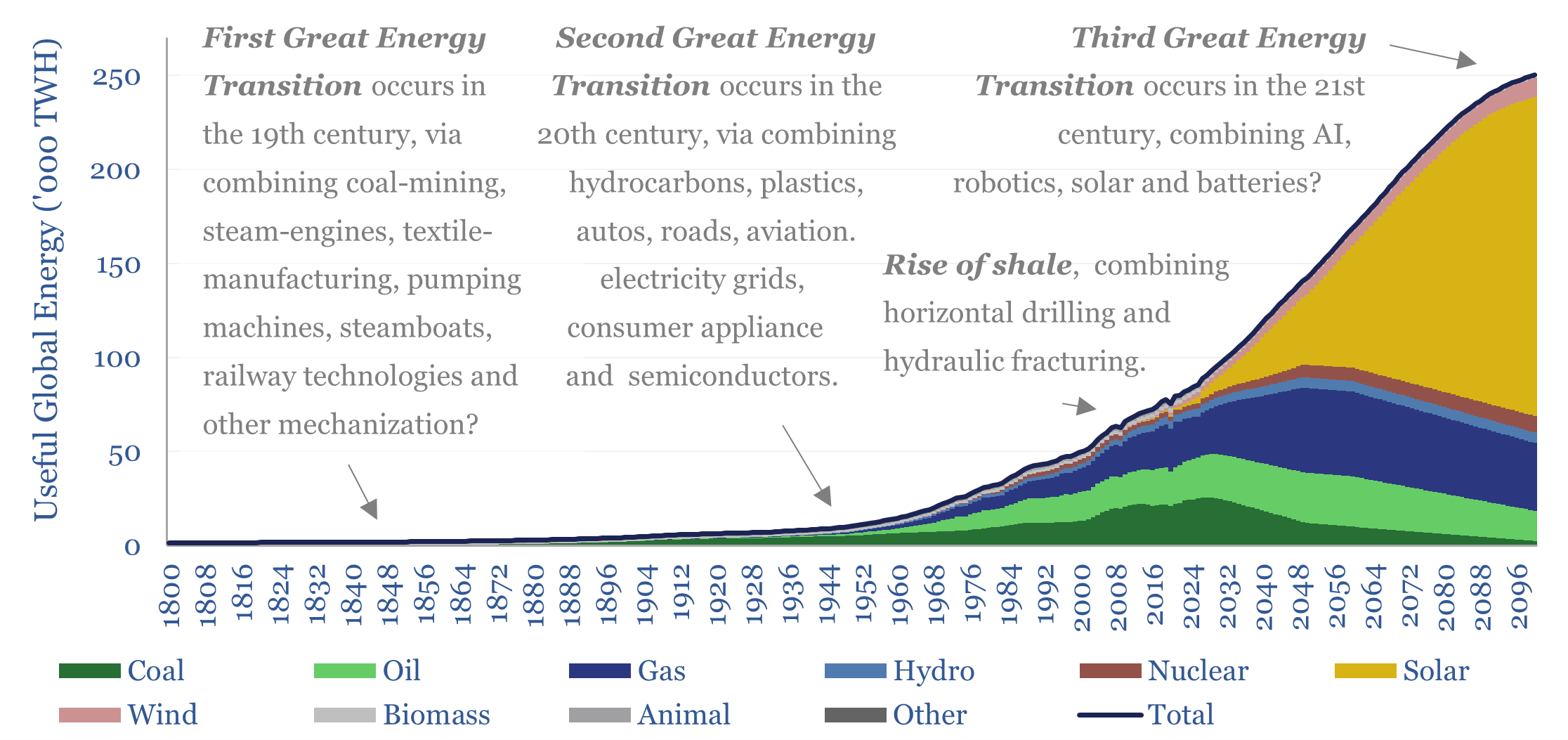
Great industrial leaps often occur when technologies collide. Hence this 20-page report explores how AI, solar, batteries and robotics might all collide together. This is transformative for the world. It represents the next “energy transition”. Hence this also becomes our new roadmap for the evolution of the global energy system.
The history of energy transitions starts with a minuscule global energy system, of 1,000 TWH in 1800, c99% dominated by muscle power and burning biomass. Then came the rise of coal, as total human energy use quadrupled by 1900, and coal provided two-thirds of the growth, unleashing steamboats, and mechanization, and railways.
But coal mining in Britain goes back to Roman times, and in China it goes back to the Han Dynasty, also two millennia earlier. The industrial revolution took off because of shallow coal mining AND the steam engine AND the mechanization of textile production, all colliding together.
Similarly, the US shale revolution, which changed the world, slowed US inflation by 0.7% pa for 15-years, and made the US energy self-sufficient, came from combining hydraulic fracturing (pioneered at vertical wells in the Hugoton gas field, in Kansas, by Stanolind, in 1947) and horizontal drilling (first undertaken in 1929, in Texas).
In this 20-page report, we argue that the next great energy transition also comes from technologies colliding, especially AI, robotics, microelectronics, solar and batteries. We chart how this is transformative for various industries. And we present case studies showing this technology transition is now getting underway.
The role of solar in this energy transition hinges on its vast scale and deflating costs. Including by using AI in the design of multi-junction cells and to automate solar installation. But the challenge so far has been absorbing solar’s daily and seasonal volatility patterns, per pages 4-7.
AI and robotics will help absorb solar, including in autonomous trucks (page 9), logistics (page 10), agriculture (pages 11-12), construction (pages 13-14) and material science (pages 15-17).
In particular, our case studies suggest a possible golden era for infrastructure-building. Large portions of the compute will be embedded in mobile machines rather than data centers? And depreciated chip-sets may be run ever more flexibly to try to unlock material science breakthroughs.
We are often asked how AI will change the global energy and industrials landscape. The knee-jerk reaction in 2025-26 has been for decision-makers to fixate on the immediate electricity demand of powering large AI data-centers. It is much broader, unlocking an entire AI energy transition. Our updated outlook for US electricity demand, and the means of powering data centers (in GW, by year) are on pages 19-20.