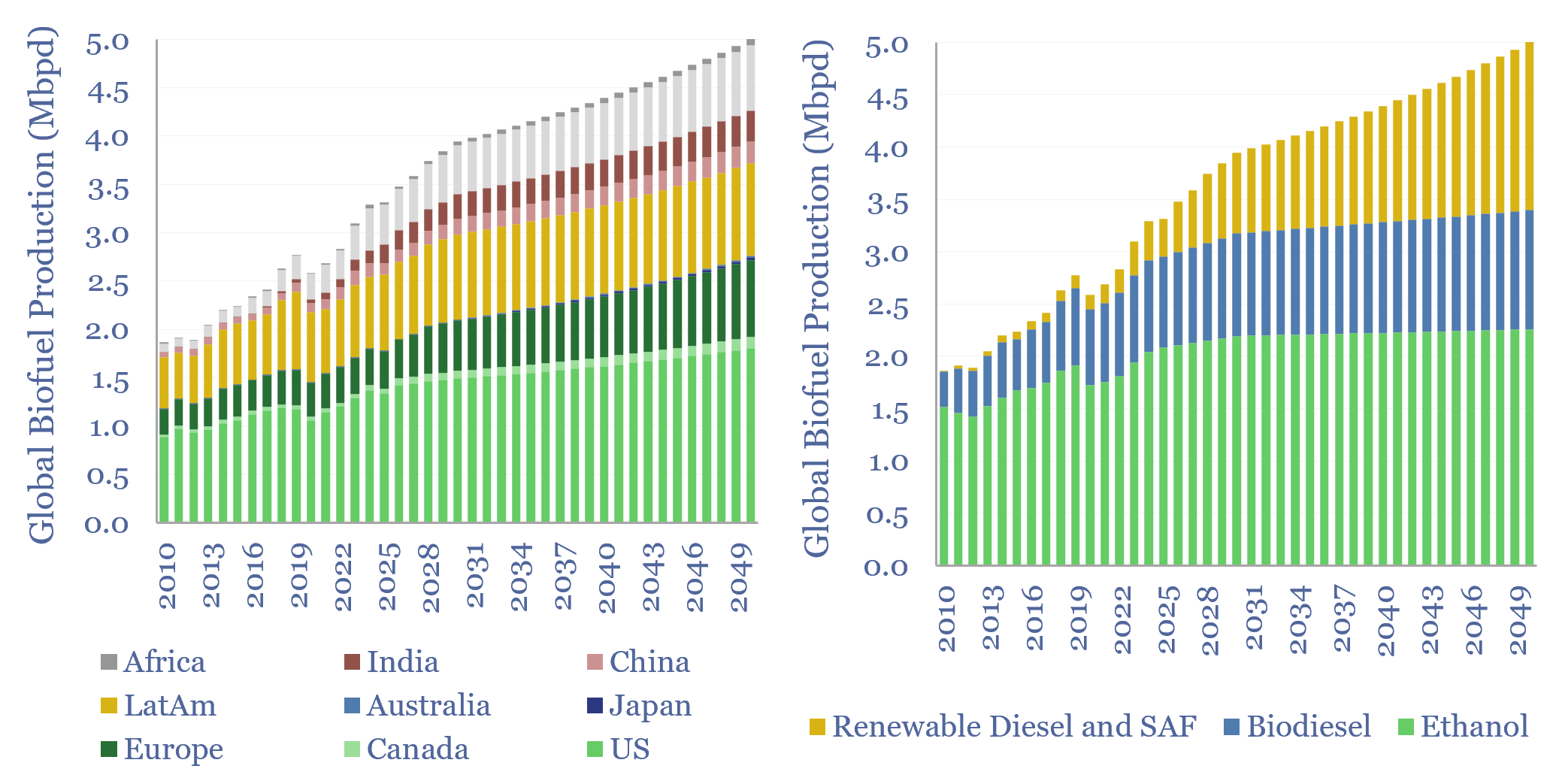
Global liquid biofuel production ran at 3.3Mbpd in 2025, of which c60% is ethanol, c30% is biodiesel and c10% is renewable diesel. 65% of global production is from the US and Brazil. Our forecasts for global liquid biofuel production reach 3.8Mbpd by 2030 and 5Mbpd by 2050, with 75% of the growth in renewable diesel.
This data-file estimates global biofuel production, for liquid biofuels, by region, by fuel, by year, based on industry data, technical papers and our own facility-by-facility tracking.
Global ethanol production stands at 2Mbpd, in volumetric terms. The US produces 1Mbpd of corn ethanol, while we see increasing value in the sugar-based bio-ethanol industry from valorizing waste bagasse, vinasse, other biomass and in backstopping increasingly volatile grids.
Biodiesel production is nearing 900kbpd, made via trans-esterification of the triglycerides in agricultural oils, detaching fatty acid methyl ester (FAME) from its glycerol backbone. FAME can be blended with diesel, up to c10%. We have also modeled biodiesel economics.
Renewable diesel production is estimated at 360kbpd in 2025, and is the fastest growing category in liquid biofuels, up 5x in the past decade, potentially doubling again by 2030 and surpassing 1.5Mbpd by 2050. It is a drop-in fuel, created by extensively hydrotreating waste oils, albeit at higher costs due to the logistical challenge of obtaining feedstock. We have also modeled renewable diesel economics.
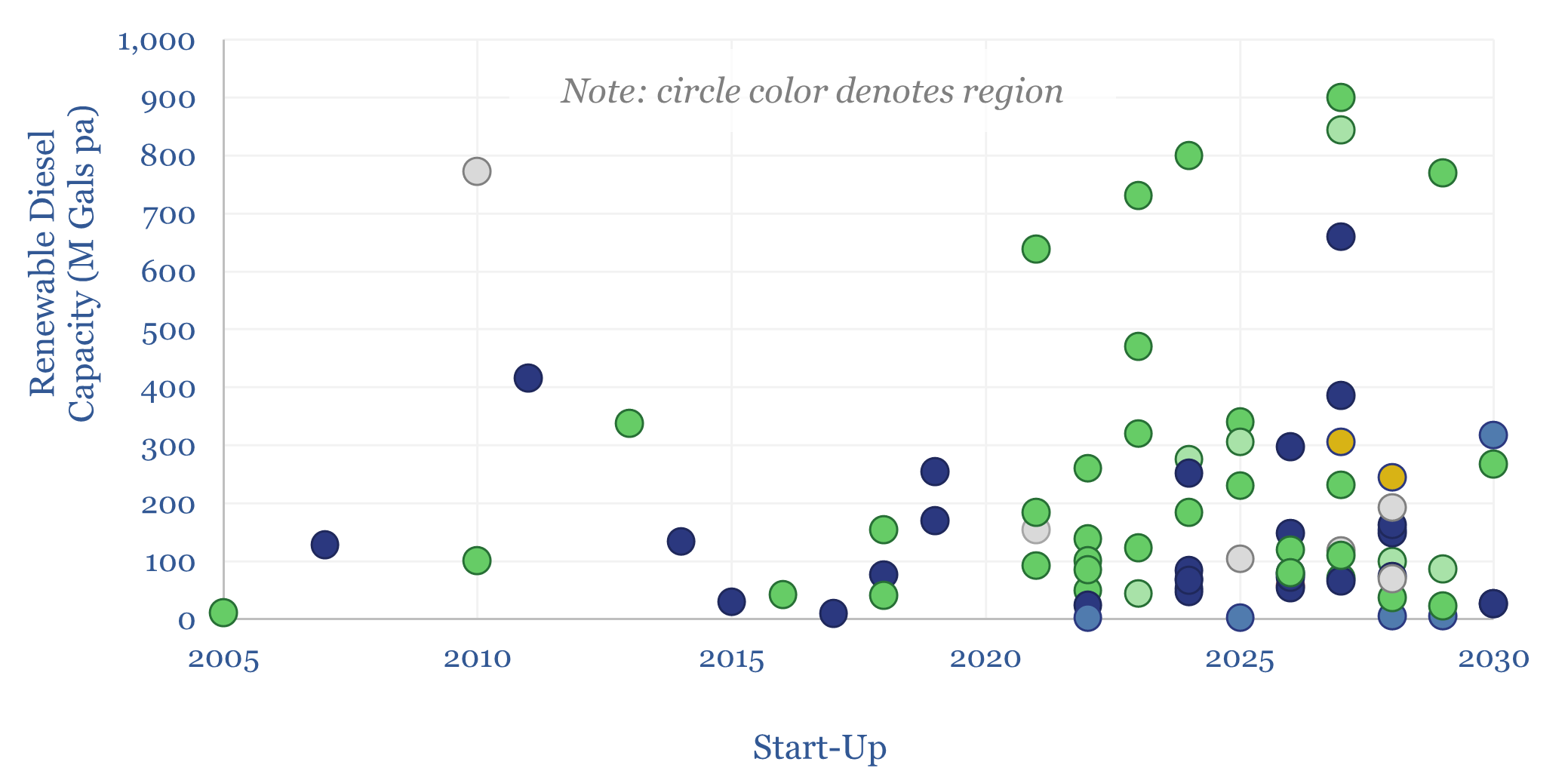
There is most activity in renewable diesel, hence we are tracking renewable diesel facilities in the ‘RD facilities’ tab of the model. Each project is summarized, risked and our notes follow in column N.
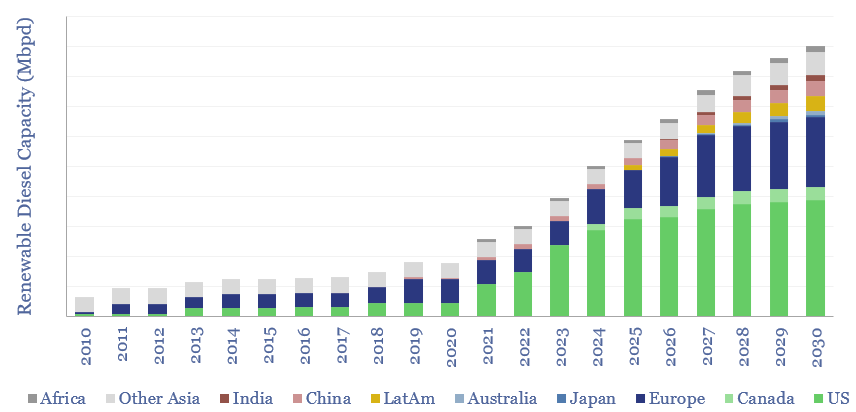
What about SAF as an alternative to jet fuel? Note that our numbers for renewable diesel include synthetic aviation fuel (SAF) that is made predominantly from the same pathway as renewable diesel, but then further paraffinized into straight-run aliphatic alkanes. Many new facilities in our databases are co-producing both renewable diesel and SAF. Note that other forms of SAF may be made from biogas-to-liquids, alcohol-to-jet or e-fuels.
Our biofuel forecasts through 2050 see ethanol running flat, as ethanol is mainly blended in with gasoline, where the electrification of vehicles is denting demand from 30Mbpd today to 20Mbpd by 2050. Biodiesel growth is driven by the emerging world. Renewable diesel grows most, helped by improving oil crops and the use of small mobile robotics to gather waste oils.
Full numbers are available in the data-file, breaking down liquid global biofuels, by region, by fuel, and over time, in kbpd, in M gallons and M liters per year.