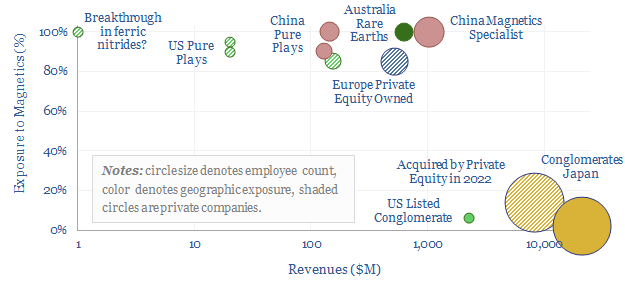
The global magnet industry is fragmented across hundreds of suppliers, including 800 in Asia-Pacific. The total market for magnetic products is worth $20bn pa, of which $10bn is NdFeB Rare Earth magnets. The purpose of this data-file is to highlight 20 leading companies producing Rare Earth magnets, their size, economics and recent focus.
End markets for magnets include electric motors, including for electric vehicles, HVAC applications such as air conditioners and heat pumps, servo motors for robotics, and electrical induction in wind turbines.
More mundanely, permanent magnets are also sold into ordinary household appliances like tumble dryers, iDevices and audio equipment. Indeed, the largest specialist magnets companies in our screen sell products to over 2,000 active customers, ranging from <1mm micro-magnets to 200mm monsters, with energy products from 1-60 MGOe.
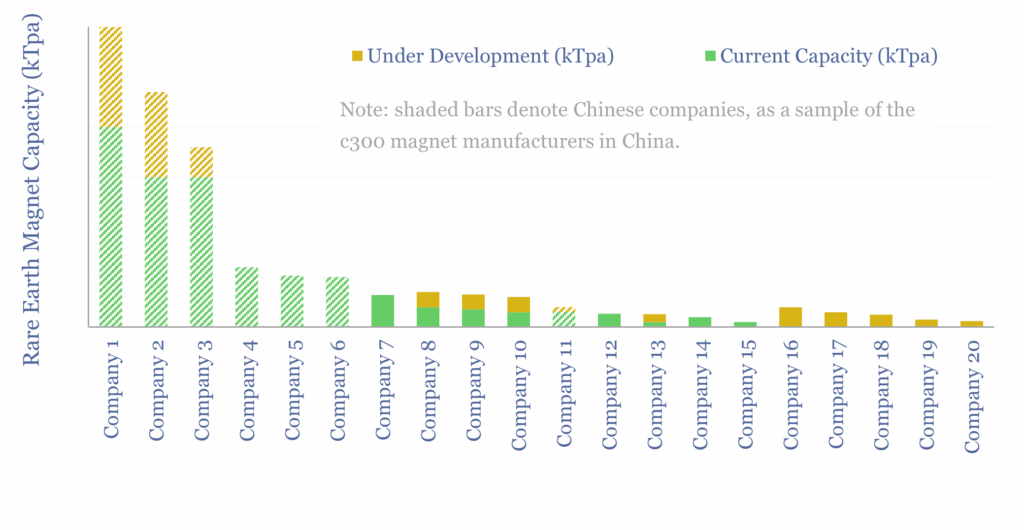
Companies producing Rare Earth magnets are profiled in this data-file, especially 20 of the largest and best-known producers, where we have quantified production capacity, size, revenues, pricing and other recent news flow.
Companies producing Rare Earth magnets will typically start with inputs such as neodymium, specialized steel grades and ferroboron, combine the materials in an induction furnace, pulverize the product, form magnet blocks, sinter the magnets, then shape the blocks into specifically shaped products, as required by their customers.
92% of the world’s sintered magnets are currently produced by Chinese companies, and the largest half-dozen companies in our data-file are all Chinese.
High competition is borne out by middling margins, which have recently run at just 3-6% for some of the Chinese magnet manufacturers. Sales prices can also be calculated by comparing revenues with implied volumes.
Companies producing Rare Earth magnets outside of China are also expanding capacity and announcing magnet manufacturing plants, across the US, Japan, Korea, Europe and other Asian countries. Plans are profiled in the data-file.
Private permanent magnets companies. An interesting trend in the screen is rising private equity activity. For example, a consortium led by Bain Capital acquired Hitachi Metals in 2022, and re-spun the company as Proterial in early 2023.
Diversified companies are also noted in the screen, with Rare Earths, magnetic materials or magnet components as part of the broader commercial portfolios, including a leading Japanese large-cap.
Useful industry data-points behind the note, such as different magnet types and their typical properties and magnet costs ($/kg), are also compiled in the data-file.
Our other Rare Earth data-files cover Rare Earth materials, Rare Earth production economics, Rare Earth magnet demand, Rare Earth magnet manufacturing costs.