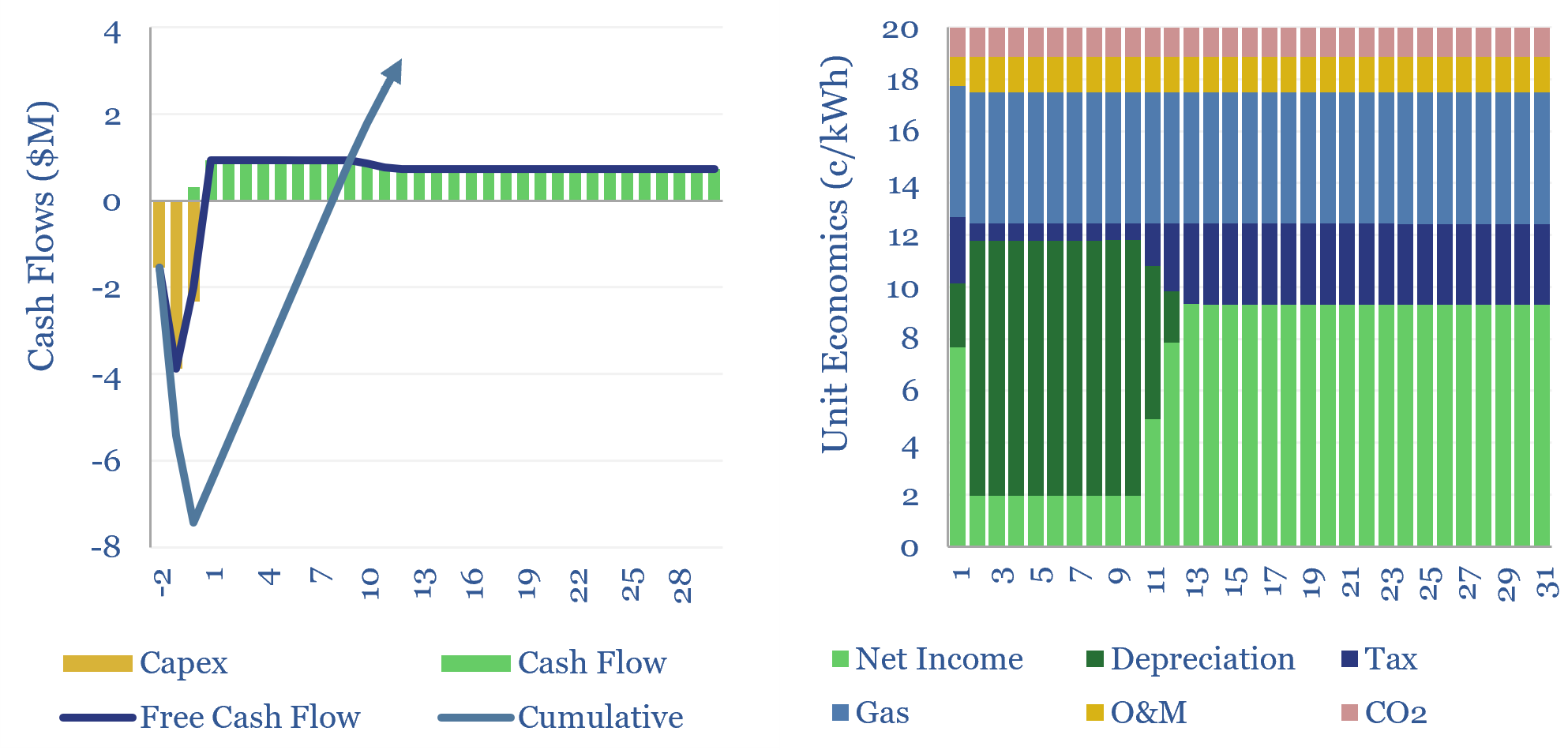
Microgrid economics are captured in this data-file. A 20c/kWh levelized cost of electricity is needed to generate a 10% IRR on a typical $5,000/kW system, sourced by solar, batteries and gas generation, plus controllers, switchgear and instrumentation.
A microgrid consists of one or more generation sources, supplying electricity to multiple loads, with the capability of operating as an island, without necessarily drawing power from a larger regional grid.
Many types of microgrids can be deployed, as evidenced in our database of microgrid companies and projects. However, a particularly interesting concept is a combination of solar, batteries and gas-fired reciprocating engines.
Capex costs of microgrids are built up as a sum-of-the-parts in this data-file, drawing on technical papers, power electronic costs, and concluding that a large share of cost is embedded in designing and installing a highly bespoke system.
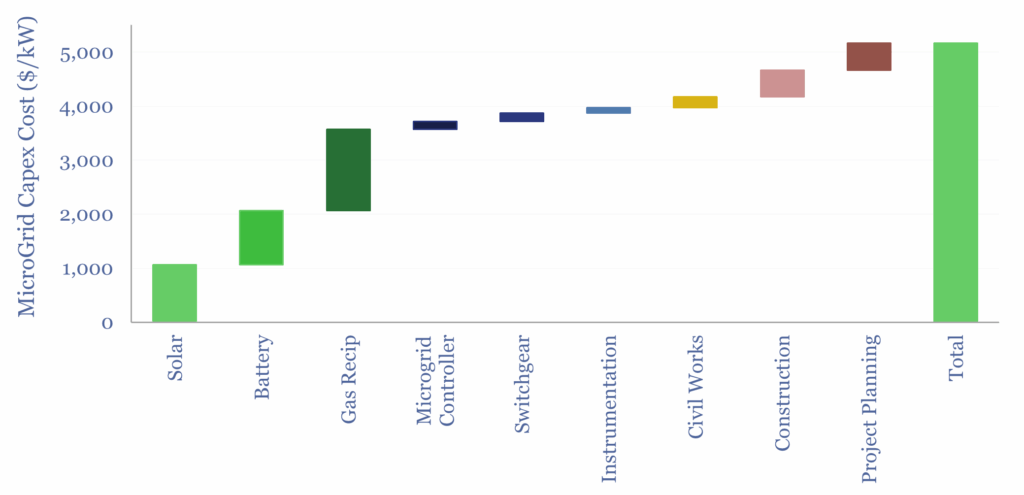
A 20c/kWh electricity price enables a 10% IRR at a typical 1.5MW microgrid costing $5,000/kW to deploy, that achieves 60% utilization, although the numbers depend on input parameters.
Different fuel sources can be compared in the data-file by flexing the gas-equivalent fuel price (in $/mcfe). A diesel-fired microgrid is likely c50% more costly. Our base case includes commercially distributed gas prices. Numbers may be moderately higher for small-scale LNG.
Please download the data-file to stress-test the microgrid economics: i.e., what is the economic sensitivity of microgrid costs to gas prices (in $/mcf), capex costs (in $/kW), utilization rates (%), overbuilding of the solar/battery (%), gas-power efficiency (%), battery round-trip efficiency (%), CO2 prices ($/ton), O&M costs ($/kW/year), and other economic inputs.