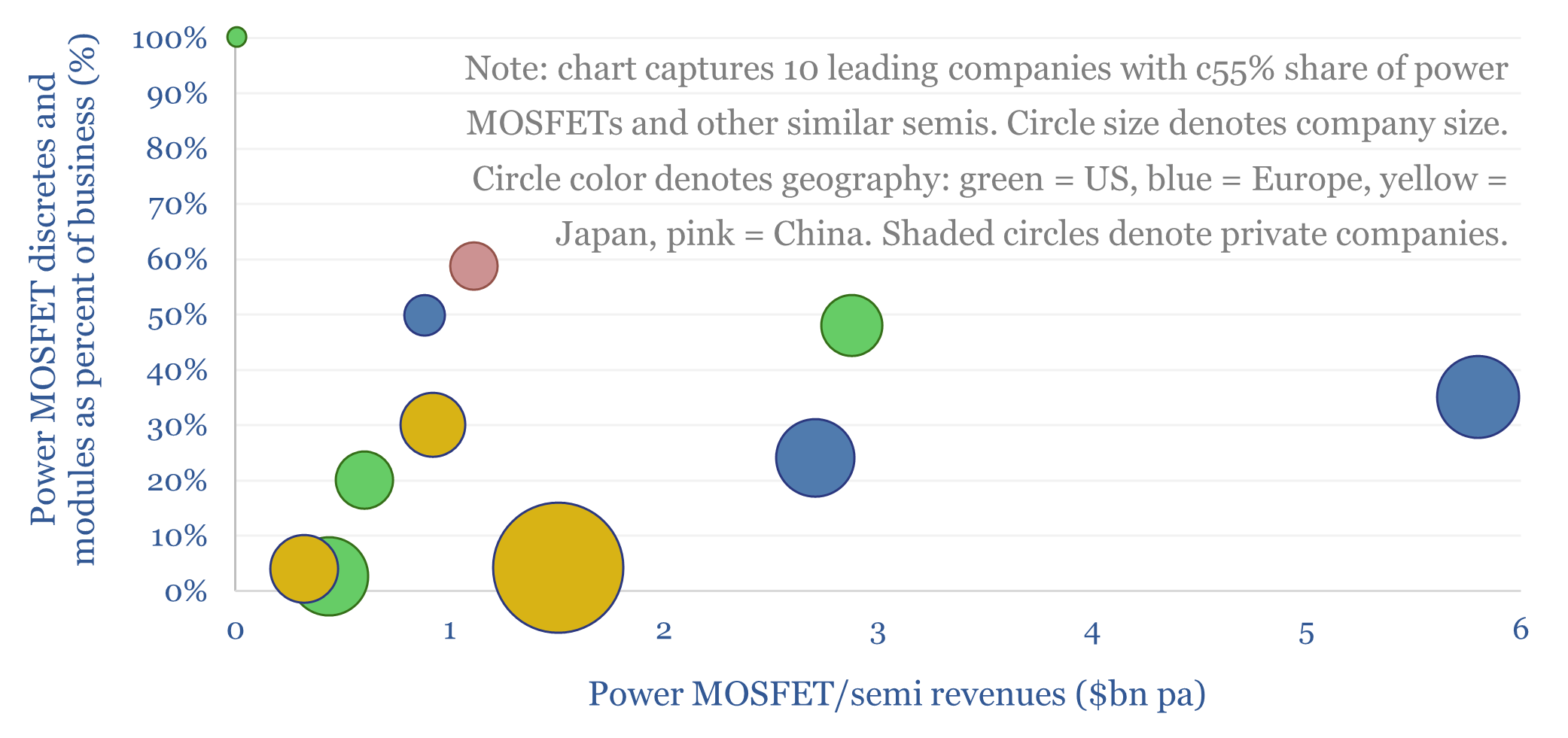
Power MOSFETs are an energy transition technology, the building block behind inverters, DC-DC converters, EV drive trains, EV chargers, renewables-battery interfaces and increasingly, the power conversion architectures for upscaling rack density at AI data-centers. Hence this data-file is a screen of power MOSFET and active semiconductor companies.
This data-file screens companies making power-MOSFETs, especially silicon carbide MOSFETs and underlying materials. For more details of these fast-acting semiconductor switches, and why they matter in the energy transition, please see our overview of MOSFETs.
For each case, we have charted the company’s revenues, their split by product/customer/geography, operating margins, employee count, market share in MOSFETs and other active power semiconductor modules/discretes, progress in wide-bandgap solutions (SiC/GaN), and gearing up into AI.
Covered companies in the data-file include leaders such as Infineon, onsemi, Rohm, STMicroelectronics and Renesas. There are also Japanese conglomerates, new Chinese suppliers, and smaller-cap entrants such as Ideal Power.
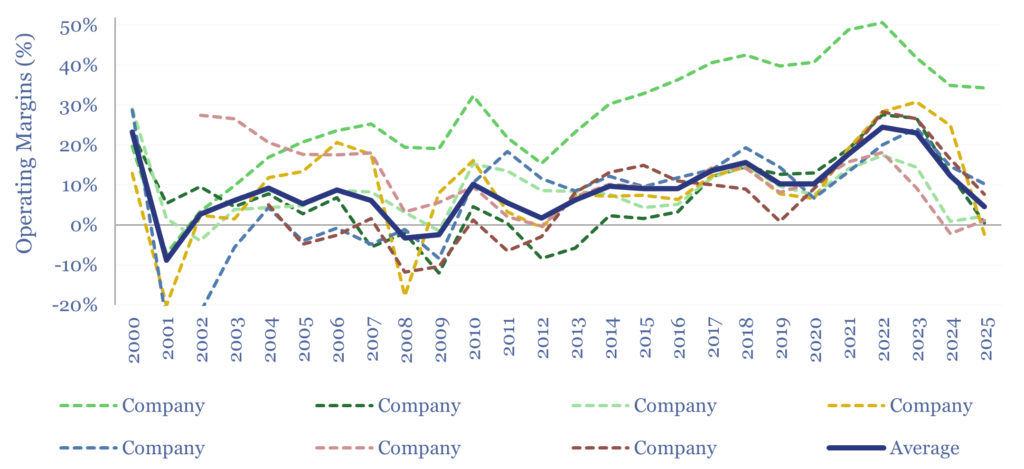
Margins and returns for active semiconductor companies have recently been in the doldrums, however, falling from 24% in 2022-23 to 12% in 2025. Across this group, c40-45% of revenues are from selling into the automotive industry, hence the industry has been hurt by downgrades to EV sales forecasts. Intense competition has been a further headwind.
However, every single active semiconductor company in our screen is now citing strong growth potential in AI. Notes are in the data-file, and also in our deeper-dive research into the power electronic components needed to increase rack density in AI data-centers, such as LLC topologies for 800V DC architectures, and solid state circuit breakers.
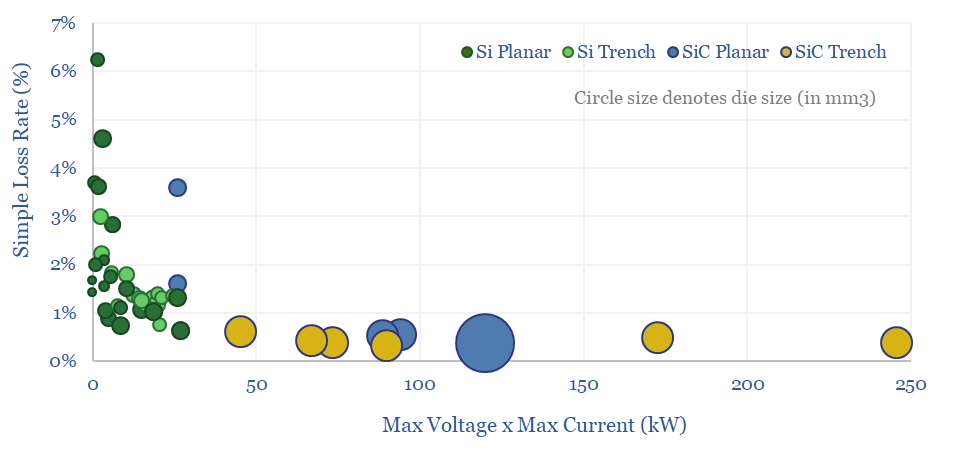
To help compare the companies making power MOSFETs, we have also tabulated the technical parameters for 50 power MOSFETs in early-2024: maximum voltage, maximum current, on resistance, die size, power dissipation, and simple-implied loss rates. The data imply that SiC devices have 50% lower on-resistivity than Si devices, trench-type MOSFETs can have 3x higher power density with lower overall loss rates. SiC trench devices had some of the highest power ratings and lowest loss rates, yet only two companies in our screen appeared to make them! Details in the data-file.
Other backup tabs in the data-file include data aggregated from technical papers, into the relative efficiencies, costs, temperature performance and other technical data of SiC semiconductors, especially compared to traditional silicon.