Rockwell Automation is the largest pure-play automation company in the world. It integrates real-time data and controls thousands of components across typical industrial facilities, often saving energy, costs and raising throughputs. This data-file reviews its product offering, case studies and IoT and automation acronyms.
Rockwell Automation was founded in 1903, is headquartered in Milwaukee, Wisconsin, and employs 27,000 people. Rockwell advertises itself as the largest pure-play automation company, including the Allen-Bradley, FactoryTalk and LifecycleIQ services.
Rockwell’s three segments manufacture Intelligent Devices ($3.8bn of revenues in 2024, at 20% 3-year EBIT margins), provide Software and Controls ($2.2bn, 29%) and provide Lifecycle Services, effectively consulting, for the design and implementation of automation solutions ($2.3bn pa, 11%).
There is an increasing focus on using AI/machine learning across the industrial landscape, but an important precursor for this is to integrate data from and send control signals to hundreds, possibly thousands, of individual sensors, meters, motors and other plant components.
The architecture needed for industrial automation is summarized across 30 case studies and 10 IoT acronyms, which are illustrated with examples in this data-file: RTD, DCS, MPC, ERP, VFDs, HMIs, OEMs, ML, PLCs, AMRs (!).
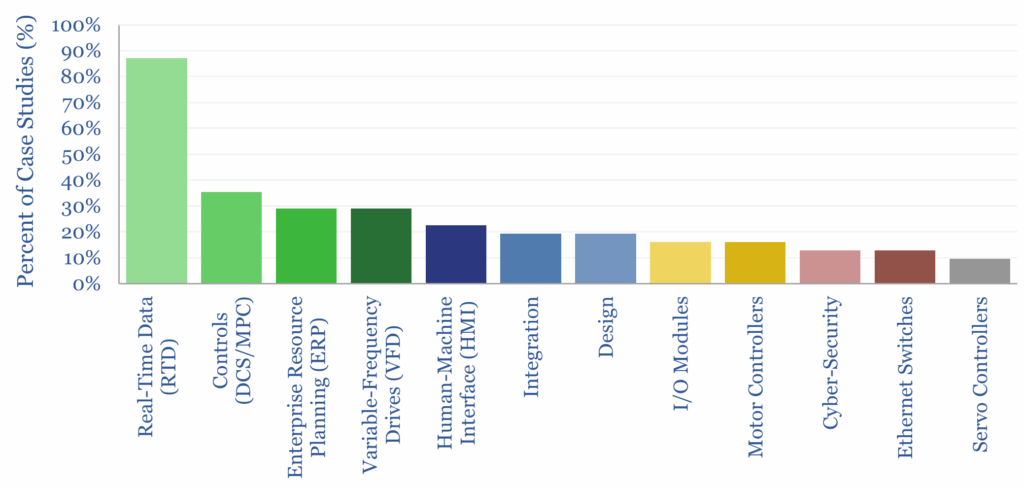
Real-time data (RTD) is the ability to see process parameters across an industrial asset. 90% of the case studies from Rockwell Automation involved gathering and using real-time data. This can help increase output from +2% to +200%, with a median of c20%, and can also unlock energy savings of 5-20%, across the case studies. Often with <1-year paybacks.
A DCS is a Distributed Control System, a computerized network, allowing for real-time, coordinated management of an industrial asset, across a large array of sensors and equipment. What stood out in the case studies is how industrial facilities – from cheese factories to chemicals plants – can often have several thousand meters and motors to integrate.
MPC moves a level further, and uses Model Predictive Control, to predict the evolution of process parameters across an industrial facility, and thus use these predictions to optimize/control the facility. In one case study, a materials manufacturer reduced the consumption of expensive inputs by 1.2-1.5%, reduced waste by 50% and also reduced energy and CO2.
ERP stands for Enterprise Resource Planning and comprise c30% of the Rockwell case studies we reviewed. An integrated system distributes information across a company, tying conditions in a facility to sales, procurement and finance functions. In one case study, a metal parts fabrication company used an ERP to increase machine availability by 8pp and reduced annual inventory losses from 15% to 2%.
Motor drivers and controllers include Variable-Frequency Drives, which can reduce energy consumption by 45% compared to simple motors that often end up over-powered. We also profile the use of HMIs, integration of data/controls from multiple OEMs, ML case studies, PLCs and autonomous mobile robotics (AMRs).
Across our broader research, we have been focused on low-voltage solutions that will help the industrial deployment of AI, such as wireless networks and instrumentation from companies such as Emerson.