Could the electricity demand of Wi-Fi networks surprise to the upside due to AI, as 100bn future devices relay 1-10Mbps of data, including for machine vision? This 15-page report outlines Wi-Fi energy economics from first principles. Vastly more network traffic can be supported, simply via efficiency gains.
Wi-Fi is boringly defined as the networking protocols following Standards 802.11x from the Institute of Electrical and Electronics Engineers (IEEE).
It gets more interesting when it is used to form local area networks (LANs), so that multiple devices can communicate via microwaves at 2.4 GHz or 5.0GHz frequency.
But by definition, Wi-Fi microwaves are part of the electromagnetic spectrum, as re-capped on page 2, which means that fundamentally Wi-Fi is communication via energy waves.
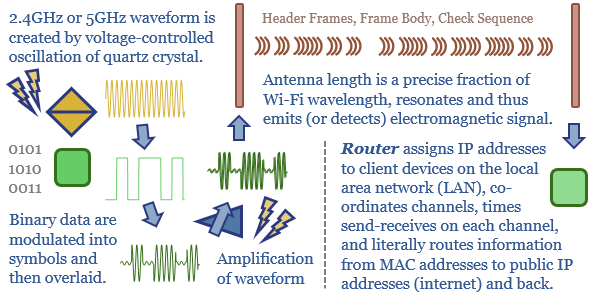
Wi-Fi signals are generated via the network interface controller chip (NIC) within any Wi-Fi capable device. The end-to-end process, including the structure of frames, acquisition of private IP addresses, bandwidths and channels, is described succinctly on pages 3-5.
How much energy is needed for Wi-Fi communication? The theoretical minimum electricity demand of Wi-Fi is given by the Shannon limit, which is also calculated from first principles on pages 6-8.
Real-world Wi-Fi devices today use around 100M times more energy than the Shannon Limit, even after accounting for attenuation losses, based on technical papers and router data reviewed on pages 9-10.
The industrial landscape is already constellated with Wi-Fi enabled devices, for example, the instrumentation and controls from Emerson. But increased data demands of AI and machine vision are covered on pages 11-13.
Our conclusion is that we can accommodate this vast increase in networking traffic without upgrading our forecasts for networking energy, for the reasons on pages 14-15. This is important for load growth forecasts.