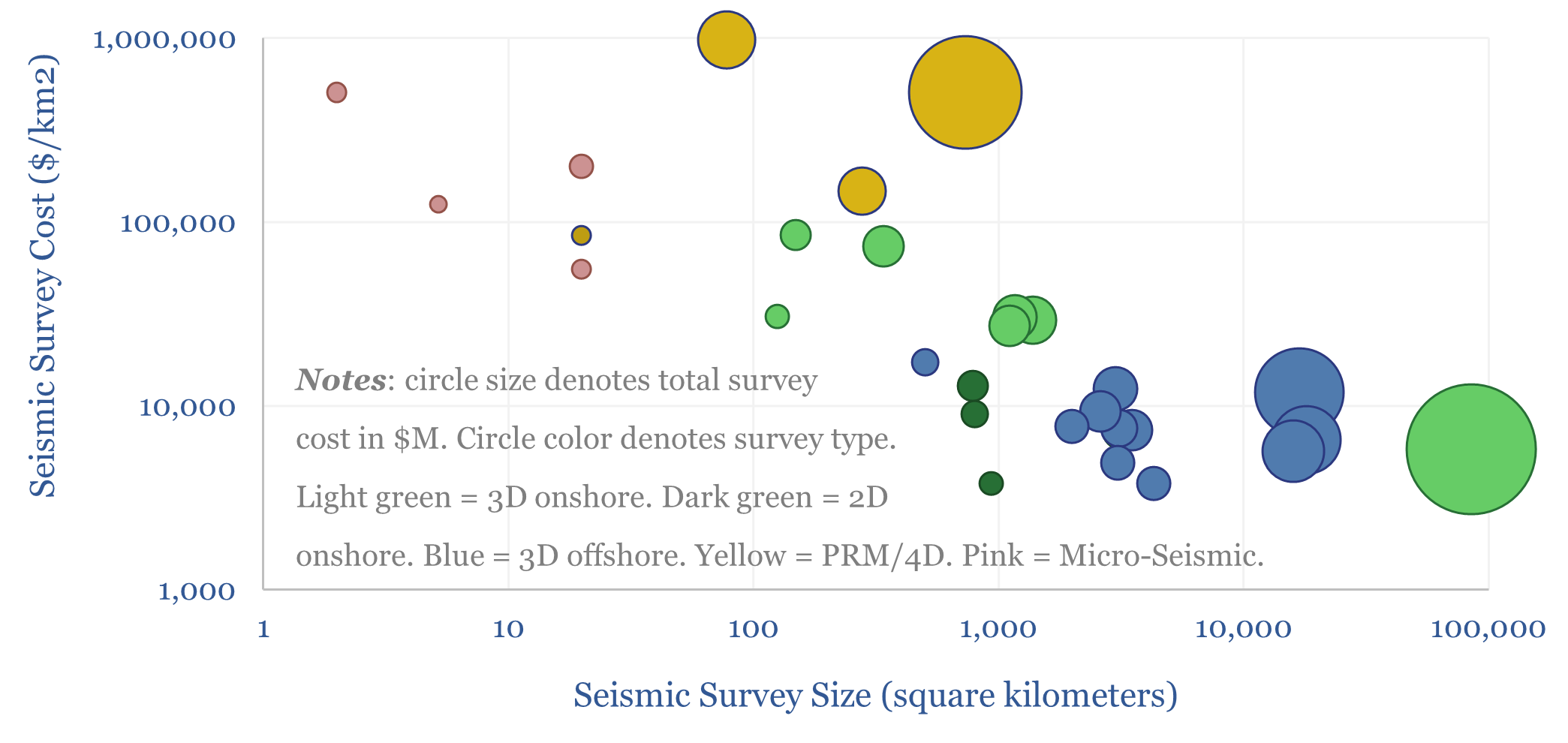
Seismic survey costs are tabulated in this data-file based on public domain disclosures from E&Ps and seismic companies. Seismic costs can range from $4,000 to $1M per square kilometer, depending on the survey size, resolution, timing, and location. Key case studies are in the data-file.
Seismic imaging involves generating seismic waves via vibroseis trucks or air guns, and then listening for the return signals via geophones or hydrophone streamers, as they reflect off different rock layers in the sub-surface. Computer methods then invert these raw gathers into images of the sub-surface.
The global seismic industry is most likely valued at $9bn in 2024. Seismic survey costs are not usually disclosed in the public domain. But some costs are. And others can be inferred from farm-in agreements, when one E&P company backs into another’s exploration licenses. Hence we have tabulated seismic costs in this data-file.
Large 3D offshore seismic surveys are most economical and can cost less than $10,000 per square kilometer, especially when they cover thousands of square kilometers.
Onshore seismic costs are usually higher, averaging $30,000 per square kilometer, at an average survey size of around 1,000 square kilometers.
Smaller-scale surveys, sometimes associated with permanent reservoir monitoring or microseismic in the shale industry, can exceed $100,000 per square kilometer in costs.
In enhanced oil recovery, when used to manage reservoirs, direct infill drilling and water injection, these costs can repay quickly. Historically, Equinor stated that it had spent $60M on 4D seismic at Gullfaks, which unlocked $1bn of additional NPV via directing 19 infill wells. BP also said it had added 1bn boe of recoverable resources via full waveform inversion of seismic around its core Gulf of America portfolio.
We can easily imagine the value of 4D seismic growing amidst the rise of AI, for improved processing and reservoir management, and to maintain competitiveness in the hydrocarbon industry.
Using small-scale seismic for monitoring the CO2 plume in the CCS industry seems more challenging. Our models of geological disposal assume costs of $10-15/ton injected would mainly cover capex of disposal wells and compressors. But seismic or microseismic could add another $1-10/ton of monitoring costs, depending on scale.
Seismic costs are also heavily geared to supply-demand dynamics, which impacts the utilization of the seismic fleet. For example, amidst the oil price downturn of 2015-16, several operators noted that seismic costs had dropped by 60-70%, compared to 2013-14 levels.