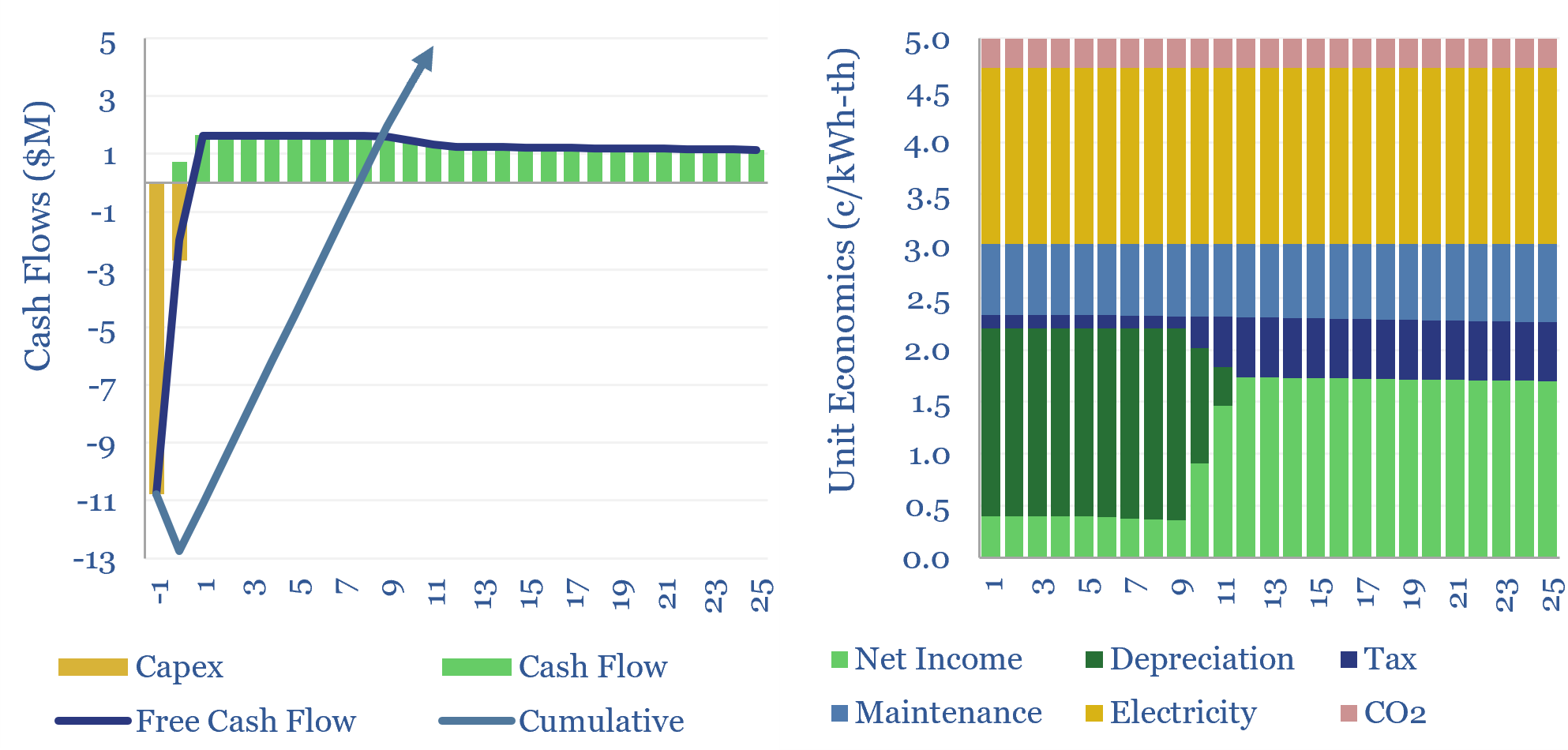
Industrial heat pump costs typically average 5c/kWh-th, when generating round-the-clock heat from 6c/kWh electricity, with a 3.5x Coefficient of Performance, and achieving a 60ºC heat lift. Our models do not yet show heat pumps, energized by excess renewables, outcompeting gas heat, especially for larger or higher-temperature applications. Costs can be stress-tested in this model.
Industrial heat pumps harvest the ‘effectively free’ energy within air, water, the ground or other process streams (relative to absolute zero). This thermodynamic energy is transferred to a refrigerant in an evaporator. Then it is released into a heat sink by compressing and condensing the refrigerant.
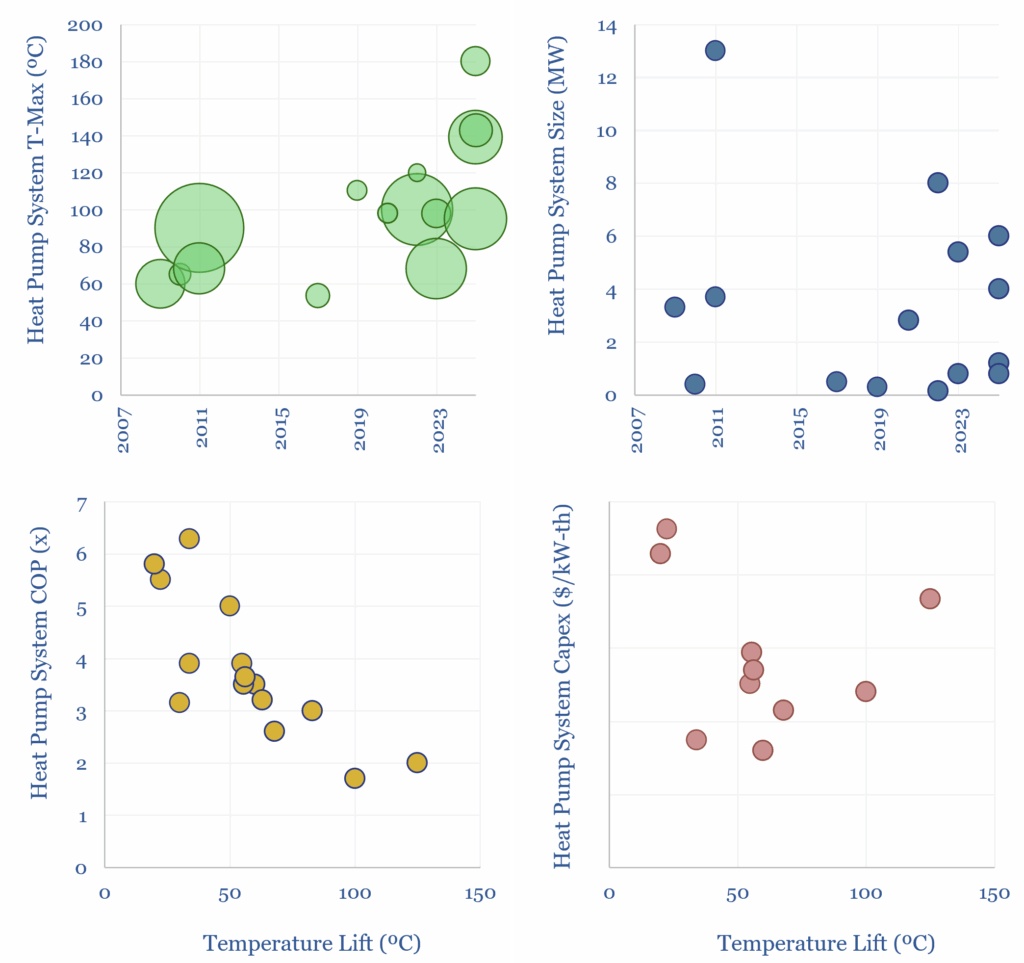
Industrial heat pumps typically generate 3-15MWth of heat, raising temperatures by 30-100ºC, with an efficient 3-7x Coefficient of Performance. These numbers are based on 15 case studies (below). The capacities and temperatures are smaller than in other industrial boilers and furnaces.
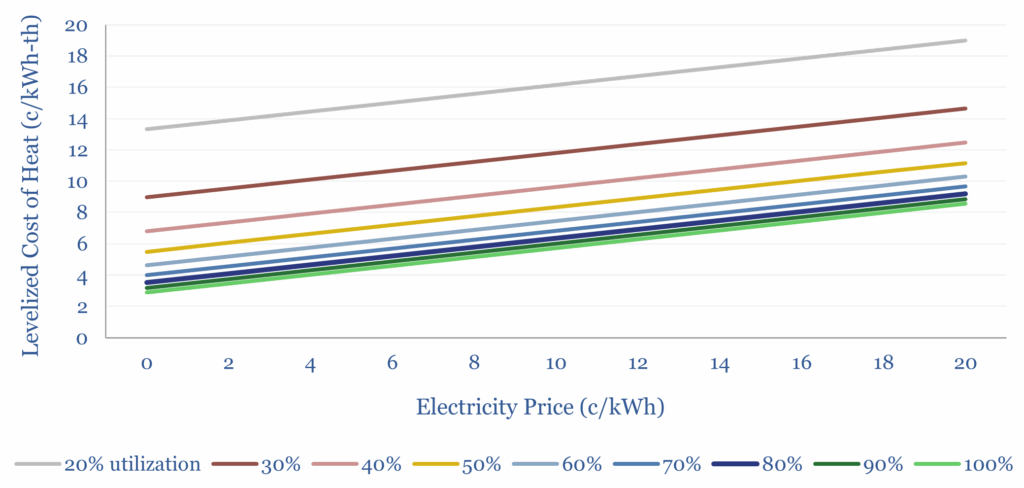
A typical heat pump with typical $/kW capex costs, 85% utilization and 6c/kWh input electricity prices must charge a 5c/kWh-th levelized cost of heat, in order to achieve a 10% IRR on its deployment and a 9-year payback period.
Industrial heat pumps are thus relatively expensive. 5c/kWh-th costs for industrial heating are comparable to burning $4/mcf gas with a $160/ton CO2 price, $10/mcf gas with a $60/ton CO2 price or $14/mcf gas with no CO2 price.
And in geographies with $10-14/mcf gas prices, we would expect much higher than 6c/kWh-e industrial electricity prices, although there may be some help from load-shifting the heat pump, depending on power prices.
Industrial heat pump costs do not yet support hybridizing industrial facilities. If we consider a heat pump that is run with 20-40% utilization, with 2-4 c/kWh-e realized electricity prices, to represent times when wind and solar are over-saturating the grid, our levelized costs come in higher at 8-14 c/kWh-th.
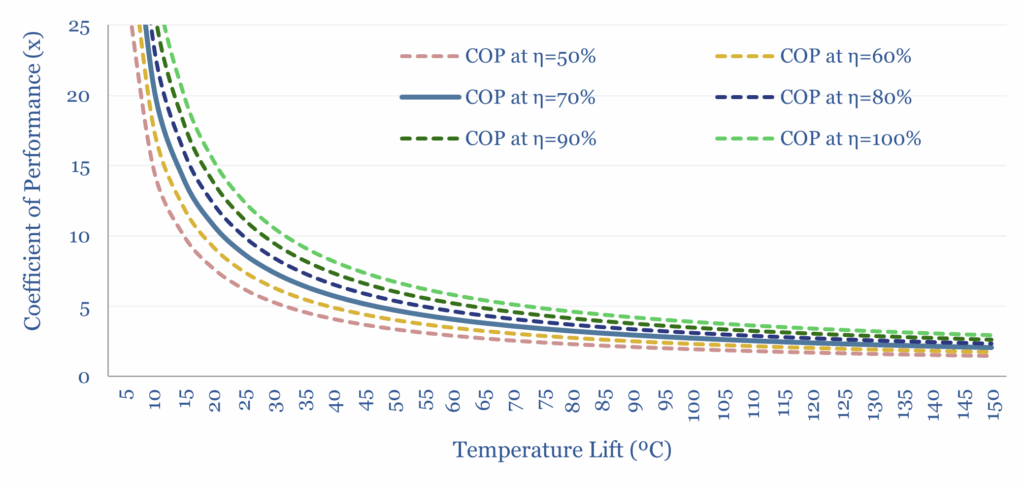
Economics also deteriorate for higher temperature lifts, and are best when trying to achieve lower temperature lifts. This follows from a heat pump’s maximum thermodynamic coefficient of performance being capped at QH / (QH – QC).
All of the costs of industrial heat pumps can be stress-tested in the data-file: capex ($/kW), capacity (MW), utilization factor (%), temperature lift (ºC), Coefficient-of-Performance (kWh-th/kWh-e), electricity price (in c/kWh), CO2 price ($/ton), O&M (% of capex) and tax rates.