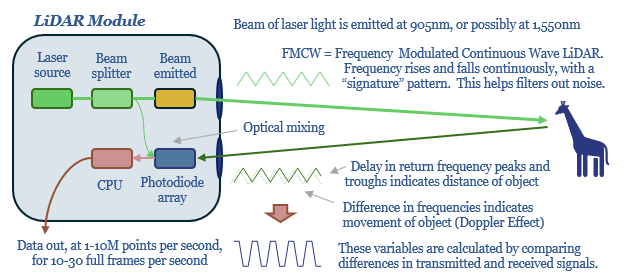
The sensors used for advanced driver assistance systems (ADAS), and increasingly for autonomous vehicles, offer useful lessons across the AI ecosystem, including robotics and autonomous mining. Hence this 17-page report revisits the debate between LiDAR vs cameras, radar and ultrasound sensors. Hardware must compete on cost and performance. But who benefits from deflation?
Deploying AI across the industrial eco-system continues to excite us, but hinges on sensors, instrumentation and controls. There is already a vast market for sensors in Advanced Driver Assistance Systems (ADAS), so what do we learn from studying this industry?
Another key debate is whether LiDAR sensors, which undoubtedly offer better localization and velocity-mapping than camera sensors, will nevertheless be rendered obsolete by improving software fed by simple cameras. Will cheap hardware and amazing software increasingly BEAT high-end hardware as a general theme in the AI era?
Whether we can de-risk autonomous technologies also matters, as reviewed on pages 2-4, for oil demand, robotics, electricity demand, construction and mining cost curves, across coal, copper, lithium, silver, PGMs. The coal cost curve then also matters for long-term LNG demand.
Sensor fusion is consistently highlighted as the most reliable way to improve perception systems, in technical papers that we reviewed, incorporating data from cameras, LiDAR, radar and ultrasound. Hence we review each technology, how it works, advantages, disadvantages and underlying materials bottlenecks, on pages 5-10.
The costs of LiDAR versus cameras, radar and ultrasonic sensors are increasingly competitive. There are arguments both ways, but we think LiDAR will find a growing role, per page 11-12.
The power consumption of LiDAR sensors versus cameras, radar and ultrasonic sensors is higher, purely at the sensor level. But is this offset later by simpler computational processing, per page 13?
The global LiDAR market has grown by over 5x since 2020, even as prices collapsed, hence we screened ten leading LiDAR companies. Intense competition and cost deflation have challenged profitability. We expect further deflation ahead, and will this benefit customers more than suppliers? We review leading suppliers on pages 14-17.