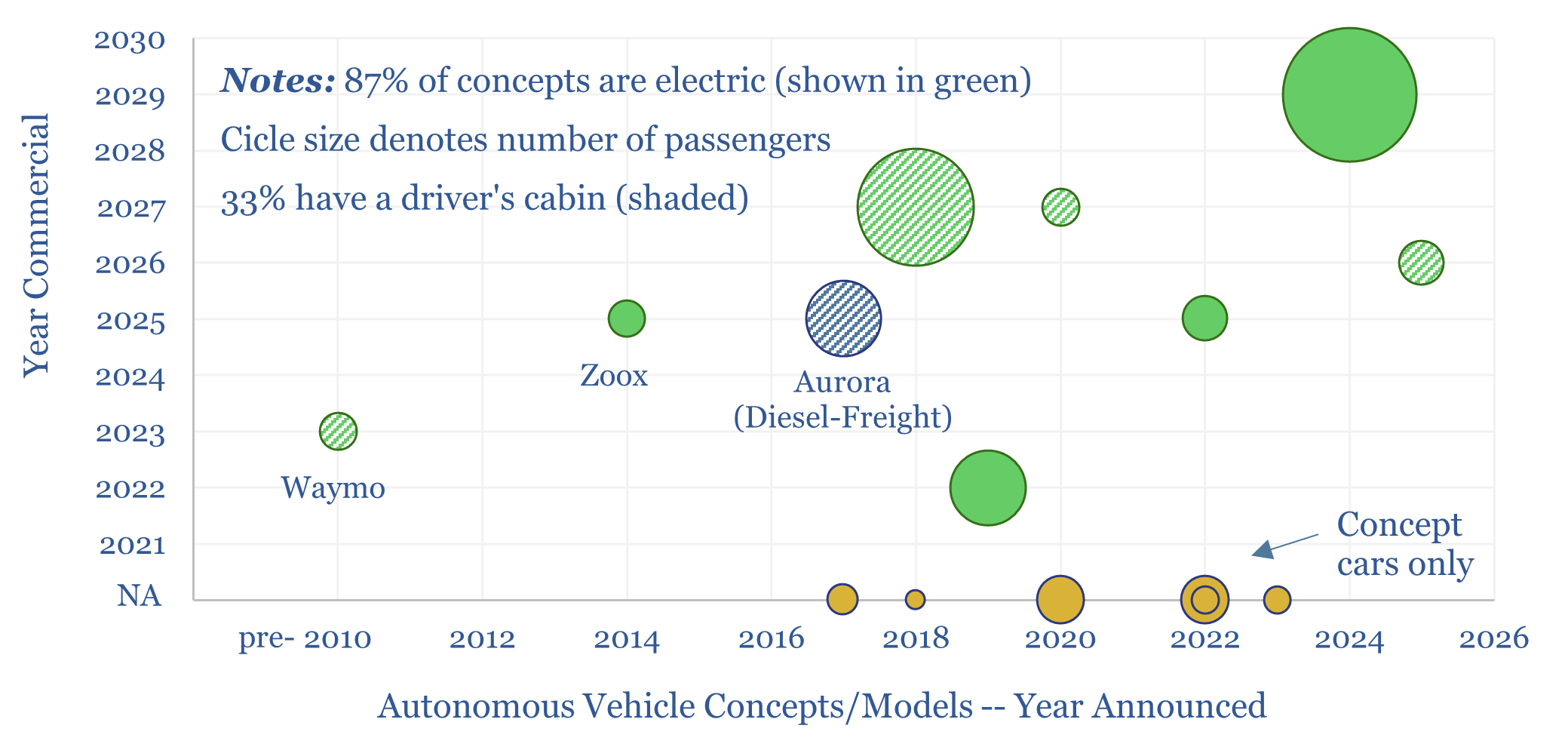
This data-file is a screen of autonomous vehicle concepts and autonomous vehicle companies. Specifically, in 2025, we profiled 15 autonomous vehicle concepts, robotaxis and autonomous trucks. 87% are envisaged to be electric. But the data also point to a broadening range of autonomous vehicle concepts emerging in future.
Across the autonomous vehicle concepts screened in this data-file, about half are commercial or pre-commercial while the other half were concepts and are not progressing to production.
87% of the autonomous vehicle concepts are envisaged to be electric. 33% still contained a driver space. And the median concept has room for 4 passengers. This might seem to have missed the point.
What excites us most is the emergence of totally new vehicle designs, which would not have been possible when vehicles had to contain a driver’s seat, and thus are better optimized for an autonomous future.
Rapid growth is visible in the space. 75% of the companies in the screen were only founded in the last decade. Many have also become public, commonly via reverse mergers, amidst recent market excitement.
This second tab in the data-file is an earlier screen of companies developing autonomous vehicles, including 14 private companies and 12 public companies, of which 8 are pure-plays focused on commercializing autonomous vehicles.
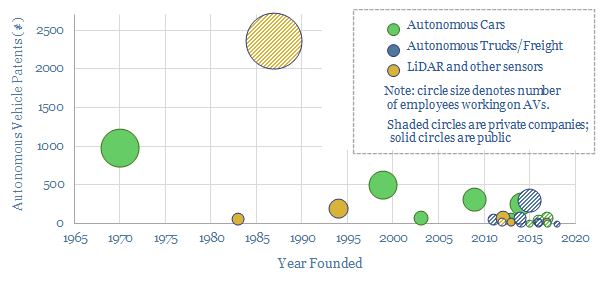
Many of the companies were proposing optimistic timelines, to introduce Level 4-5 autonomy within 2021-25, although this has clearly proven to be too optimistic, and more realistic commerciality dates are shown in the Concepts tab.
On the other hand, autonomous vehicles are now running commercially from the likes of Waymo, Aurora and Zoox. Likely costs are captured in our model of autonomous vehicle economics.
By transportation type, autonomous truck and freight-moving applications are most common, followed by autonomous cars, sensor technologies (especially LiDAR), then taxis, then finally passenger shuttles.