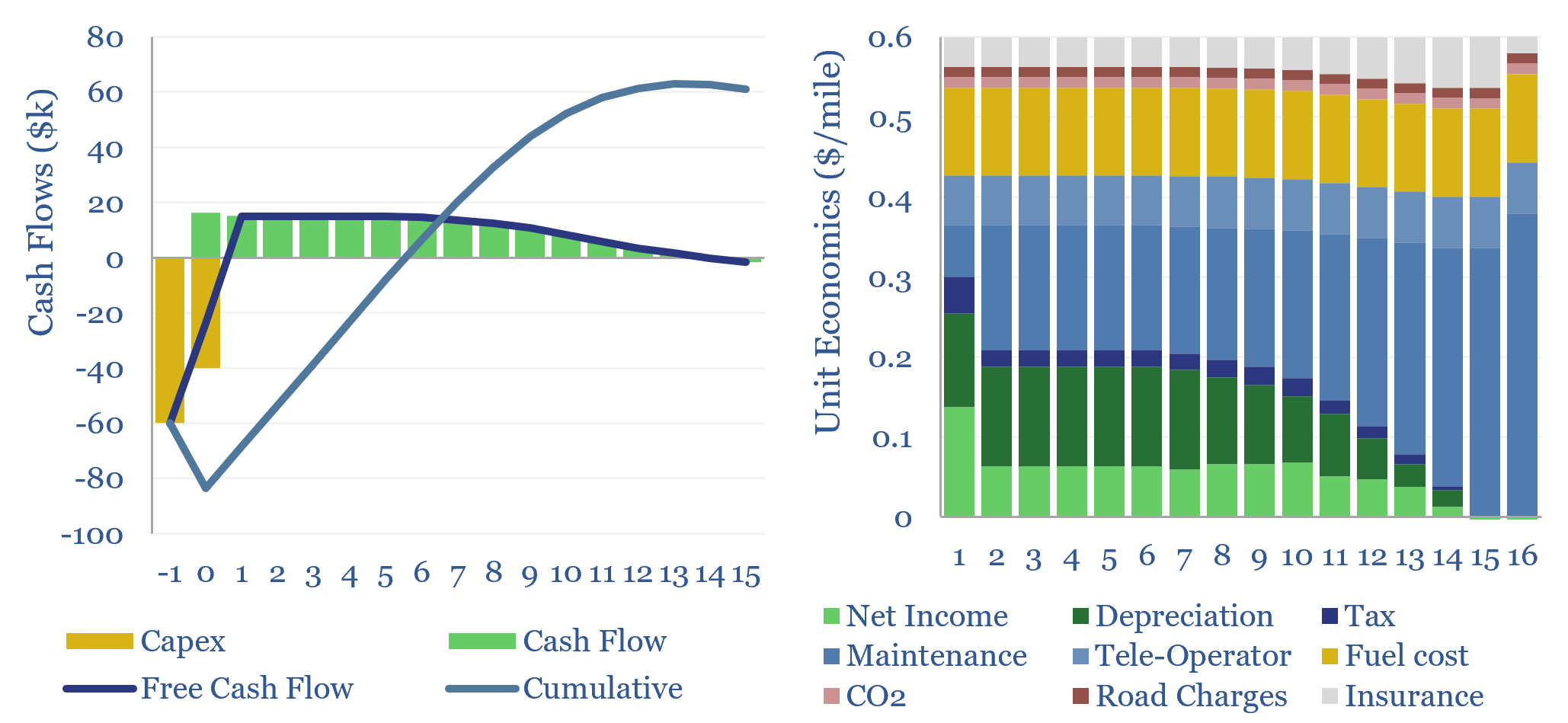
This data-file explores the costs of autonomous vehicles. An autonomous vehicle traveling c100,000 miles per year, at 20% capacity utilization, must charge a fee of $0.6/mile, in order to generate a 10% IRR on c$100k of vehicle acquisition capex.
Autonomous vehicles, including robotaxis, are being commercialized by Waymo, Zoox and other companies explored in our screen of autonomous vehicle concepts.
In this data-file, we aim to break down the costs of autonomous vehicles, across capex costs, fuel, road charges, tele-operator costs, maintenance and insurance. Our numbers are informed by surveying broader vehicle ownership costs.
In our base case, a future autonomous vehicle with a 20% utilization rate, at an average speed of 50mph, must charge $0.6/mile in order to generate a 10% IRR on $100k of up-front capex costs.
Costs are similar for combustion-based or electric vehicles, assuming $3/gallon on-highway gasoline prices in the US, or 20c/kWh delivered electricity prices, adding the costs of an EV charging station to regional electricity prices. Both numbers can be flexed in the model.
Autonomous vehicles being deployed in 2025-26 likely have higher capex costs, in the range of $150-200k, which also suggests higher costs, but likely to reduce over time due to greater processing power and deflation in components such as LiDAR.
For comparison, a driver that is paid $20-30/hour, in vehicle with average speed of 30-50mph, equates to a cost of $0.4-1/mile. Conversely, once a tele-operator can look after c20 autonomous vehicles, tele-operator cost should be below $0.05/mile.
We think autonomous vehicles could add over 5Mbpd to long-term oil demand. And they could also accelerate the deployment of electric vehicles for urban mobility and robotics. Please download the data-file to stress-test autonomous vehicle economics.